Ko Un - Maninbo - Peace & War
Здесь есть возможность читать онлайн «Ko Un - Maninbo - Peace & War» весь текст электронной книги совершенно бесплатно (целиком полную версию без сокращений). В некоторых случаях можно слушать аудио, скачать через торрент в формате fb2 и присутствует краткое содержание. Год выпуска: 2015, ISBN: 2015, Издательство: Bloodaxe Books, Жанр: Поэзия, на английском языке. Описание произведения, (предисловие) а так же отзывы посетителей доступны на портале библиотеки ЛибКат.
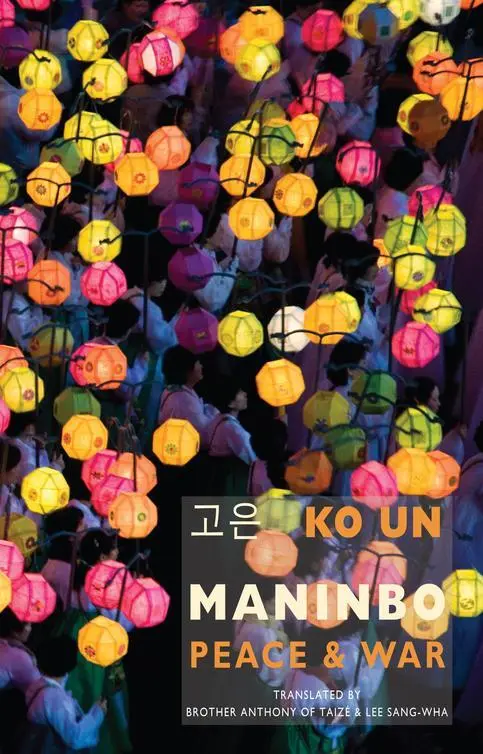
- Название:Maninbo: Peace & War
- Автор:
- Издательство:Bloodaxe Books
- Жанр:
- Год:2015
- ISBN:9781780372433
- Рейтинг книги:3 / 5. Голосов: 1
-
Избранное:Добавить в избранное
- Отзывы:
-
Ваша оценка:
Maninbo: Peace & War: краткое содержание, описание и аннотация
Предлагаем к чтению аннотацию, описание, краткое содержание или предисловие (зависит от того, что написал сам автор книги «Maninbo: Peace & War»). Если вы не нашли необходимую информацию о книге — напишите в комментариях, мы постараемся отыскать её.
Maninbo: Peace & War — читать онлайн бесплатно полную книгу (весь текст) целиком
Ниже представлен текст книги, разбитый по страницам. Система сохранения места последней прочитанной страницы, позволяет с удобством читать онлайн бесплатно книгу «Maninbo: Peace & War», без необходимости каждый раз заново искать на чём Вы остановились. Поставьте закладку, и сможете в любой момент перейти на страницу, на которой закончили чтение.
Интервал:
Закладка:
His chanting
sounded like a magpie’s squawk.
One day he left abruptly
and without any preparation went up the southern slopes of Jiri Mountain.
There, in a small rock cave,
he lived like a wild animal
on roots of trees, wild fruits, other such.
All he had was his koan,
the character Mu (  , Nothingness) of Master Zhaozhou.
Later he would get rid of that, too.
The hair on his head growing long,
his beard growing long, he became a wild animal.
He gave up living as a human being,
and died alone.
It was in the late 1970s
that the animal returned to a human state,
when his bones were reverently gathered up.
They should have been left where they were.
Shameful!
Ho In-su
Maybe it’s near that perilous sea at Indangsu
where filial Sim Cheong was sacrificed to the Dragon King
after she sold herself for three hundred sacks of rice
in hope of restoring sight to her blind father –
Baengnyeong Island in the West Sea!
It stretches deep under the sea,
with Jangsangot in North Korea nearby.
There lies freedom for seagulls.
There the young priest Ho In-su spends his days.
He has a bed of lovely little cockscombs in his heart.
He quarrels with no one,
never quarrelled with anyone even in childhood.
When one lyric poem emerges
his joy is such that the time for Mass is a bit delayed.
In Incheon across the sea,
a heated sit-in strike is in progress
at the Catholic Centre in Dap-dong,
but here among the sea breezes of Baengnyeong Island
Ho’s clothes are flapping wildly.
Three Family Names
King Hyoseong of Silla had a daughter, the princess Yu-hwang.
The king chose Won Il-sin,
renowned for his filial piety, as son-in-law.
The couple had four sons –
Sam-seok, Sam-myeong, Sam-jae, Deuk-yun.
The two sons Sam-seok and Sam-myeong took their father’s family name,
Sam-jae adopted his mother’s Yu as his surname,
and Deuk-yun, his mother’s Hwang.
Later, not those with the family name Won,
but the Yu of Changwon
and the Hwang of Changwon begot descendants.
They were originally a single bloodline,
then diverged into three streams,
flowing on,
flowing on
At times they were indifferent to one another,
like dogs and hens,
at times they desired one another, as hawks hunger for magpies,
and at times they were like a cluster of boils
all breaking out together.
Traveller reaching a village of barking dogs,
a village clouded with evening smoke –
from which family do you trace your descent?
The Cleaner at Okcheon Station
The seats in the slow trains to Busan are hard.
While the trains stop for a while
at Okcheon station
we see a bent-backed old cleaner.
The station is clean,
marigolds bloom in tidy rows,
and cockscombs too.
He pays no heed
to the passing trains,
just keeps on sweeping over and over.
At home, there’s no photo of his dead wife.
For him, the inside of the station
is more like home.
He staggers for a moment
in the wind from the new Saemaul express trains.
Seol Dae-ui
His American name was David John Seel.
Quite a guy,
quite a guy.
Sometimes a transplanted tree casts a vast shadow.
Arriving in Korea
he spent ten years,
twenty years,
thirty-six years in all.
When he was head of the Jesus Hospital
at the foot of Mount Daga in Jeonju,
once, when a TB patient coughed up black blood and collapsed,
he saved his life by mouth-to-mouth resuscitation.
He sucked in that black blood,
sucked in that dying man’s breath.
The first and most sacred task in this world
is saving another’s life.
An Unfilial Son is Weeping
Eom Ju-pal, the eldest son of Mr Eom of Hwagokpon-dong,
turned up late for his father’s wake.
Late at night,
dead drunk,
he sang an old popular song,
‘An Unfilial Son is Weeping’.
Under the awnings people whispered.
His brothers tried to stop him.
Tried,
but they were grabbed by the collars, knocked down
by Eom Ju-pal’s powerful fist.
For long ages, men have performed so-called filial and unfilial acts.
Animals are really pure.
Winged animals
and land animals are pure.
Mother and
father
give birth to their young then rear them, and that’s all.
They do not live at the expense of their children,
depending on their filial devotion.
Bearing and raising them,
that’s the end of it.
What pure disinterestedness.
In general,
exalting filial love quickly leads to exalting loyalty,
and when loyalty is exalted
comes, often enough, dictatorship.
VOLUME 14
Mr Foul-Mouth
On the southern slopes of Namsan
was a spot that just after Liberation
came to be known as Liberation Village.
It was on a steep alley
that twisted so
that once you were inside
there was no way out.
The roofs were head-high.
Mr Foul-Mouth from Pyeongan province in North Korea,
his stiff white hair in a crew cut,
would go up and down,
swearing in a loud voice every day.
‘Bloody goddamn…
Bloody goddam…
That f..cking bastard…’
On March 1, 1978, the Independence Movement holiday,
there was no peep from Mr Foul-Mouth,
him with the stiff white hair in a crew cut.
That morning he died, as if to celebrate
the Anniversary of the Independence Movement.
His Own Sword
King Sinmun of later Silla,
came to the throne with the help of Jang Bo-go
who controlled Cheonghaejin, the West Sea.
Therefore
the king’s son, when he became the next king,
intended to take the second daughter of Jang, his father’s benefactor, as his queen.
How could Your Majesty take an islander’s daughter as your queen?
Objections came thick and fast.
Hearing of this, Jang Bo-go grew furious
and decided to destroy Seorabeol, the Silla capital:
Outrageous!
Outrageous!
Then the Silla general Yeom Jang
claimed it was he who had complained to the king,
and hastened out to meet Jang Bo-go.
The two of them drank their fill together
and that night, once they were drunk,
Yeom Jang
pulled Jang Bo-go’s sword from its sheath
and drove it into his breast.
A great hero who could not be killed by others’ swords
had to die by his own.
After that came a time when Korea lost control of the sea,
the sea by which they could cross not only to Okinawa
but to distant Annam.
An Inkstone from Dangye
Chusa Wandang Kim Jeong-hui,
created a new pen-name for himself
every time he produced a piece of calligraphy,
every time he painted.
He ended up having hundreds of pen-names.
His inkstone from Dangye
accompanied him when he was exiled
to Daejeonghyeon on Jeju Island.
It spent its whole life with him,
until at last he wore a hole in it
with so much grinding,
repeated grinding of ink,
and could no longer function as an inkstone.
Читать дальшеИнтервал:
Закладка:
Похожие книги на «Maninbo: Peace & War»
Представляем Вашему вниманию похожие книги на «Maninbo: Peace & War» списком для выбора. Мы отобрали схожую по названию и смыслу литературу в надежде предоставить читателям больше вариантов отыскать новые, интересные, ещё непрочитанные произведения.





Обсуждение, отзывы о книге «Maninbo: Peace & War» и просто собственные мнения читателей. Оставьте ваши комментарии, напишите, что Вы думаете о произведении, его смысле или главных героях. Укажите что конкретно понравилось, а что нет, и почему Вы так считаете.