Ko Un - Maninbo - Peace & War
Здесь есть возможность читать онлайн «Ko Un - Maninbo - Peace & War» весь текст электронной книги совершенно бесплатно (целиком полную версию без сокращений). В некоторых случаях можно слушать аудио, скачать через торрент в формате fb2 и присутствует краткое содержание. Год выпуска: 2015, ISBN: 2015, Издательство: Bloodaxe Books, Жанр: Поэзия, на английском языке. Описание произведения, (предисловие) а так же отзывы посетителей доступны на портале библиотеки ЛибКат.
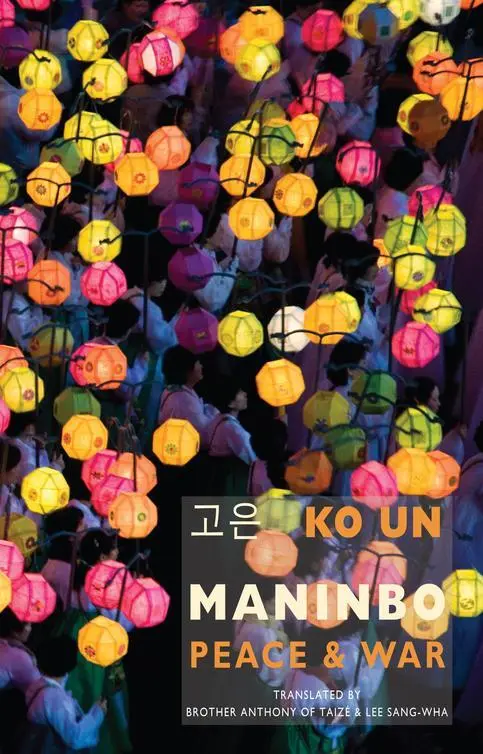
- Название:Maninbo: Peace & War
- Автор:
- Издательство:Bloodaxe Books
- Жанр:
- Год:2015
- ISBN:9781780372433
- Рейтинг книги:3 / 5. Голосов: 1
-
Избранное:Добавить в избранное
- Отзывы:
-
Ваша оценка:
Maninbo: Peace & War: краткое содержание, описание и аннотация
Предлагаем к чтению аннотацию, описание, краткое содержание или предисловие (зависит от того, что написал сам автор книги «Maninbo: Peace & War»). Если вы не нашли необходимую информацию о книге — напишите в комментариях, мы постараемся отыскать её.
Maninbo: Peace & War — читать онлайн бесплатно полную книгу (весь текст) целиком
Ниже представлен текст книги, разбитый по страницам. Система сохранения места последней прочитанной страницы, позволяет с удобством читать онлайн бесплатно книгу «Maninbo: Peace & War», без необходимости каждый раз заново искать на чём Вы остановились. Поставьте закладку, и сможете в любой момент перейти на страницу, на которой закончили чтение.
Интервал:
Закладка:
Those descended from the nobility, from the yangban class,
understood well how yangban worshipped their ancestors.
They were themselves the robbers
of the grave sites.
The robber brothers, Yu Seung-ok and Yu Guk-hyeon,
were direct descendants from yangban
who had been expert at digging up graves.
By day they had looked most fine,
their way of clearing their throats had great dignity.
When a ripe watermelon is cut open
it is red and dignified.
The French robbers who in times past
dug up the grave of Prince Namyeon,
they must have looked fine too.
A Police Spy
The Writers’ Council for the Practice of Freedom
had no office,
so if the chairman was walking along a street,
that street was the office,
the bar where the secretary was sitting was the office.
It was the second dissident group
that the Park Jung-hee government decided to eliminate.
When they got together in a bar
outwardly it might have looked as if they were enjoying a drink,
but secretly
they were discussing a rally or a declaration on the situation
they planned to issue a few days later.
Eom Ok-nam
was sure to appear at every such gathering,
saying he admired writers with such upright minds.
At times he would pay for a third round of drinks,
contribute some bulgogi ,
even buy the chairman a new suit.
That tall Eom Ok-nam with large whites to his eyes
was a police agent who reported every detail
to the CIA headquarters on Mount Namsan.
He only pretended to be a fan of the writers.
Later it was learned
he was separated from his wife,
had been kicked out
after extorting money from his wife’s family.
When he went to the bath house
he would come out four hours later,
saying:
‘Ah, I feel better now.’
Little Ham Seok-heon’s Teacher
When Ham Seok-heon was a child
at a village school in Yongdangpo, North Pyeongan province,
the teacher of the calligraphy class
took great care of the students,
stooping over them
as they wrote one character after another.
His students also had to learn
to grind the ink steadily
and hold the brush firmly.
He would snatch the brush from an awkward student’s hand.
Grabbing the boy’s hand from behind, he would say:
‘You little brat,
how will you make your writing strong
if you hold your brush as weakly as that?
‘Japanese writing may be pretty,
but our writing must above all be strong.’
Jeong Jeom’s Grandmother
Something like a mass of red-bean gruel
hangs dangling,
off almost the whole left side of her face.
It looks as if gruel boiled up
for some time
before stopping where it did.
Seen one way, it is gruel,
another, a human face.
Luckily or unluckily,
the eye and eyebrow on the right side are attractive.
Notwithstanding,
during her lifetime
she had a husband,
gave birth to sons and daughters,
and now her grandchildren run away from her.
Jeong Jeom’s grandmother with her red-bean gruel
wears double-decker gold rings,
two, in case one might seem insufficient,
on her quite swollen finger.
Not only her face: her finger too is weighed down.
Two Singers
They never made a hit.
But though they would never be famous
they were people who just loved singing,
regardless of the season, spring or autumn
Among those singers,
was a sensible girl.
who lived near the bank of Wansan stream on Omokdae Hill in Jeonju.
Having heard of her
somehow or other,
a middle-aged singer came to visit
from Geumgu in Gimje at the foot of Moak Mountain
His traditional jade-green coat and white rubber slippers were gorgeous.
Bowing politely, he said:
‘I have come to hear your unusual voice.’
The young girl greeted him just as politely.
Then the girl and the man
spread a rush mat on Omokdae Hill,
brought out drum and fan,
tested the drum. They worried
the drum’s leather had grown slack because of the weather
or its strength been sapped for lack of use.
‘I have neither natural talent nor good discipline,’
said the man,
‘so please listen with a generous heart.
First I will sing a danga
inviting you to sing.’
The man sang a danga :
‘Flowers are blooming on this hill and that…’
Once his sometimes sonorous,
sometimes delicate singing ended,
he bowed politely
and took back the drumstick.
Now the girl rose softly to her feet,
lifted her scarlet skirts slightly,
opened the fan,
began the first passage from the Song of Chunhyang.
Her dazzling voice,
flowing over and pouring out,
joined with the stream below.
The man rose, saying:
‘I have heard most precious singing.’
The girl stood there, replying:
‘Oh no, not at all.
I am humbled and grateful that you have listened.
May you have a safe journey home.’
An Elderly Comfort Woman
A passage in Kakou Senda’s
Military Comfort Woman says :
An old Korean woman of sixty
living in Japan
was never able to return to her own country.
In the colonial period
she was a sex slave for Japanese soldiers.
Some days she serviced 300 or 320.
Don’t be surprised.
If each man took a minimum of three minutes,
that means she lay there for seventeen hours with legs spread.
In spite of that, she did not die.
This happened in the South Pacific, in remote Rabaul.
It might have been better
had she been bitten by a cobra and died.
Because of the soldiers’ inflamed desire,
having never seen a woman for months and months,
the women never had a day off.
That comfort woman,
that old Korean Japanese woman
died beside a small brazier in an old tatami room.
Skin covered her bones,
clothes covered her skin,
so she was no longer a comfort woman.
I will not mention her name here.
A Child
One very cold day in January, 1978, thirteen or fourteen below zero,
there were some 130,000 shacks on the outskirts of Seoul,
housing one and a half million people
who leased with key money deposits,
or rented some of the smallest, just 5 pyeong in size
or 12.
All told, one-fifth of Seoul’s seven and a half million
lived in shacks
on the banks of streams,
on hillsides,
on scraps of suburban land.
Shacks covered with planks and roofing,
in Sadang-dong,
Bongcheon-dong,
Sillim-dong,
Siheung-dong,
Changsin-dong,
on the banks of Cheonggye Stream, Jungnang Stream.
One latrine for twenty households:
fierce fights at the latrines from early morning on.
An abandoned child
in a steep alley between the shacks
in Sadang 4-dong
was fourteen years old
but looked thirty.
What’s your name?
Ju Man-seok.
The naked child stood with his penis bluish in the cold,
his drooping penis looked forty.
And yet,
and yet,
a smile remained,
a flower-like smile,
or rather,
that of a child with chronic intestinal problems,
a dried-up smile.
A Day without Beggars
Интервал:
Закладка:
Похожие книги на «Maninbo: Peace & War»
Представляем Вашему вниманию похожие книги на «Maninbo: Peace & War» списком для выбора. Мы отобрали схожую по названию и смыслу литературу в надежде предоставить читателям больше вариантов отыскать новые, интересные, ещё непрочитанные произведения.











Обсуждение, отзывы о книге «Maninbo: Peace & War» и просто собственные мнения читателей. Оставьте ваши комментарии, напишите, что Вы думаете о произведении, его смысле или главных героях. Укажите что конкретно понравилось, а что нет, и почему Вы так считаете.