Ko Un - Maninbo - Peace & War
Здесь есть возможность читать онлайн «Ko Un - Maninbo - Peace & War» весь текст электронной книги совершенно бесплатно (целиком полную версию без сокращений). В некоторых случаях можно слушать аудио, скачать через торрент в формате fb2 и присутствует краткое содержание. Год выпуска: 2015, ISBN: 2015, Издательство: Bloodaxe Books, Жанр: Поэзия, на английском языке. Описание произведения, (предисловие) а так же отзывы посетителей доступны на портале библиотеки ЛибКат.
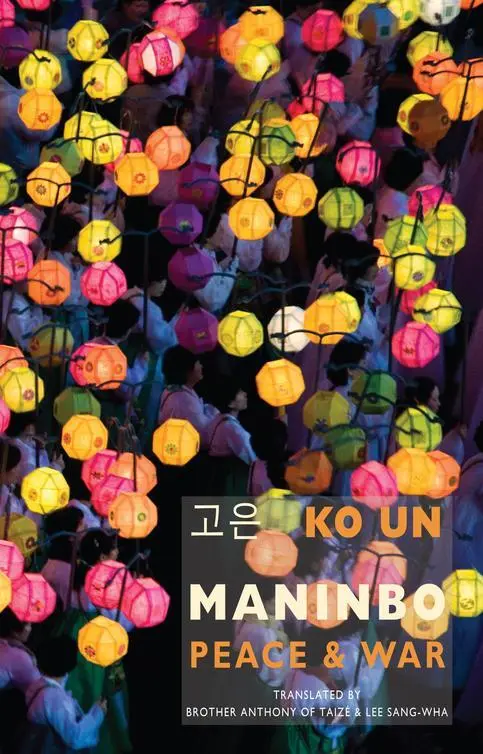
- Название:Maninbo: Peace & War
- Автор:
- Издательство:Bloodaxe Books
- Жанр:
- Год:2015
- ISBN:9781780372433
- Рейтинг книги:3 / 5. Голосов: 1
-
Избранное:Добавить в избранное
- Отзывы:
-
Ваша оценка:
Maninbo: Peace & War: краткое содержание, описание и аннотация
Предлагаем к чтению аннотацию, описание, краткое содержание или предисловие (зависит от того, что написал сам автор книги «Maninbo: Peace & War»). Если вы не нашли необходимую информацию о книге — напишите в комментариях, мы постараемся отыскать её.
Maninbo: Peace & War — читать онлайн бесплатно полную книгу (весь текст) целиком
Ниже представлен текст книги, разбитый по страницам. Система сохранения места последней прочитанной страницы, позволяет с удобством читать онлайн бесплатно книгу «Maninbo: Peace & War», без необходимости каждый раз заново искать на чём Вы остановились. Поставьте закладку, и сможете в любой момент перейти на страницу, на которой закончили чтение.
Интервал:
Закладка:
While the country changed names,
from the Republic of Korea
to the People’s Republic,
and then from the People’s Republic
back to the Republic of Korea,
his elder son was a soldier for the South,
while the younger had gone off to volunteer for the North.
Even when the dog wagged its tail,
Old Sim’s lips wouldn’t open.
Soon he’d be marking the third anniversary of his wife’s death.
He felt lonely, he whose old nickname was ‘thin-as-a-post’.
More than himself,
his shadow was ‘thin-as-a-post’.
In all his sixty years
he had only ever told three or four lies.
He, too, needed to chain-smoke:
cigarettes rolled from dried tobacco leaves.
The Lake
I grew up in the Bujeon Highlands, South Hamgyeong province.
If I climbed over the mountain, panting,
I could gaze down at Bujeon Lake.
I wanted to stand there
forever
like the trees, like the dead trees there by the lake.
And I wanted my dead friend Jin-man
to come stand with me for a really long time.
The lake was a place the spirits of the departed visited.
At the time of the January 4 Retreat
when tens of thousands were swarming southward,
I was lucky to manage to embark on an American navy LST,
a 100-to-1 chance, 150-to-1.
Tens of thousands who failed to get away were without hope.
Surrounded by anxiety and fear, I rode all the way down to Busan.
I became a night worker on number 3 dock in Busan,
then a deliveryman for a Chinese restaurant,
a carrier of relief goods at Gukje Market,
a gangster,
a jailbird doing time for violence,
a gangster again.
Once only did pure passion erupt from deep in my heart:
I fell in love with Miss Kim who worked in a tea-room
and gave her a gold ring for her birthday.
After I went to jail
she disappeared somewhere,
Seoul, perhaps,
or Dongducheon.
Throughout those hectic days,
steadfast was my own Bujeon Lake,
which lay behind me,
beckoning me to come,
come back, quickly.
I lost my left arm in a gang fight in Nampo-dong, Busan.
I am called Left-armed Yeong-nam.
Despair
On October 5, 1950, when Seoul was recaptured
after three months’ occupation by the North,
hope was everywhere.
By a low shack where the stream’s murmuring was always heard
outside of north Jaha Gate, Seoul,
surely the apricot trees would blossom next spring?
The daughter of that house, as she lay in bed sick,
was raped by a man in a UN jacket.
She collapsed,
the man spat, then vanished.
On roadside telegraph poles, flyers were posted:
Long live President Syngman Rhee! Long live General MacArthur!
Hope was everywhere.
Young Jun-ho
After scattering his father’s ashes
over the fast-flowing stream
from the dusky bank of the Seomjin River,
the boy looked up
toward Nogodan Ridge.
It was shrouded in cloud.
From now on fourteen-year-old Jun-ho,
wherever he is, will live without a father,
starving one day in three.
The wind will always be against him.
The boy takes after his father, chip off the block.
Commie’s kid,
Commie’s kid:
that name will stay with him all his life.
Bachelor Kim
Prisoner number 7501.
They called him ‘number seven thousand five hundred and one’.
They called him ‘seven five o one’.
Sometimes,
they called him
Bachelor Kim.
He came in aged 27 –
forty-five years of solitary confinement in a tiny cell
The day came when he was released, aged 72.
At dawn his cell door opened.
‘You’ve had a hard time,’
his first warm greeting.
A firm conviction that still sometimes blazed up
was lodged firmly inside his withering body,
utterly unchanged.
Bachelor Kim.
He entered as a youthful bachelor,
exited an elderly bachelor.
His clear, high-pitched voice
was rarely heard
under a forehead sunk like a weathered grave.
He was taciturn.
His real name was Kim Seon-myeong.
He was a soldier in the People’s Army, then a POW.
Despite the Geneva Convention
he was first sentenced to death,
then to life imprisonment.
As a child, all the land
for miles around was his family’s.
He was the son of a man whose land yielded ten thousand bushels,
10,000 bushels, annually.
Afterwards,
the war between South and North
immured one young man in prison for so many years.
He once said to someone that living is better than dying,
— sure, living .
Bachelor Kim’s remaining life was the life of a stone
sunk in water all on its own.
Man-su’s Grandma
They barely avoided the miseries of a refugee camp.
They built a shack at the top of Dodong hill opposite Seoul Station.
The family of five felt blessed.
However, Mansu’s grandma had lost her wits
amid the crowds of people fleeing
in the winter of 1950.
‘Let’s go,
let’s go,
let’s go home,’
she used to insist after pissing on the floor.
Her son Sun-gon was a porter at the railway station.
Her grandsons Man-su and Man-gil delivered newspapers at dawn.
They ate dark brown soup with dough flakes twice a day,
around a small circular table.
The old woman poured out curses
at her daughter-in-law in the kitchen:
‘You bitch, you brought me here,
bitch, you brought me here to kill me,’
and then she sobbed,
and continued to shout:
‘Let’s go,
let’s go,
Sun-kon,
let’s go home.
Let’s leave that bitch behind and go.’
The nights were all hers.
She had never been more than a mile or so from home.
Born at the foot of Cheonbul Mountain in South Hamgyeong province,
on marrying she moved to the nearest village
over the hill,
lived there for sixty-six years.
Then she was brought hundreds of miles down to unfamiliar Seoul.
‘Let’s go,
let’s go,’
that was all she said,
never removing the towel wrapped round her head.
The House with Wooden Tiles
Sacred, truly sacred, is the smoke rising as evening rice is being cooked!
Until August 10, 1945,
Korea was a single whole.
Since August 10, 1945,
Korea has been two.
America it was that proposed dividing the peninsula at the 38th parallel,
American forces occupying the South,
Soviet troops the North.
The Japanese surrender
on August 15, 1945
was supposed to signify the liberation of Korea.
In fact, it signified
the division of Korea.
The 38th parallel passed through an old wood-tiled house,
a house built by slash-and-burn farmers
on a hilltop above the Soyang River in Inje County, Gangwon province,
at the waist of the peninsula.
Northern guards occupied it.
Southern guards challenged them.
Both shouted: It’s our house,
it’s our land.
Each threatened the other,
firing blanks.
Then someone had a bright idea:
What about demolishing
the house altogether?
That’s it!
The house roofed with wooden tiles in that remote valley,
a house inhabited by four generations,
vanished.
The owner, Im Bong-sul, aged sixty-four,
and his granddaughter Im Gasina, aged fourteen,
Читать дальшеИнтервал:
Закладка:
Похожие книги на «Maninbo: Peace & War»
Представляем Вашему вниманию похожие книги на «Maninbo: Peace & War» списком для выбора. Мы отобрали схожую по названию и смыслу литературу в надежде предоставить читателям больше вариантов отыскать новые, интересные, ещё непрочитанные произведения.









Обсуждение, отзывы о книге «Maninbo: Peace & War» и просто собственные мнения читателей. Оставьте ваши комментарии, напишите, что Вы думаете о произведении, его смысле или главных героях. Укажите что конкретно понравилось, а что нет, и почему Вы так считаете.