Ko Un - Maninbo - Peace & War
Здесь есть возможность читать онлайн «Ko Un - Maninbo - Peace & War» весь текст электронной книги совершенно бесплатно (целиком полную версию без сокращений). В некоторых случаях можно слушать аудио, скачать через торрент в формате fb2 и присутствует краткое содержание. Год выпуска: 2015, ISBN: 2015, Издательство: Bloodaxe Books, Жанр: Поэзия, на английском языке. Описание произведения, (предисловие) а так же отзывы посетителей доступны на портале библиотеки ЛибКат.
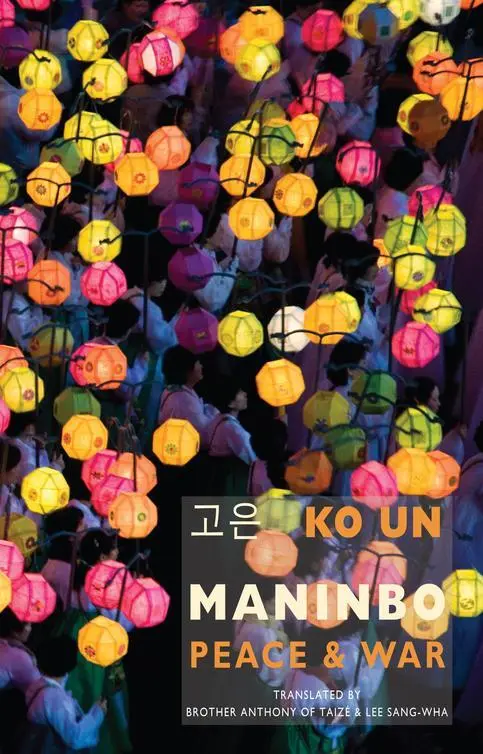
- Название:Maninbo: Peace & War
- Автор:
- Издательство:Bloodaxe Books
- Жанр:
- Год:2015
- ISBN:9781780372433
- Рейтинг книги:3 / 5. Голосов: 1
-
Избранное:Добавить в избранное
- Отзывы:
-
Ваша оценка:
Maninbo: Peace & War: краткое содержание, описание и аннотация
Предлагаем к чтению аннотацию, описание, краткое содержание или предисловие (зависит от того, что написал сам автор книги «Maninbo: Peace & War»). Если вы не нашли необходимую информацию о книге — напишите в комментариях, мы постараемся отыскать её.
Maninbo: Peace & War — читать онлайн бесплатно полную книгу (весь текст) целиком
Ниже представлен текст книги, разбитый по страницам. Система сохранения места последней прочитанной страницы, позволяет с удобством читать онлайн бесплатно книгу «Maninbo: Peace & War», без необходимости каждый раз заново искать на чём Вы остановились. Поставьте закладку, и сможете в любой момент перейти на страницу, на которой закончили чтение.
Интервал:
Закладка:
Its local committee members
had to run away.
But they did not just run away
with eyes burning.
They took 150 people with them,
saying that they had to do night work at the aerodrome,
pushed them into air-raid shelters built by the Japanese army
near the end of the Japanese occupation.
The 150 were buried alive,
stabbed with bamboo spears
until their hearts leaped out,
stripped naked and raped,
beaten over the head
with stones.
They were pushed inside alive
and covered with earth.
In retribution against her right-wing father,
former head of the irrigation association,
they buried his lovely only daughter, Yi Jeong-sun,
after they had gang-raped her.
Pretty much a rotting corpse,
yet how peaceful
was her dead face, eyes so quietly shut,
how very peaceful.
About a year later,
the war was still far from over,
Yi Jeong-sun appeared in a dream to her friend Go Ok-hui
who lived in Okjeong-gol.
‘Ok-hui!
I’ve come back.
Our dog
used to leave marks of its journey
by pissing
as it followed mother across the fields.
I, too, left marks up there in heaven,
so I could come back now
without getting lost along the way.’
Go Ok-hui woke up and wept, alone. The first cock began to crow.
Widow Mun
Her husband,
her tender-hearted,
slightly pockmarked,
generous-hearted husband,
was early requisitioned by the Japanese
as a labourer in the Pacific islands,
and never came back.
Field work and rice-paddy work, all was hers now.
Their older son grew up.
The younger one was born posthumously. He, too, grew up.
During the Korean War, the elder son joined the army
and never came back.
Nobody knew whether
he was alive or dead.
The younger boy, who had never seen his father,
went downtown
and on his way home,
though still only a lad,
got dragged off by the national defence corps.
It was talked of much later. Those were dark days.
She went out alone to weed the paddy field a second time
at the height of summer heat.
The sun beat down mercilessly
on the back of widow Mun of the Nampyeong family.
As Lao Tzu said:
Heaven is not benevolent.
The Fields That Winter
Winter fields rest well.
If their owner is industrious
they are harrowed
then exposed to the icy wind,
and they rest well.
A notification of death-in-action arrived — a mimeographed form.
The box with the remains of their son,
staff sergeant Kim Seung-ho, did not arrive.
In that single day,
his father, Kim Chil-seong,
aged from fifty-one
to something like seventy.
Leaving his wife wailing and beating the floor.
he went out into the winter fields
alone.
There was nowhere to look. He smoked his third cigarette.
One Kitchen
There is nothing but the Duman River
outside the town of Gyeongseong, North Hamgyeong province.
People sowed millet
in stony fields,
and it grew.
Despite the bitter cold
it managed to survive into the following spring.
On the day the one worm-eaten peach tree blossomed
the women smiled brightly.
The poor family of An Deok-su
lived on good terms with Bak Gi-jun’s family,
sharing a kitchen.
The two families
would cook together
and share the food.
On days when the two families quarrelled,
An Deok-su’s family
would cook first and eat,
after which Bak Gi-jun’s family
would prepare their meal and eat.
When An Deok-su’s daughter Il-sun
and Bak Gi-jun’s son Seong-ho
went into the willow grove on the sandbanks in the Duman River
and didn’t come back,
the two families went out to search for them.
They became in-laws.
Poverty divides people,
and it brings them together.
When reclaimed land is continually trodden down
it becomes firm.
Home
About 3,000,000 people moved South;
more than 100,000 moved North.
Those 100,000 were welcomed splendidly.
But one by one they disappeared
until few remained.
The 3,000,000 who came South were like roots.
They kept saying
they were uprooted
but their roots went deep.
A home is a grave on a hill buried in the heart.
A home
is the memory of one who has left it behind.
A home exists in time.
That 10,000,000 families are divided between North and South
is one fact of modern Korea’s history.
It is not a past that we should go back to,
but the start of tomorrow.
I want to go back. I want to go back.
I want to go back to a home on the banks of the Duman River.
I want to go back to my home beside the Daedong River.
I want to ride a sleigh there.
Mother,
are you still alive?
There was one,
O Jong-cheol,
who did not linger in the past.
Born in Wonsan, South Hamgyeong Province,
he crossed the 38th Parallel southward shortly after Korea became independent.
He lived like a mole.
He lived as a penniless sluggard.
Then, reborn, he studied at an evening college,
set up a textile factory and
a leather goods factory.
He never once talked about home.
He bought a hill, bought vast rice fields
in Yeoju, Gyeonggi province.
He set up empty graves for three generations of his ancestors.
On the autumn harvest memorial day, they were his home village.
Ortega Kim
Time brings today and yesterday together.
Time brings here and there together.
Even long-lasting sorrow
cannot but be the veins of time.
His mother wore a black skirt and white blouse made of cotton.
She never wore any other clothes.
When she came home from the millet field
and removed the towel from her head, she was beautiful.
To the son
who left his mother
in a remote village in Uncheon, North Pyeongan province,
time meant here and there.
That image of his mother in black skirt and white blouse from fifty years ago
stuck with him, unchanging.
Kim Yeong-man, a sixteen-year-old in the People’s Army,
came down South from the North.
His battalion came down
as far as Yeosu
on the Southern Sea.
They crossed the Seomjin River
to attack Masan.
He soon forgot his familiar landscapes.
He was taken prisoner during the Masan assault.
In the prisoner-of-war camp on Geoje Island
fervent communist prisoners were fearless together.
The anti-communist prisoners began to gather separately.
Kim Yeong-Man
chose neither the North
nor the South,
but went to neutral India.
From India he went to Mexico.
From Mexico he and others went to Cuba.
In a slum alley in Havana’s old town
Ortega Kim
forgot every last word of Korean.
Only the image of his mother in black skirt and white blouse
hung hazily above his eyebrows.
Nam Ja-hyeon
Born in 1872, died in 1933.
Born in Seokbo, Yeongyang, North Gyeongsang province,
she married at nineteen.
Her husband, Kim Yeong-ju,
was killed fighting in Kim Do-hyeon’s righteous army.
She remained with her husband’s family
bringing up his posthumous child.
When the Independence Movement started in 1919,
Читать дальшеИнтервал:
Закладка:
Похожие книги на «Maninbo: Peace & War»
Представляем Вашему вниманию похожие книги на «Maninbo: Peace & War» списком для выбора. Мы отобрали схожую по названию и смыслу литературу в надежде предоставить читателям больше вариантов отыскать новые, интересные, ещё непрочитанные произведения.






Обсуждение, отзывы о книге «Maninbo: Peace & War» и просто собственные мнения читателей. Оставьте ваши комментарии, напишите, что Вы думаете о произведении, его смысле или главных героях. Укажите что конкретно понравилось, а что нет, и почему Вы так считаете.