Ko Un - Maninbo - Peace & War
Здесь есть возможность читать онлайн «Ko Un - Maninbo - Peace & War» весь текст электронной книги совершенно бесплатно (целиком полную версию без сокращений). В некоторых случаях можно слушать аудио, скачать через торрент в формате fb2 и присутствует краткое содержание. Год выпуска: 2015, ISBN: 2015, Издательство: Bloodaxe Books, Жанр: Поэзия, на английском языке. Описание произведения, (предисловие) а так же отзывы посетителей доступны на портале библиотеки ЛибКат.
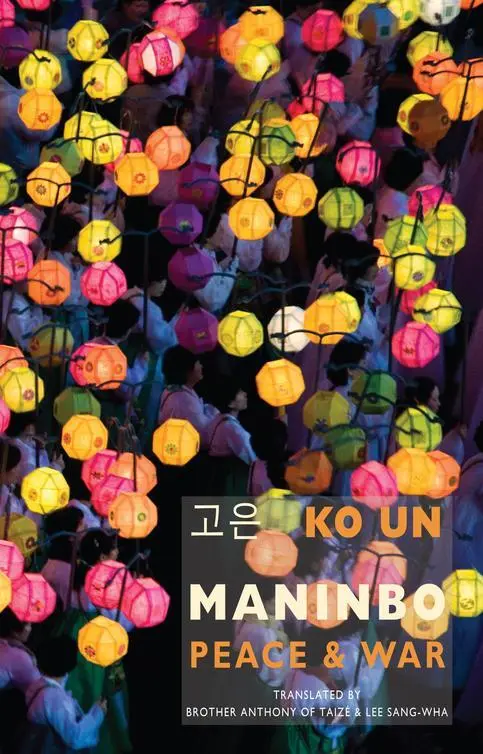
- Название:Maninbo: Peace & War
- Автор:
- Издательство:Bloodaxe Books
- Жанр:
- Год:2015
- ISBN:9781780372433
- Рейтинг книги:3 / 5. Голосов: 1
-
Избранное:Добавить в избранное
- Отзывы:
-
Ваша оценка:
Maninbo: Peace & War: краткое содержание, описание и аннотация
Предлагаем к чтению аннотацию, описание, краткое содержание или предисловие (зависит от того, что написал сам автор книги «Maninbo: Peace & War»). Если вы не нашли необходимую информацию о книге — напишите в комментариях, мы постараемся отыскать её.
Maninbo: Peace & War — читать онлайн бесплатно полную книгу (весь текст) целиком
Ниже представлен текст книги, разбитый по страницам. Система сохранения места последней прочитанной страницы, позволяет с удобством читать онлайн бесплатно книгу «Maninbo: Peace & War», без необходимости каждый раз заново искать на чём Вы остановились. Поставьте закладку, и сможете в любой момент перейти на страницу, на которой закончили чтение.
Интервал:
Закладка:
when a person should introduce himself by name,
he just mutters,
bowing his head.
When he leaves condolence money at a house in mourning
he never writes his name on the envelope,
so when the chief mourner meets him a few months later,
he hesitates to thank him, not sure
whether he paid a visit
or not.
Perhaps he hides his name out of humility,
preferring to have no nameplate or house number in this world
where people love to make their names known.
Or maybe that’s not the reason, either.
On general election days
all he does is put a mark on a paper and leave.
When it happens to be a fine day
and flocks of sparrows fly high,
does each individual bird have a name?
Why, a name is a person’s prison.
The Entrance to Camp Reagan
After the Armistice,
the village at the gates of Camp Reagan
in Pocheon, Gyeonggi province,
flourished as a brothel town for soldiers.
The instant the camp was abandoned
the town fell to ruin.
The leader of the town’s prostitutes
was Rita Kim,
born Kim Ok-suk.
After servicing some hundreds of white soldiers
and some hundreds of black soldiers,
she became the head of the prostitutes’ union,
spokesperson and leader
for the whores of Pocheon county.
Her walls were covered with certificates of appreciation
and letters of thanks from local county heads:
‘For your contribution to the modernisation of our land…’
Once the Americans cleared out, Korean soldiers moved in.
With the whores gone too,
all that remained of the town were a few small shops.
Kim Ok-suk, left alone, quickly aged and fell sick.
She even stopped swearing as she used to,
‘Men are nothing but dicks.’
The High and Low Tides in the West Sea
During the mid-Joseon period,
Korea’s submission to China was abject.
In fact the Ming dynasty was on the wane,
but among Korean nobility
submission became all the more prevalent.
For example, faced with the question why
only Korea’s West Coast has high and low tides,
and not the East, they replied:
‘It’s because
China is the source of tides.
Since the West Sea is close to China
it experiences high and low tides,
whereas the East Sea is far away from China,
so no tides can reach there.’
The moment that was said,
the moon emerged from behind a cloud.
They were like dogs barking in that moonlit night.
Hong’s Wife in a Shack by Cheonggye Stream
She was probably just the right wife for a man like that.
Just right for her husband the wild boar
who did manual labour,
hurt his back
and was laid up in his room.
She was glib-tongued, that woman.
They had two sons
and three daughters,
kids who never took
to anything like school.
Instead, boys and girls alike,
they took to trouble, taking upon themselves
each and every accident,
from the slums all the way up to
the Willow Tree House at the end of Euljiro.
Early on, the oldest boy did time
in the juvenile wing of Seodaemun detention centre.
Beginning with him,
whenever a son or daughter came home after brawling,
Hong’s wife would say,
‘Back home? What for?
You should be rotting in the cemetery
in Manguri or Miari.
Scum of a prick’s prick,
why haven’t you croaked already?
Ayyy! You good-for-nothing, hundred-ton dead weight!’
And yet, though she was a really foul-mouthed woman,
once, when she saw a voluptuous waning moon,
on her way back late at night from the communal loo,
she exclaimed: ‘My my my, just look at that goddamn moon!
Looks like the sweetheart I’ve spent ten million years longing for.’
A Quack
Baek Un-hak rented a room in an inn in Wonjeong-dong, Jeju City
as a master of the Book of Changes ,
of the Four Pillars and the Eight Characters .
Meanwhile, another Baek Un-hak was telling tall tales
as a fortuneteller in Jongno 4-ga, Seoul.
In fact, that Baek Un-hak took his name
from the famous fortune-teller Baek Un-hak of late Joseon.
Anyway, whatever the reason,
this other poor Baek Un-hak
(the one who’d crossed over to Jeju Island)
wore plain glass spectacles on his plain nose –
perhaps because his eyes alone had no authority –
and let a few hairs grow out in semblance of a beard.
Maybe in order to impress those who came to consult him,
he would add some ridiculous English
to the fortunes he told.
He also claimed that a true interpretation of the Four Pillars
could be found in the philosophy of fortunà
as taken back to Italy by Marco Polo.
He pretended to be very intelligent,
very learned.
When he got paid for thus cheating the islanders
day after day, he would go out drinking alone.
Back home, late at night, alone and very drunk,
he would wail and pound on the floor:
Why is it my fortune
that I must ever deceive people?
Such a person, so honest with himself,
might he not be mistaken for the ancient sage Kasyapa
or the apostle Peter?
Third Daughter Seong-suk
Seong-suk’s mother
gave birth to her third daughter
as plums outside Jaha Gate were ripening.
On that day, as the plums were falling,
Seong-suk’s mother burst into tears
once she realised it was yet another daughter.
She cried, cried loudly, finding no reward in childbirth,
and feeling no hunger after.
So she had no idea at all
whether Seong-suk was born by night
or by day
or at what hour.
Not only Seong-suk’s mother,
but her father,
her grandmother, too, had no idea.
Seong-suk grew up
without a name,
her birth unregistered
and her mother always grumbling:
‘Begone with you, quickly,
go!’
Her father,
recalling Yi Seong-suk, a girl in Uijeongbu
who once showed him the way,
gave her that name.
Unsure of the day of her birth,
let alone the hour,
she grew up
a very pretty girl,
became a really beautiful young woman,
of such loveliness as is rarely found
even in distant lands –
Portugal, say,
or Sweden.
The Widow in the Central Market
She’s known as the Generalissima of the dried fish booths
in Seongdong-gu’s Central Market.
If the woman in the next booth over
plays the coquette with a customer,
she cries out, ‘Bloody bitch, gone mad again.
She’s mad to do what she does by night
again in broad daylight.’
When the Generalissima shrieks,
all shut their mouths, Shhhh!
in the dried fish booths,
in the fruit stalls beyond,
in the fresh fish shops,
no matter who’s in the wrong.
It’s like driest dust being driven from furrows by a strong wind.
Covered by thick awnings,
no sunshine enters the market all day long.
She seizes every opportunity
to squeal like a sow having its throat cut,
cursing her dead husband:
‘That goddamn heel, croaked first,
making all this trouble for me, the bastard.’
When it rains, water pools on the awning
then cascades down over her:
‘That goddamn Heaven,
goddamn God!’
Читать дальшеИнтервал:
Закладка:
Похожие книги на «Maninbo: Peace & War»
Представляем Вашему вниманию похожие книги на «Maninbo: Peace & War» списком для выбора. Мы отобрали схожую по названию и смыслу литературу в надежде предоставить читателям больше вариантов отыскать новые, интересные, ещё непрочитанные произведения.












Обсуждение, отзывы о книге «Maninbo: Peace & War» и просто собственные мнения читателей. Оставьте ваши комментарии, напишите, что Вы думаете о произведении, его смысле или главных героях. Укажите что конкретно понравилось, а что нет, и почему Вы так считаете.