Ko Un - Maninbo - Peace & War
Здесь есть возможность читать онлайн «Ko Un - Maninbo - Peace & War» весь текст электронной книги совершенно бесплатно (целиком полную версию без сокращений). В некоторых случаях можно слушать аудио, скачать через торрент в формате fb2 и присутствует краткое содержание. Год выпуска: 2015, ISBN: 2015, Издательство: Bloodaxe Books, Жанр: Поэзия, на английском языке. Описание произведения, (предисловие) а так же отзывы посетителей доступны на портале библиотеки ЛибКат.
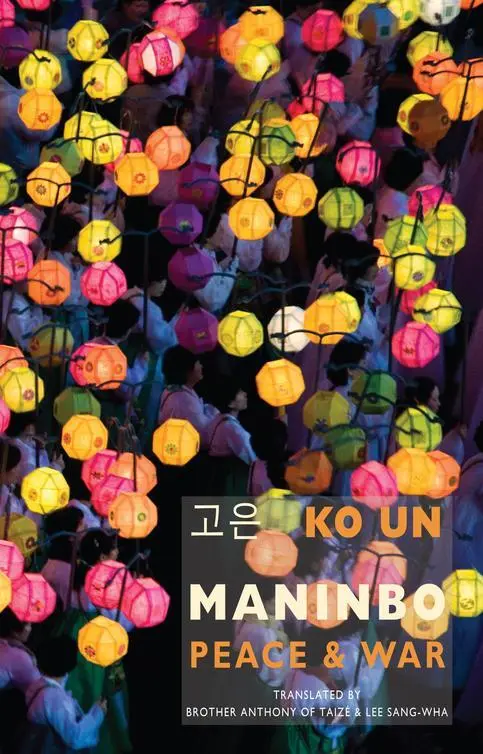
- Название:Maninbo: Peace & War
- Автор:
- Издательство:Bloodaxe Books
- Жанр:
- Год:2015
- ISBN:9781780372433
- Рейтинг книги:3 / 5. Голосов: 1
-
Избранное:Добавить в избранное
- Отзывы:
-
Ваша оценка:
Maninbo: Peace & War: краткое содержание, описание и аннотация
Предлагаем к чтению аннотацию, описание, краткое содержание или предисловие (зависит от того, что написал сам автор книги «Maninbo: Peace & War»). Если вы не нашли необходимую информацию о книге — напишите в комментариях, мы постараемся отыскать её.
Maninbo: Peace & War — читать онлайн бесплатно полную книгу (весь текст) целиком
Ниже представлен текст книги, разбитый по страницам. Система сохранения места последней прочитанной страницы, позволяет с удобством читать онлайн бесплатно книгу «Maninbo: Peace & War», без необходимости каждый раз заново искать на чём Вы остановились. Поставьте закладку, и сможете в любой момент перейти на страницу, на которой закончили чтение.
Интервал:
Закладка:
When people buy dried fish from the Generalissima
for their family memorial rites,
their ancestors’ appetites are aroused.
Since the 1970s, cocks seem to crow any time they want,
so the spirits of ancestors can’t make out
when exactly it’s time to leave;
it’s only right, then, that their descendants
should at least arouse their appetites.
Gongju Dawdler
‘I hate that song most, “The dawn bell has rung…”
the Saemaeul Song,* I hate that most.’
There was a time you had to be ready to be arrested
if you said something like that.
Even speaking such words took too long.
Such is the dawdling dialect of Chungcheong province.
It’s not just in speaking.
Rising
from sitting
takes a long, long time, too.
When they go to Seoul from Daejeon station
they are sure to take the slow train,
which stops at every station,
at every station.
‘What would I take
a fast train for?’
When they cross the street,
they slowly start to cross
after coughing three or four times
long after all the other people have crossed.
If a companion urges them on:
‘What do you hurry for
so much?
If you hurry, even the rice isn’t properly cooked.
‘Look at the moon
at night.
It moves
slowly,
slowly,
as if not moving at all.
‘If we live by minutes and seconds, we’re done for.
It’s the same with living by hours.
‘Therefore we must have
a night
like half a day, like
early evening,
night,
and early dawn
when the cockerel comes late to the first flap of its wings.
What are you thinking?’
* Song of the New Village (Saemaeul) Movement during the Park Jung-hee era.
The Man in Tapgol Park
Tapgol Park,
a place crowded with elderly folk,
where old men
covered in age spots
grab one another by the collar and sort of fight,
ah!.. there he is.
Mansu Coffee Shop
on a side-street in Cheongjin-dong, Seoul,
a place crowded with elderly folk
…there he is.
A place where the elderly roll walnuts in their palms,
sinews squirming on the backs of their hands,
a place where they talk about everything,
shouting this
and that,
and pinch the buttocks of the girl serving coffee,
…there he is.
He’s a young man of thirty,
but when asked why he comes here
he says it’s the only place he feels comfortable;
when asked his age,
he says he’s sixty-five.
They say he was forced to do military service
after he lied about his age,
and his mind was affected
after a beating by a superior in the barracks,
so he was discharged on medical grounds,
and mentally he is old and mad.
Could be so:
the Tang genius, the poet Li Ho, wrote that
at twenty a man is already old.
Father and Son
The father, Shin Gil-ho was 51,
the son, Shin Haeng-bok, 26.
The father had six convictions for larceny,
the son had four convictions for larceny.
In prison, a convict who is penniless is known as dog hair ,
while one who cashes promissory notes
or cheques is called tiger hair .
Dog-hair father and son
were assigned to different cells,
but after supper,
with difficulty, they communicated
through a little barred window in the back.
From the father’s third theft
the son
had followed in his father’s footsteps.
What they said:
Did you eat enough?
Yes, Dad.
Rub the palms of your hands and the soles of your feet a lot.
And don’t skip rubdowns with a cold towel.
Yes, all right, son.
The father, with his shining, prematurely bald head,
murmured to himself:
My boy, I know nothing else about him,
but he’s the most filial son in the country.
Jeong Hwa-am
Moving secretly through many parts of China,
he devoted himself to the independence movement in his fatherland.
Along with his devotion and tenacity, he was cautious,
so he survived and came back home.
Even back home, prison was his politics.
His fatherland,
the Korean peninsula
where the sea on three sides can never be calm,
was always the land he dreamed of.
He passed fifty,
sixty,
seventy.
With reality so bleak, even dreaming was hard.
He rejected all honors.
Belief was his only politics.
Even a 40-watt light in a dreary cell
was an utterly vain dream to him
each day when he awoke.
He was no reality, he was a legend.
As if modern history were ancient history,
Jeong Hwa-am endured, white-haired.
The Shit Clan
I have three surnames.
In this land
where changing surnames is one of the greatest humiliations,
I have three or four surnames.
In Japan there is a surname Gui,
meaning ghost,
often therefore changed into the wife’s family name.
My case has nothing to do with such customs.
However, my family name can be Kim,
or Nam
or sometimes Jang.
Yet I am no swindler.
Not content with those names, anyway,
I adopt my mother’s surname Ko
and am sometimes called Ko.
Once I got dreadfully drunk
and fell into an old-style latrine,
after which I was Bun,
meaning Shit.
Until the 1970s, some eccentrics from the late Joseon period
continued to live with various names like this,
which meant that life was never boring.
My family name was Shit.
The Long-Term Guest at the Dabok Inn in Dadong
Jin Dal-ho
was a man with plans, great or shaky,
who sold his lands in Jeong-eup in North Jeolla
and came up to Seoul.
Though born to the fields,
his body as a whole
was in good shape,
no need for a carpenter to ply his inked cord.
His lips were always fresh,
and when he washed up in the morning
he never gave a damn about others in the queue.
He washed his neck,
behind his ears, beneath his ears,
the ridge of his nose,
even his chest beneath his undervest, two or three times.
He soaped for a long time,
and rinsed off the foam for a long time, too.
Only then did he say: Now I feel alive, I can enjoy my food.
Yet day after day nothing worked out
and he stayed at the Dabok Inn as a long-term guest
for over a year.
His notebook held
the President’s phone number,
some National Assemblyman’s phone number,
even the switchboard at Midopa department store,
each compactly set down,
but day after day nothing worked out.
All he could manage was
to seduce the woman working at the inn
and make love to her at night.
Three Feet of Rotten Rope
In Yeongdong, North Chungcheong province,
nobody cared about the Yushin Reforms or anything else.
There was one man who took care of all the village’s unpleasant jobs
such as renting a room for gamblers,
laying out the body if someone died,
castrating a pig,
mating cows or horses.
That was No Bong-gu.
So poor that the roof of his house rotted into furrows,
but always warm-hearted
like the fire in a brazier.
In the winter when it was too cold to move,
and children walked with short, quick steps,
Читать дальшеИнтервал:
Закладка:
Похожие книги на «Maninbo: Peace & War»
Представляем Вашему вниманию похожие книги на «Maninbo: Peace & War» списком для выбора. Мы отобрали схожую по названию и смыслу литературу в надежде предоставить читателям больше вариантов отыскать новые, интересные, ещё непрочитанные произведения.









Обсуждение, отзывы о книге «Maninbo: Peace & War» и просто собственные мнения читателей. Оставьте ваши комментарии, напишите, что Вы думаете о произведении, его смысле или главных героях. Укажите что конкретно понравилось, а что нет, и почему Вы так считаете.