Adolf Hitler - Hitler’s Second Book
Здесь есть возможность читать онлайн «Adolf Hitler - Hitler’s Second Book» весь текст электронной книги совершенно бесплатно (целиком полную версию без сокращений). В некоторых случаях можно слушать аудио, скачать через торрент в формате fb2 и присутствует краткое содержание. Город: New York, Год выпуска: 2003, ISBN: 2003, Издательство: Enigma Books, Жанр: Публицистика, на английском языке. Описание произведения, (предисловие) а так же отзывы посетителей доступны на портале библиотеки ЛибКат.
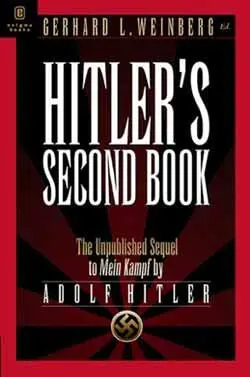
- Название:Hitler’s Second Book
- Автор:
- Издательство:Enigma Books
- Жанр:
- Год:2003
- Город:New York
- ISBN:978-1929631162
- Рейтинг книги:4 / 5. Голосов: 1
-
Избранное:Добавить в избранное
- Отзывы:
-
Ваша оценка:
Hitler’s Second Book: краткое содержание, описание и аннотация
Предлагаем к чтению аннотацию, описание, краткое содержание или предисловие (зависит от того, что написал сам автор книги «Hitler’s Second Book»). Если вы не нашли необходимую информацию о книге — напишите в комментариях, мы постараемся отыскать её.
* * * In 1958, while directing the microfilming and organization of a trove of archives that the U.S. forces had taken from the Nazis at the end of WWII, historian Weinberg (
) discovered the manuscript of a second book that Hitler had written but never published. The manuscript was published in German in 1961, accompanied by Weinberg’s annotations, but this is the first authoritative English version (a pirated and poor translation appeared in the 1960s). The text bears all of Hitler's hallmarks: rambling thoughts, half-baked ideas, pedantic writing-along with a terrifying, sustained belief in war and violence as the means to ensure that Germans would flourish. Compared to
, there are fewer pages devoted to Jews. Nonetheless, what comes across most strongly is Hitler’s abiding commitment to the principle of race and his identification of Jews as the enemy that threatened to undo all that Germans had created. Hitler dwells at length on foreign policy, and outlines a strategy of alliance with Fascist Italy and Great Britain. (He actually believed that Britain would accept a German-dominated European continent so long as Germany did not challenge the overseas British empire.) He also foresees an inevitable clash with the United States. This provides solid historical background on Hitler's thinking in the late 1920s, when his party was nothing more than a tiny, radical sect. Weinberg provides helpful notes and a very informative introduction.
Copyright 2003 Reed Business Information, Inc. “Politics is history in the making.”
Such were the words of Adolf Hitler in his untitled, unpublished, and long suppressed second work written only a few years after the publication of
.
Only two copies of the 200 page manuscript were originally made, and only one of these has ever been made public. Kept strictly secret under Hitler’s orders, the document was placed in an air raid shelter in 1935 where it remained until it’s discovery by an American officer in 1945.
Written in 1928, the authenticity of the book has been verified by Josef Berg (former employee of the Nazi publishing house Eher Verlag), and Telford Taylor (former Brigadier General U.S.A.R., and Chief Counsel at the Nuremburg war-crimes trials) who, after an analysis made in 1961, comments:
*as quoted by http://www.pharo.com/lost&found.htm
“If Hitler’s book of 1928 is read against the background of the intervening years, it should interest not scholars only, but the general reader.”*
Hitler’s Second Book — читать онлайн бесплатно полную книгу (весь текст) целиком
Ниже представлен текст книги, разбитый по страницам. Система сохранения места последней прочитанной страницы, позволяет с удобством читать онлайн бесплатно книгу «Hitler’s Second Book», без необходимости каждый раз заново искать на чём Вы остановились. Поставьте закладку, и сможете в любой момент перейти на страницу, на которой закончили чтение.
Интервал:
Закладка:
For Germany, Italy’s entry into the World War perforce should have been the occasion for a fundamental revision of her attitude vis-à-vis Austria-Hungary. It is not a political act, let alone an expression of the sagacity and competence of political leaders, in such a case to find no other answer than sullen indignation and impotent rage. Such a thing is usually harmful even in private life, but in political life it is worse than a crime. It is an act of stupidity.
And even if this attempt at a change of the former German attitude had led to no success, it at least would have absolved the nation’s political leadership from the guilt of not having tried it. In any case, after Italy’s entry into the World War, Germany should have tried to put an end to the two front war. She should then have striven for a separate peace with Russia, not only on the basis of a renunciation of any utilisation of the successes in the east already achieved by German arms, but even, if necessary, of a sacrifice of Austria-Hungary. Only the complete dissociation of German policy from the task of saving the Austrian State and its exclusive concentration on the task of helping the German Folk could still afford a possibility of victory, according to human appraisals.
Moreover, with the demolition of Austria-Hungary, the incorporation of nine million German Austrians into the Reich as such would have been a more worthwhile success before history and for our Folk’s future than the gain, doubtful in its consequences, of a few French coal and iron mines. But it must be stressed again and again that the task — even of a German foreign policy that is only bourgeois national — should not have been the preservation of the Habsburg State, but exclusively the salvation of the German Nation, including the nine million Germans in Austria. Otherwise nothing else at all, indeed absolutely nothing else.
As is known, the reaction of the Reich’s leaders to the situation created by Italy’s entry into the World War was quite different. They tried more than ever to save the Austrian State with its deserting Slavic brothers of the alliance by staking German blood in a still greater measure, and, in the homeland, by calling down heaven’s revenge on the faithless erstwhile ally. In order to cut themselves off from any possibility of ending the two front war, they let the artful and cunning Vienna diplomacy induce them to found the Polish State. Thereby any hope of arriving at an understanding with Russia, which naturally could have been obtained at the expense of Austria-Hungary, was shrewdly prevented by the Habsburgs. Thus the German soldier from Bavaria, Pomerania, Westphalia, Thüringia and East Prussia, from Brandenburg, Saxony and from the Rhine, was given the high honour, in the most terrible, bloody battles of world history, to sacrifice his life by the hundreds of thousands, not for the salvation [formation] of the German Nation, but for the formation of a Polish State to which, in case of a favourable outcome of the World War, the Habsburgs would have given a representative, and which then would have been an eternal enemy for Germany.
Bourgeois national State policy. But if this reaction to the Italian step had already been an unforgivable absurdity during the War, the preservation of this emotional reaction to the Italian step after the War was a still greater, capital stupidity.
To be sure, Italy was in the coalition of victor States even after the War, and hence also on the side of France.
But this was natural, for Italy had certainly not entered the War out of pro French feelings. The determining force which drove the Italian Folk to it was exclusively the hatred against Austria and the visible possibility of being able to benefit their own Italian interests. This was the reason for the Italian step, and not any kind of fantastic emotional feeling for France. As a German one can be deeply pained that Italy took far reaching steps now that the collapse of her hated centuries old enemy has taken place, but one must not let it deprive his mind of sound reason. Fate had changed. Once Austria had more than 800000 Italians under her rule, and now 200000
Austrians fell under Italy’s rule. The cause of our pain is that these 200000 who interest us are of German nationality.
Neither the future aims of a national nor of a Folkishly conceived Italian policy are fulfilled by the elimination of the eternally latent Austrian Italian conflict. On the contrary, the enormous increase of the self consciousness and power consciousness of the Italian Folk by the war, and especially by Fascism, will only increase its strength to pursue greater aims. Thus the natural conflicts of interest between Italy and France will increasingly appear. We could have counted on that and hoped for it as early as the year 1920. As a matter of fact, the first signs of an internal disharmony between the two States were already visible at that time. Whereas the Southern Slav instincts for a further curtailment of the Austrian German element were sure of France’s undivided sympathy, the Italian attitude already at the time of the liberation of Carinthia from the Slavs was at least very well disposed toward the German element. This inner shift vis-à-vis Germany was also displayed in the attitude of the Italian commissions in Germany itself, most pointedly on the occasion of the struggles in Upper Silesia.
At any rate, at that time one could already discern the beginning of an inner estrangement, albeit only faint at first, between the two Latin nations. According to all human logic and reason, and on the basis of all the experiences of history hitherto, this estrangement must increasingly deepen and one day end in an overt struggle.
Whether she likes it or not, Italy will have to fight for her State’s existence and future against France, just as Germany itself. It is not necessary for this that France always be in the foreground of operations. But she will pull the wires of those whom she has cleverly brought into a state of financial and military dependence on her, or with whom she seems to be linked by parallel interests. The Italian French conflict can just as well begin in the Balkans, as it may find its end on the lowlands of Lombardy.
In view of this compelling probability of a later enmity of Italy with France, already in the year 1920 this very State came under consideration primarily as a future ally for Germany. The probability increased to certainty when, with the victory of Fascism, the weak Italian Government, which ultimately was subject to international influences, was eliminated, and a regime took its place which had nailed the exclusive representation of Italian interests as a slogan on its banners. A weak Italian democratic bourgeois government, by disregarding Italy’s real future tasks, could perhaps have maintained an artificial relation with France. But a nationally conscious and responsible Italian regime, never. The struggle of the Third Rome for the future of the Italian Folk acquired its historic declaration on the day when the FASCES became the symbol of the Italian State. Thus one of the two Latin nations will have to leave its place in the Mediterranean Sea, whereas the other will acquire supremacy as the prize of this struggle.
As a nationally conscious and rationally thinking German, I firmly hope and strongly wish that this State may be Italy and not France.
Thereby my attitude toward Italy will be induced by motives of future expectations, and not by sterile reminiscences of the War.
The standpoint, Declarations Of War Are Accepted Here, as an inscription on troop transports, was a good sign of the victorious confidence of the peerless Old Army. As a political proclamation, however, it is a mad stupidity. Today it is even more mad if one takes the position that, for Germany, no ally can warrant consideration which stood on the enemy’s side in the World War and shared in the spoils of the World War at our expense. If Marxists, Democrats and Centrists raise such a thought to a leitmotif of their political activity, this is clearly for the reason that this most degenerate coalition does not desire a resurgence of the German Nation ever. But if national bourgeois and Fatherland circles take over such ideas, then that’s the limit. For let one name any power at all which could possibly be an ally in Europe and which has not enriched itself territorially at our expense or that of our allies of that time. On the basis of this standpoint, France is excluded from the outset because she stole Alsace-Lorraine and wants to steal the Rhineland, Belgium because it possesses Eupen and Malmedy, England because, even if she does not possess our colonies, at least she administers them in large part. And any child knows what this means in the life of nations. Denmark is excluded because she took North Schleswig, Poland because she is in possession of West Prussia and Upper Silesia and parts of East Prussia, Czechoslovakia because she oppresses almost four million Germans, Rumania because she likewise has annexed more than a million Germans, Yugoslavia because she has nearly 600000 Germans, and Italy because today she calls the Southern Tyrol her own.
Читать дальшеИнтервал:
Закладка:
Похожие книги на «Hitler’s Second Book»
Представляем Вашему вниманию похожие книги на «Hitler’s Second Book» списком для выбора. Мы отобрали схожую по названию и смыслу литературу в надежде предоставить читателям больше вариантов отыскать новые, интересные, ещё непрочитанные произведения.




Обсуждение, отзывы о книге «Hitler’s Second Book» и просто собственные мнения читателей. Оставьте ваши комментарии, напишите, что Вы думаете о произведении, его смысле или главных героях. Укажите что конкретно понравилось, а что нет, и почему Вы так считаете.