Adolf Hitler - Hitler’s Second Book
Здесь есть возможность читать онлайн «Adolf Hitler - Hitler’s Second Book» весь текст электронной книги совершенно бесплатно (целиком полную версию без сокращений). В некоторых случаях можно слушать аудио, скачать через торрент в формате fb2 и присутствует краткое содержание. Город: New York, Год выпуска: 2003, ISBN: 2003, Издательство: Enigma Books, Жанр: Публицистика, на английском языке. Описание произведения, (предисловие) а так же отзывы посетителей доступны на портале библиотеки ЛибКат.
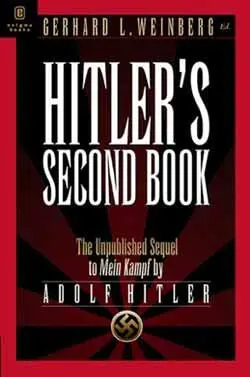
- Название:Hitler’s Second Book
- Автор:
- Издательство:Enigma Books
- Жанр:
- Год:2003
- Город:New York
- ISBN:978-1929631162
- Рейтинг книги:4 / 5. Голосов: 1
-
Избранное:Добавить в избранное
- Отзывы:
-
Ваша оценка:
Hitler’s Second Book: краткое содержание, описание и аннотация
Предлагаем к чтению аннотацию, описание, краткое содержание или предисловие (зависит от того, что написал сам автор книги «Hitler’s Second Book»). Если вы не нашли необходимую информацию о книге — напишите в комментариях, мы постараемся отыскать её.
* * * In 1958, while directing the microfilming and organization of a trove of archives that the U.S. forces had taken from the Nazis at the end of WWII, historian Weinberg (
) discovered the manuscript of a second book that Hitler had written but never published. The manuscript was published in German in 1961, accompanied by Weinberg’s annotations, but this is the first authoritative English version (a pirated and poor translation appeared in the 1960s). The text bears all of Hitler's hallmarks: rambling thoughts, half-baked ideas, pedantic writing-along with a terrifying, sustained belief in war and violence as the means to ensure that Germans would flourish. Compared to
, there are fewer pages devoted to Jews. Nonetheless, what comes across most strongly is Hitler’s abiding commitment to the principle of race and his identification of Jews as the enemy that threatened to undo all that Germans had created. Hitler dwells at length on foreign policy, and outlines a strategy of alliance with Fascist Italy and Great Britain. (He actually believed that Britain would accept a German-dominated European continent so long as Germany did not challenge the overseas British empire.) He also foresees an inevitable clash with the United States. This provides solid historical background on Hitler's thinking in the late 1920s, when his party was nothing more than a tiny, radical sect. Weinberg provides helpful notes and a very informative introduction.
Copyright 2003 Reed Business Information, Inc. “Politics is history in the making.”
Such were the words of Adolf Hitler in his untitled, unpublished, and long suppressed second work written only a few years after the publication of
.
Only two copies of the 200 page manuscript were originally made, and only one of these has ever been made public. Kept strictly secret under Hitler’s orders, the document was placed in an air raid shelter in 1935 where it remained until it’s discovery by an American officer in 1945.
Written in 1928, the authenticity of the book has been verified by Josef Berg (former employee of the Nazi publishing house Eher Verlag), and Telford Taylor (former Brigadier General U.S.A.R., and Chief Counsel at the Nuremburg war-crimes trials) who, after an analysis made in 1961, comments:
*as quoted by http://www.pharo.com/lost&found.htm
“If Hitler’s book of 1928 is read against the background of the intervening years, it should interest not scholars only, but the general reader.”*
Hitler’s Second Book — читать онлайн бесплатно полную книгу (весь текст) целиком
Ниже представлен текст книги, разбитый по страницам. Система сохранения места последней прочитанной страницы, позволяет с удобством читать онлайн бесплатно книгу «Hitler’s Second Book», без необходимости каждый раз заново искать на чём Вы остановились. Поставьте закладку, и сможете в любой момент перейти на страницу, на которой закончили чтение.
Интервал:
Закладка:
Hence the sober perception of British interests will be determining for English foreign policy in the future too.
Whoever cuts across these interests will thereby also be England’s enemy in the future. Whoever does not touch them, his existence will also not be touched by England. And whoever can be useful to her from time to time will be invited on England’s side regardless of whether he had been an enemy in the past or perhaps can again become one in the future.
Only a bourgeois national German politician can manage to refuse a useful alliance for the reason that later, perhaps, it can end in enmity. To impute such an idea to an Englishman is an insult to the political instinct of this Folk.
Naturally if Germany does not set herself any political goal, and we muddle through planlessly from one day to the other as up to now without any guiding thought; or if this goal lies in the restoration of the borders and territorial conditions of the year 1914 and thereby in the end lands into a policy of world trade, colonisation and naval power, England’s future enmity with us will indeed be certain. Then Germany will suffocate economically under her Dawes burdens, politically decay under her Locarno treaties, and increasingly weaken racially in order finally to terminate her life as a second Holland or a second Switzerland in Europe. This can certainly be achieved by our bourgeois national and patriotic armchair politicians; for this all they need do is continue further along their present path of phrase mongering, shooting off their mouths in protests, making war on all Europe, and then crawling cravenly into a hole before every act. This then is what the national bourgeois patriotic policy of Germany’s resurgence means. Thus, just as our bourgeoisie in the course of barely sixty years has known how to degrade and to compromise the national concept, so in its decline does it destroy the beautiful concept of the Fatherland by degrading it also to a mere phrase in its patriotic leagues.
To be sure, yet another important factor emerges in regard to England’s attitude toward Germany: the decisive influence world Jewry also possesses in England. Just as surely as Anglosaxonism itself can overcome its war psychosis vis-à-vis Germany, world Jewry just as surely will neglect nothing to keep the old enmities alive so as to prevent a pacification of Europe from materialising, and thereby enable it to set its Bolshevist destructive tendencies into motion amid the confusion of a general unrest.
We cannot discuss world policy without taking this most terrible power into account. Therefore I will deal especially with this problem further in this book.
Chapter 15
ITALY AS AN ALLY
Certainly if England is under no compulsion to maintain her wartime enmity toward Germany forever on grounds of principle, Italy has even less grounds to do so. Italy is the second State in Europe that must not be fundamentally hostile to Germany. Indeed, her foreign policy aims need not cross with Germany’s at all. On the contrary, with no other State does Germany have perhaps more interests in common than precisely with Italy, and conversely.
At the same time that Germany tried to achieve a new national unification, the same process also took place in Italy. To be sure, the Italians lacked a central power of gradually growing, and ultimately towering, importance, such as Germany in the making possessed in Prussia. But as German unification was primarily opposed by France and Austria as true enemies, so likewise did the Italian unification movement also have to suffer most under these two powers. The chief cause, of course, lay with the Habsburg State which must have and did have a vital interest in the maintenance of Italy’s internal dismemberment. Since a State of the size of Austria-Hungary is unthinkable without direct access to the sea, and the only territory which could be considered for this — at least in regard to its cities — was inhabited by Italians, Austria necessarily disapprovingly opposed the rise of a united Italian State for fear of the possible loss of this territory in case of the founding of an Italian national State. At that time even the boldest political aim of the Italian Folk could lie only in its national unification. This then perforce also conditioned the foreign policy attitude. Hence as Italian unification [that through Savoys]
slowly took shape, Cavour, its brilliant great statesman, utilised all possibilities which could serve this particular aim. Italy owes the possibility of her unification to an extraordinarily cleverly chosen alliance policy. Its aim was primarily to bring about the paralysis of the chief enemy of unification, Austria-Hungary, indeed finally to induce this State to leave the north Italian provinces. Withal, even after the conclusion of the provisional unification of Italy, there were more than 800000 Italians in Austria-Hungary alone. The national aim of the further unification of people of Italian nationality was at first bound to undergo a postponement when, for the first time, there began to arise the dangers of an Italian French estrangement. Italy decided to enter the Triple Alliance, chiefly in order to gain time for her inner consolidation.
The World War at last brought Italy into the camp of the Entente for reasons that I have already discussed.
Thereby Italian unity had been carried a powerful step forward. Even today, however, it is not yet completed.
For the Italian State, though, the great event was the elimination of the hated Habsburg empire. To be sure, its place was taken by a Southern Slav structure which already presented a danger hardly less great for Italy on the basis of general national viewpoints.
For just as little as the bourgeois national and purely border policy conception in Germany could in the long run satisfy our Folk’s vital needs, equally little could the purely bourgeois national unification policy of the Italian State satisfy the Italian Folk.
Like the German Folk, the Italian Folk lives on a small soil surface which in part is scantily fertile. For centuries, indeed many centuries, this overpopulation has forced Italy to a permanent export of people. Even though a great part of these emigrants, as seasonal labourers, return to Italy in order to live there on their savings, this leads more than ever to a further aggravation of the situation. Not only is the population problem not solved thereby, but it is sharpened rather. Just as Germany through her export of goods fell into a state of dependence on the ability, potentiality and willingness of other powers and countries to receive these goods, likewise and exactly did Italy with her export of people. In both cases a closing of the receiving market, resulting from events of any kind whatsoever, perforce led to catastrophic consequences within these countries.
Hence Italy’s attempt to master the problem of sustenance through an increase of her industrial activity cannot lead to any ultimate success because, at the outset, the lack of natural raw materials in the Italian Motherland robs her in great measure of the required ability to compete.
Just as in Italy the conceptions of a formal bourgeois national policy are being overcome and a Folkish feeling of responsibility is taking its place, likewise will this State also be forced to deviate from its former political conceptions in order to turn to a territorial policy on a grand scale.
The shore basins of the Mediterranean Sea constitute, and hence remain, the natural area of Italian expansion.
The more presentday Italy departs from her former unification policy and goes over to an imperialist policy, the more will she fall into the ways of ancient Rome, not out of any presumption to power, but out of deep, internal necessities. If today Germany seeks soil in Eastern Europe, this is not the sign of an extravagant hunger for power, but only the consequence of her need for territory. And if today Italy seeks to enlarge her influence on the shores of the Mediterranean basin and ultimately aims to establish colonies, it is also only the release ensuing from sheer necessity, out of a natural defence of interests. If the German pre War policy had not been struck with total blindness, it would necessarily have supported and fostered this development with every means. Not only because it would have meant a natural strengthening of an ally, but because it might perhaps have offered the only possibility of drawing Italian interests away from the Adriatic Sea and thereby lessened the sources of irritation with Austria-Hungary. Such a policy, in addition, would have stiffened the most natural enmity which can ever exist, namely that between Italy and France, the repercussions of which would have strengthened the Triple Alliance in a favourable sense.
Читать дальшеИнтервал:
Закладка:
Похожие книги на «Hitler’s Second Book»
Представляем Вашему вниманию похожие книги на «Hitler’s Second Book» списком для выбора. Мы отобрали схожую по названию и смыслу литературу в надежде предоставить читателям больше вариантов отыскать новые, интересные, ещё непрочитанные произведения.





Обсуждение, отзывы о книге «Hitler’s Second Book» и просто собственные мнения читателей. Оставьте ваши комментарии, напишите, что Вы думаете о произведении, его смысле или главных героях. Укажите что конкретно понравилось, а что нет, и почему Вы так считаете.