Adolf Hitler - Hitler’s Second Book
Здесь есть возможность читать онлайн «Adolf Hitler - Hitler’s Second Book» весь текст электронной книги совершенно бесплатно (целиком полную версию без сокращений). В некоторых случаях можно слушать аудио, скачать через торрент в формате fb2 и присутствует краткое содержание. Город: New York, Год выпуска: 2003, ISBN: 2003, Издательство: Enigma Books, Жанр: Публицистика, на английском языке. Описание произведения, (предисловие) а так же отзывы посетителей доступны на портале библиотеки ЛибКат.
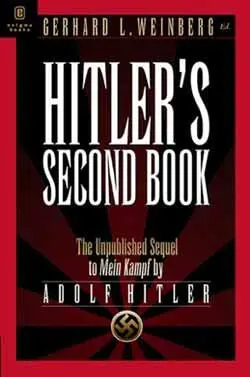
- Название:Hitler’s Second Book
- Автор:
- Издательство:Enigma Books
- Жанр:
- Год:2003
- Город:New York
- ISBN:978-1929631162
- Рейтинг книги:4 / 5. Голосов: 1
-
Избранное:Добавить в избранное
- Отзывы:
-
Ваша оценка:
Hitler’s Second Book: краткое содержание, описание и аннотация
Предлагаем к чтению аннотацию, описание, краткое содержание или предисловие (зависит от того, что написал сам автор книги «Hitler’s Second Book»). Если вы не нашли необходимую информацию о книге — напишите в комментариях, мы постараемся отыскать её.
* * * In 1958, while directing the microfilming and organization of a trove of archives that the U.S. forces had taken from the Nazis at the end of WWII, historian Weinberg (
) discovered the manuscript of a second book that Hitler had written but never published. The manuscript was published in German in 1961, accompanied by Weinberg’s annotations, but this is the first authoritative English version (a pirated and poor translation appeared in the 1960s). The text bears all of Hitler's hallmarks: rambling thoughts, half-baked ideas, pedantic writing-along with a terrifying, sustained belief in war and violence as the means to ensure that Germans would flourish. Compared to
, there are fewer pages devoted to Jews. Nonetheless, what comes across most strongly is Hitler’s abiding commitment to the principle of race and his identification of Jews as the enemy that threatened to undo all that Germans had created. Hitler dwells at length on foreign policy, and outlines a strategy of alliance with Fascist Italy and Great Britain. (He actually believed that Britain would accept a German-dominated European continent so long as Germany did not challenge the overseas British empire.) He also foresees an inevitable clash with the United States. This provides solid historical background on Hitler's thinking in the late 1920s, when his party was nothing more than a tiny, radical sect. Weinberg provides helpful notes and a very informative introduction.
Copyright 2003 Reed Business Information, Inc. “Politics is history in the making.”
Such were the words of Adolf Hitler in his untitled, unpublished, and long suppressed second work written only a few years after the publication of
.
Only two copies of the 200 page manuscript were originally made, and only one of these has ever been made public. Kept strictly secret under Hitler’s orders, the document was placed in an air raid shelter in 1935 where it remained until it’s discovery by an American officer in 1945.
Written in 1928, the authenticity of the book has been verified by Josef Berg (former employee of the Nazi publishing house Eher Verlag), and Telford Taylor (former Brigadier General U.S.A.R., and Chief Counsel at the Nuremburg war-crimes trials) who, after an analysis made in 1961, comments:
*as quoted by http://www.pharo.com/lost&found.htm
“If Hitler’s book of 1928 is read against the background of the intervening years, it should interest not scholars only, but the general reader.”*
Hitler’s Second Book — читать онлайн бесплатно полную книгу (весь текст) целиком
Ниже представлен текст книги, разбитый по страницам. Система сохранения места последней прочитанной страницы, позволяет с удобством читать онлайн бесплатно книгу «Hitler’s Second Book», без необходимости каждый раз заново искать на чём Вы остановились. Поставьте закладку, и сможете в любой момент перейти на страницу, на которой закончили чтение.
Интервал:
Закладка:
In a time such as this when public life acquires its shape from parties of this kind and is represented solely by people of inferior character, it is the duty of a national reform Movement to go its own way even in foreign policy which some day, according to all human prediction and reason, must lead to the success and happiness of the Fatherland. Hence, so far as the reproach of conducting a policy that does not correspond to official foreign policy comes from the Marxist democratic Centre camp, it can be set aside with the contempt it deserves. But if bourgeois national and so called Fatherland circles raise it, this is really only the expression and the symbol of the state of mind of professional joiners which exerts itself only in protests, and simply cannot seriously grasp that another movement possesses the indestructible will ultimately to become a power, and that in a prevision of this fact it already undertakes the necessary education of this power.
Since the year 1920 I have tried with all means and most persistently to accustom the National Socialist Movement to the idea of an alliance among Germany, Italy and England. This was very difficult, especially in the first years after the War, since the God Punish England standpoint, first and foremost, still robbed our Folk of any capacity for clear and sober thinking in the sphere of foreign policy, and continued to hold it prisoner.
The situation of the young Movement was infinitely difficult even vis-à-vis Italy, especially since an unprecedented reorganisation of the Italian Folk set in under the leadership of the brilliant statesman Benito Mussolini, which drew the protest of all the States directed by Freemasonry. For whereas up to the year 1922 the fabricators of official German opinion took altogether no notice of the sufferings of those parts of our Folk severed from Germany through their crimes, they now suddenly began to honour the Southern Tyrol with their attention. With all the means of a cunning journalism and a mendacious dialectic, the Southern Tyrol problem was blown up into a question of extraordinary importance so that, in the end, Italy incurred a proscription in Germany and Austria conferred on none other of the victor States. If the National Socialist Movement honestly wanted to represent its foreign policy mission, sustained by the conviction of the unconditional necessity of the same, it could not draw back from the struggle against this system of lies and confusion. Thus at the same time it could not count on any allies, but instead had to be guided by the idea that one should sooner renounce a cheap popularity rather than act against a perceived truth, a necessity that lay before one, and the voice of one’s conscience. And even if one would thereby be defeated, this would still be more honourable than to participate in a crime that had been seen through.
When in the year 1920 I pointed to the possibility of a later association with Italy, all the prerequisites thereto, at least at first, actually seemed to be lacking. Italy was in the circle of the victor States, and shared in the actual or merely presumed advantages of this situation. In the years 1919 and 1920 there seemed no prospect at all that the inner structure of the Entente would loosen in any predictable time. The powerful world coalition still placed a great value on showing that it was a self sufficient guarantor of the victory and thus also of the peace. The difficulties which had already come to light in connection with the drawing up of the peace treaties came all the less to the consciousness of a broad public opinion since the directors of an adroitly staged production knew how to preserve the impression of complete unity, at least outwardly. This common action was based just as much on the public opinion which had been created by a generally homogeneous war propaganda as it was on the still insecure fear of the German giant. Only slowly did the outside world get a glimpse of the dimensions of Germany’s inner decay. A further reason contributed to the seemingly almost indissoluble solidarity of the victor States: the hope of the individual States that they would thus not be overlooked when the time came to share the spoils. Finally there was the further fear that if at that time a State should actually withdraw, Germany’s fate, nevertheless, would have taken no other course, and then perhaps France alone would be the sole beneficiary of our collapse. For in Paris they naturally never gave a thought to bringing about a change in the attitude toward Germany which had been set in motion during the War. For me the peace is the continuation of the war. With this statement, white haired old Clemenceau expressed the French Folk’s real intentions.
The complete planlessness of German intentions confronted this, at least seeming, inner solidity of the coalition of victors, the immovable aim of which, inspired by France, was the complete annihilation of Germany even after the event. Next to the contemptible villainy of those who in their country, against all truth and against their own conscience, put the blame for the war on Germany and insolently deduced a justification for the enemy’s extortions therefrom, stood a partly intimidated, partly uncertain national side which believed that now after the ensuing collapse it could help matters by means of the most painful possible reconstruction of the nation’s past.
We lost the war in consequence of a lack of national passion against our enemies. The opinion in national circles was that we must replace this harmful deficiency and anchor this hatred against the former enemies in the peace.
At the same time it was noteworthy that, from the start, this hatred was concentrated more against England, and later Italy, than against France. Against England because, thanks to the Bethmann Hollwegian soporific policy, nobody had believed in a war with England up to the last hour. Therefore her entry into the war was viewed as an extraordinarily shameful crime against loyalty and faith. In the case of Italy the hatred was even more understandable in view of the political thoughtlessness of our German Folk. They had been so imprisoned in the mist and fog of the Triple Alliance by official government circles that even Italy’s non intervention for the benefit of Austria-Hungary and Germany was viewed as a breach of loyalty. And they saw a boundless perfidy in the later joining up of the Italian Folk with our enemies. This accumulated hatred was discharged in the typically bourgeois national fulmination and battle cry: God Punish England. Since God is just as much on the side of the stronger and the more determined, as well as preferably on the side of those who are cleverer, he manifestly refused to inflict this punishment. Nevertheless, at least during the war, whipping up of our national passion by every means was not only allowed but obviously called for. It was only a hindrance in that we were blinded by it to the real actualities, although the passion was never fanned too high among us. In politics there is no standpoint of contrariness, and therefore, even during the War, it was wrong to draw no other consequences, especially from Italy’s entry into the world coalition, except those of a flaming anger and indignation. For, on the contrary, we should have had the duty then especially to keep on reexamining the possibilities of the situation in order to come to those decisions that might have warranted consideration for saving the threatened German Nation. For with Italy’s entry into the front of the Entente, an extraordinary aggravation of the war situation was unavoidable, not only in consequence of the increase in terms of arms which the Entente acquired, but much more rather in consequence of the moral strengthening which necessarily lay in the emergence of such a power on the side of the world coalition being formed, especially for France. In terms of duty, the Nation’s political leaders at that time perforce should have decided, cost what it may, to put an end to the two front and three front war. Germany was not responsible for the further maintenance of the corrupt, slovenly Austrian State. Nor did the German soldier fight for the family power policy of the hereditary House Of Habsburg. This at best lay in the mind of our non combatant hurrah!-shouters, but not in that of those at the front shedding their blood. The sufferings and hardships of the German musketeers were already immeasurable in the year 1915. These sufferings could be demanded for the future and the preservation of our German Folk, but not for the salvation of the Habsburg big power megalomania. It was a monstrous idea to let millions of German soldiers bleed in a hopeless war only so that a dynasty could preserve a State, the most private dynastic interests of which for centuries had been anti German. This insanity will become completely understandable to us in its entirety only if we keep in view that the best German blood had to be shed so that, in the most favourable case, the Habsburgs might again have another chance to denationalise the German Folk in peacetime. We not only had to undertake the most monstrous bloodshed on two fronts for this madness, which screamed to heaven, no, we were even duty bound again and again to fill the holes which treason and corruption had torn in our worthy ally’s front with German flesh and blood. And thereby we made this sacrifice for a dynasty which itself was ready to leave its all sacrificing ally in the lurch at the first opportunity which offered itself. And who indeed later did just this. To be sure, our bourgeois national Fatherland patriots speak as little of the betrayal as they do of the continuous betrayal of the Austrian troops of Slavic nationality allied with us, who went over to the enemy’s side in whole regiments and brigades, in order finally in their own legions to join the fight against those who had been dragged into this dreadful misfortune by the operations of their State. Moreover, by itself, Austria-Hungary would never have participated in a war which might have involved Germany. That here or there some perhaps really believed to gain protection from the Triple Alliance, grounded in reciprocity, can be ascribed only to the boundless ignorance of Austrian conditions which generally prevailed in Germany. The worst disappointment for Germany would have materialised had the World War broken out on account of Germany. The Austrian State, with its Slav majority and with its Habsburg Ruling House, fundamentally anti German and anti Reich oriented, would never have taken up arms to defend and assist Germany against all the rest of the world, as Germany stupidly did. As a matter of fact, vis-à-vis Austria-Hungary, Germany had but one duty to fulfil, namely: to save the German element of this State by all means, and to eliminate the most degenerate, most guilt laden dynasty that the German Folk ever had to endure.
Читать дальшеИнтервал:
Закладка:
Похожие книги на «Hitler’s Second Book»
Представляем Вашему вниманию похожие книги на «Hitler’s Second Book» списком для выбора. Мы отобрали схожую по названию и смыслу литературу в надежде предоставить читателям больше вариантов отыскать новые, интересные, ещё непрочитанные произведения.




Обсуждение, отзывы о книге «Hitler’s Second Book» и просто собственные мнения читателей. Оставьте ваши комментарии, напишите, что Вы думаете о произведении, его смысле или главных героях. Укажите что конкретно понравилось, а что нет, и почему Вы так считаете.