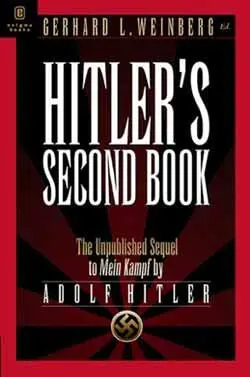
Adolf Hitler - Hitler’s Second Book
Здесь есть возможность читать онлайн «Adolf Hitler - Hitler’s Second Book» весь текст электронной книги совершенно бесплатно (целиком полную версию без сокращений). В некоторых случаях можно слушать аудио, скачать через торрент в формате fb2 и присутствует краткое содержание. Город: New York, Год выпуска: 2003, ISBN: 2003, Издательство: Enigma Books, Жанр: Публицистика, на английском языке. Описание произведения, (предисловие) а так же отзывы посетителей доступны на портале библиотеки ЛибКат.
- Название:Hitler’s Second Book
- Автор:
- Издательство:Enigma Books
- Жанр:
- Год:2003
- Город:New York
- ISBN:978-1929631162
- Рейтинг книги:4 / 5. Голосов: 1
-
Избранное:Добавить в избранное
- Отзывы:
-
Ваша оценка:
Hitler’s Second Book: краткое содержание, описание и аннотация
Предлагаем к чтению аннотацию, описание, краткое содержание или предисловие (зависит от того, что написал сам автор книги «Hitler’s Second Book»). Если вы не нашли необходимую информацию о книге — напишите в комментариях, мы постараемся отыскать её.
* * * In 1958, while directing the microfilming and organization of a trove of archives that the U.S. forces had taken from the Nazis at the end of WWII, historian Weinberg (
) discovered the manuscript of a second book that Hitler had written but never published. The manuscript was published in German in 1961, accompanied by Weinberg’s annotations, but this is the first authoritative English version (a pirated and poor translation appeared in the 1960s). The text bears all of Hitler's hallmarks: rambling thoughts, half-baked ideas, pedantic writing-along with a terrifying, sustained belief in war and violence as the means to ensure that Germans would flourish. Compared to
, there are fewer pages devoted to Jews. Nonetheless, what comes across most strongly is Hitler’s abiding commitment to the principle of race and his identification of Jews as the enemy that threatened to undo all that Germans had created. Hitler dwells at length on foreign policy, and outlines a strategy of alliance with Fascist Italy and Great Britain. (He actually believed that Britain would accept a German-dominated European continent so long as Germany did not challenge the overseas British empire.) He also foresees an inevitable clash with the United States. This provides solid historical background on Hitler's thinking in the late 1920s, when his party was nothing more than a tiny, radical sect. Weinberg provides helpful notes and a very informative introduction.
Copyright 2003 Reed Business Information, Inc. “Politics is history in the making.”
Such were the words of Adolf Hitler in his untitled, unpublished, and long suppressed second work written only a few years after the publication of
.
Only two copies of the 200 page manuscript were originally made, and only one of these has ever been made public. Kept strictly secret under Hitler’s orders, the document was placed in an air raid shelter in 1935 where it remained until it’s discovery by an American officer in 1945.
Written in 1928, the authenticity of the book has been verified by Josef Berg (former employee of the Nazi publishing house Eher Verlag), and Telford Taylor (former Brigadier General U.S.A.R., and Chief Counsel at the Nuremburg war-crimes trials) who, after an analysis made in 1961, comments:
*as quoted by http://www.pharo.com/lost&found.htm
“If Hitler’s book of 1928 is read against the background of the intervening years, it should interest not scholars only, but the general reader.”*
Hitler’s Second Book — читать онлайн бесплатно полную книгу (весь текст) целиком
Ниже представлен текст книги, разбитый по страницам. Система сохранения места последней прочитанной страницы, позволяет с удобством читать онлайн бесплатно книгу «Hitler’s Second Book», без необходимости каждый раз заново искать на чём Вы остановились. Поставьте закладку, и сможете в любой момент перейти на страницу, на которой закончили чтение.
Интервал:
Закладка:
Thus, for our national bourgeois and patriotic circles, the alliance possibilities are altogether impossible. But then they do not need them at all. For through the flood of their protests, and the rumble of their hurrahs, they will in part stifle the resistance of the other parts of the world, and in part overthrow it. And then, without any allies, indeed without any weapons, supported only by the clamourousness of their glib tongue, they will retrieve the stolen territories, let England subsequently still be punished by God, but chastise Italy and deliver her to the deserved contempt of the whole world — so far as up to this point they have not been hanged on lamp posts by their own momentary foreign policy allies, the Bolshevist and Marxist Jews.
At the same time, it is noteworthy that our national circles of bourgeois and patriotic origin never at all realise that the strongest proof of the fallacy of their attitude toward foreign policy lies in the concurrence of Marxists, Democrats and Centrists, above all especially in the concurrence of Jewry. But one must know our German bourgeoisie well in order immediately to know why this is so. They are all infinitely happy at least to have found an issue in which the presumed unity of the German Folk seems to be effected. No matter if this concerns a stupidity. Despite this, it is infinitely comforting for a courageous bourgeois and Fatherland politician to be able to talk in tones of national struggle without receiving a punch on the jaw for it from the nearest communist. That they are spared this only for the reason that their political conception is just as sterile in national terms as it is valuable in Jewish Marxist terms, either does not occur to these people, or it is concealed in the deepest recesses of their being. The extent which the corruption of lies and cowardice has assumed among us is something unheard of.
When in the year 1920 I undertook to orient the foreign policy position of the Movement toward Italy, I at first ran into complete incomprehension on the part of national circles, as well as in so called Fatherland circles. It was simply incomprehensible to these people how, contrary to the general duty of continual protests, one could formulate a political idea which — taken practically — signified the intrinsic liquidation of one of the enmities of the World War. In general, national circles found it beyond comprehension that I did not want to place the main weight of national activity on protests which were trumpeted to the skies in front of the Feldherrnhalle in München, or somewhere else, now against Paris, then again against London or also against Rome, but wanted to place it instead on the elimination first within Germany of those responsible for the collapse. A flaming protest demonstration against Paris also took place in München on the occasion of the Paris diktat, which, to be sure, must have caused M. Clemenceau little worry. But it induced me to elaborate with all vigour the National Socialist attitude in opposition to this protest mania. France had only done what every German could know and perforce should have known. Were I myself a Frenchman I would have supported Clemenceau as a matter of course. To bark permanently at an overpowering adversary from a distance is as undignified as it is idiotic. On the contrary, the national opposition of the Fatherland circles should have bared its teeth at those in Berlin who were responsible for, and guilty of, the terrible catastrophe of our collapse. To be sure, it was more comfortable to scream against Paris curses which could not be actualised in view of the factual conditions, than to stand up against Berlin with deeds.
This also applied especially to the representatives of that Bavarian government policy, who, to be sure, sufficiently exhibit the nature of their brilliance by the facts of their success up to now. For the very men who continually asserted the desire to preserve Bavaria’s sovereignty, and who at the same time also had in view maintenance of the right to conduct foreign policy, should primarily have been obliged to put forth a possible foreign policy of such sort that Bavaria, thereby, could of necessity have obtained leadership of a real national opposition in Germany conceived in its grand aspects. In view of the complete inconsistency of Reich policy or of the deliberate intention to ignore all real avenues of success, it is precisely the Bavarian State that should have risen to the role of spokesman for a foreign policy which, according to human prediction, might one day have brought an end to Germany’s dreadful isolation.
But even in these circles they confronted the foreign policy conception of an association with Italy, as espoused by me, with a complete and stupid thoughtlessness. Instead of thus rising in a bold way to the role of spokesmen and guardians of the highest national German interests for the future, they preferred, from time to time, with one eye blinking toward Paris while the other was raised up to heaven, to asseverate their loyalty to the Reich on the one hand, and on the other their determination nevertheless to save Bavaria by letting the fires of Bolshevism burn out in the north. Yes, indeed, the Bavarian State has entrusted the representation of its sovereign rights to intellectual characters of a wholly special greatness.
In view of such a general mentality, it should surprise nobody that, from the very first day, my foreign policy conception encountered, if not direct rejection, at least a total lack of understanding. Frankly speaking, I expected nothing else at that time. I still took account of the general war psychosis, and strove only to instil a sober world view of foreign policy into my own Movement.
At that time, I did not yet have to endure any kind of overt attacks on account of my Italian policy. The reason for this probably lay, on the one hand, in the fact that for the moment it was held to be completely devoid of danger, and on the other that Italy herself likewise had a government subject to international influences. Indeed, in the background it was perhaps even hoped that this Italy could succumb to the Bolshevist plague, and then she would be highly welcome as an ally, at least for our Left circles.
Besides, on the Left at that time, one could not very well take a position against the elimination of war enmity, since in this very camp they were anyhow making constant efforts to extirpate the hateful, demeaning, and — for Germany — so unjustified feeling of hatred born of the War. It would not have been easy to launch a criticism against me from these circles over a foreign policy conception, which, as a prerequisite for its realisation, would after all have caused at least the removal of the war hatred between Germany and Italy.
I must, however, stress once more that perhaps the main reason why I found so little positive resistance lay for my enemies in the presumed harmlessness, enviability and thereby also the non dangerous character of my action.
This situation changed almost in one stroke when Mussolini had begun the March on Rome. As if by a magic word, the running fire of poisoning and slander against Italy by the entire Jewish press began from this hour on.
And only after the year 1922 was the Southern Tyrol question raised and made into a pivotal point of German Italian relations, whether the Southern Tyroleans themselves wanted it so or not. It did not take long before even Marxists became the representatives of a national opposition. And now one could experience the unique spectacle of Jews and Folkish Germans, Social Democrats and members of the Patriotic Leagues, communists and national bourgeois, arm in arm, spiritually marching across the Brenner in order to carry out the reconquest of this territory in mighty battles but, to be sure, without the shedding of blood. A charm of a wholly special character was further added to this bold national front by the fact that even those out and out Bavarian particularist representatives of Bavarian sovereign rights, whose spiritual forefathers over a hundred years before had surrendered the good Andreas Hofer to the French and let him be shot, also vigorously interested themselves in the freedom struggle for the country of Andreas Hofer.
Читать дальшеИнтервал:
Закладка:
Похожие книги на «Hitler’s Second Book»
Представляем Вашему вниманию похожие книги на «Hitler’s Second Book» списком для выбора. Мы отобрали схожую по названию и смыслу литературу в надежде предоставить читателям больше вариантов отыскать новые, интересные, ещё непрочитанные произведения.




Обсуждение, отзывы о книге «Hitler’s Second Book» и просто собственные мнения читателей. Оставьте ваши комментарии, напишите, что Вы думаете о произведении, его смысле или главных героях. Укажите что конкретно понравилось, а что нет, и почему Вы так считаете.