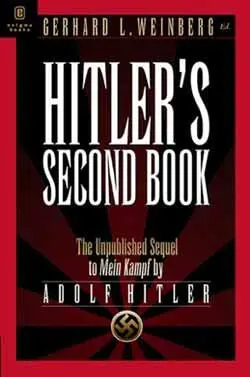
Adolf Hitler - Hitler’s Second Book
Здесь есть возможность читать онлайн «Adolf Hitler - Hitler’s Second Book» весь текст электронной книги совершенно бесплатно (целиком полную версию без сокращений). В некоторых случаях можно слушать аудио, скачать через торрент в формате fb2 и присутствует краткое содержание. Город: New York, Год выпуска: 2003, ISBN: 2003, Издательство: Enigma Books, Жанр: Публицистика, на английском языке. Описание произведения, (предисловие) а так же отзывы посетителей доступны на портале библиотеки ЛибКат.
- Название:Hitler’s Second Book
- Автор:
- Издательство:Enigma Books
- Жанр:
- Год:2003
- Город:New York
- ISBN:978-1929631162
- Рейтинг книги:4 / 5. Голосов: 1
-
Избранное:Добавить в избранное
- Отзывы:
-
Ваша оценка:
Hitler’s Second Book: краткое содержание, описание и аннотация
Предлагаем к чтению аннотацию, описание, краткое содержание или предисловие (зависит от того, что написал сам автор книги «Hitler’s Second Book»). Если вы не нашли необходимую информацию о книге — напишите в комментариях, мы постараемся отыскать её.
* * * In 1958, while directing the microfilming and organization of a trove of archives that the U.S. forces had taken from the Nazis at the end of WWII, historian Weinberg (
) discovered the manuscript of a second book that Hitler had written but never published. The manuscript was published in German in 1961, accompanied by Weinberg’s annotations, but this is the first authoritative English version (a pirated and poor translation appeared in the 1960s). The text bears all of Hitler's hallmarks: rambling thoughts, half-baked ideas, pedantic writing-along with a terrifying, sustained belief in war and violence as the means to ensure that Germans would flourish. Compared to
, there are fewer pages devoted to Jews. Nonetheless, what comes across most strongly is Hitler’s abiding commitment to the principle of race and his identification of Jews as the enemy that threatened to undo all that Germans had created. Hitler dwells at length on foreign policy, and outlines a strategy of alliance with Fascist Italy and Great Britain. (He actually believed that Britain would accept a German-dominated European continent so long as Germany did not challenge the overseas British empire.) He also foresees an inevitable clash with the United States. This provides solid historical background on Hitler's thinking in the late 1920s, when his party was nothing more than a tiny, radical sect. Weinberg provides helpful notes and a very informative introduction.
Copyright 2003 Reed Business Information, Inc. “Politics is history in the making.”
Such were the words of Adolf Hitler in his untitled, unpublished, and long suppressed second work written only a few years after the publication of
.
Only two copies of the 200 page manuscript were originally made, and only one of these has ever been made public. Kept strictly secret under Hitler’s orders, the document was placed in an air raid shelter in 1935 where it remained until it’s discovery by an American officer in 1945.
Written in 1928, the authenticity of the book has been verified by Josef Berg (former employee of the Nazi publishing house Eher Verlag), and Telford Taylor (former Brigadier General U.S.A.R., and Chief Counsel at the Nuremburg war-crimes trials) who, after an analysis made in 1961, comments:
*as quoted by http://www.pharo.com/lost&found.htm
“If Hitler’s book of 1928 is read against the background of the intervening years, it should interest not scholars only, but the general reader.”*
Hitler’s Second Book — читать онлайн бесплатно полную книгу (весь текст) целиком
Ниже представлен текст книги, разбитый по страницам. Система сохранения места последней прочитанной страницы, позволяет с удобством читать онлайн бесплатно книгу «Hitler’s Second Book», без необходимости каждый раз заново искать на чём Вы остановились. Поставьте закладку, и сможете в любой момент перейти на страницу, на которой закончили чтение.
Интервал:
Закладка:
No, if for Germany there remains any choice between France and Italy, then, according to all human reason, Italy alone warrants consideration for Germany. For a victory with France over Italy will bring us the Southern Tyrol and a stronger France to boot as a subsequent enemy. A victory over France with Italy’s help will bring us Alsace-Lorraine at the least, and at most, the freedom to carry out a genuine large scale territorial policy. And in the long run it is through this alone that Germany can live in the future, and not through Southern Tyrol. Nor will it do to choose one among all the severed territories, and indeed the one most unimportant to us in a vital sense, and to stake the total interests of a nation of 70000000 people, actually to renounce its future, just so that wretched fantastic German hurrah!-patriots can obtain a momentary gratification. And all this on account of a sheer phantom, for in reality the Southern Tyrol would be as little helped thereby as it is now.
The National Socialist Movement as such must educate the German Folk to the effect that it must not shrink from staking its blood for the sake of shaping its life. But, likewise, our Folk must be educated to the effect that such a staking of their blood, at least in future history, must never again take place for the sake of phantoms.
Let our protest patriots and Fatherland Leaguers for once please say how they envisage the reconquest of the Southern Tyrol other than by military violence. Let them, for once, summon up the honesty to avow, if they seriously believe it, that one day Italy — made mellow simply by their verbiage and heated protests — will hand over the Southern Tyrol, or whether they are not also convinced that a State with some existing national consciousness will give up a territory for which it had fought for four long years only under the compulsion of a military decision. Let them not always prattle that we, or I, had renounced the Southern Tyrol. These infamous liars know very well that, at least as far as regards my own person, I fought at the Front at the time when the fate of the Southern Tyrol was being decided, something which not a few of the presentday meeting protesters neglected to do at that time. And that at the same time, however, the forces with which our Patriotic Leaguers and National bourgeoisie make a common foreign policy and agitate against Italy, sabotaged the victory with every means, that international Marxism, democracy and the Centre even in peacetime neglected nothing in order to weaken and paralyse the military power of our Folk, and that finally they organised a revolution during the War which necessarily led to the collapse of the German Homeland and with it of the German Army.
The Southern Tyrol was also lost to the German Folk through the activity of these people, and the accursed weakness and impotence of our presentday bourgeois manic protesters. It is a contemptible falsification on the part of these so called national patriots if today they talk about a renunciation of the Southern Tyrol. No, dear gentlemen, don’t twist and squirm in such a cowardly way over the right word. Don’t be too cowardly to come right out and say that today it could only be a question of the conquest of the Southern Tyrol. For the renunciation, gentlemen of the National Leagues, was effected by your worthy presentday allies, the one time Marxist betrayers of their country, with all legal governmental forms. And the only ones who had the courage to take an open position against this crime at that time were not you, esteemed National Leaguers and bourgeois diplomatists, but rather the small National Socialist Movement and primarily myself. Indeed, sirs, when you were so quiet that nobody in Germany had an idea of your existence, so deeply had you crawled off into your mouse holes, it was then in the years 1919 and 1920 that I came forth against the shame of signing the peace treaties — and not secretly, behind four walls, but publicly. At that time, however, you were still so cowardly that never once did you dare to come to one of our meetings for fear of being cudgelled by your present foreign policy allies, the Marxist street tramps.
The men who signed the Peace Treaty Of Saint Germain were as little National Socialists as the signers of the Peace Treaty Of Versailles. They were the members of the parties who, by this signing, merely capped their decades long betrayal of their country. Whoever today wants to change the fate of the Southern Tyrol in any way cannot renounce anything that was already renounced in all forms by the presentday protesters. At most he can only reconquer it.
I am most fanatically opposed to this, to be sure, and I announce the most extreme resistance to this endeavour, and I shall fight with the utmost fanaticism against the men who are trying to drive our Folk into this adventure, as bloody as it is insane. I did not learn about the War at a restaurant table reserved for regular customers. Nor was I, in this War, one of those who had to give orders or to command. I was an ordinary soldier who was given orders for four and a half years, and who nevertheless honourably and truly fulfilled his duty. But I thereby had the good fortune to know war as it is, and not as one would like to see it. As a simple soldier, who had known only its dark sides, I was for this war up to the last hour because I was convinced that the salvation of our Folk could lie only in victory. Since, however, there is now a peace which others have perpetrated, I fight to the utmost against a war which would not benefit the German Folk, but instead only those who once before sacrilegiously traded the blood sacrifice of our Folk for their interests. I am of the conviction that one day I will not be lacking in the determination, to bear the responsibility even, if necessary, of staking the blood of the German Folk. But I fight against even a single German being dragged off to a battlefield, for fools or criminals to nourish their plans on his blood. Whoever reflects on the unprecedented horror and the frightful misery of a modern war, or considers the boundless demands on the nervous stamina of a Folk, must take fright at the idea that such a sacrifice could be demanded for a success which in the most favourable case could never be consonant with this enormous effort. And I also know that if today the people of the Southern Tyrol, so far as it thinks along exclusively German lines, were gathered in one front and the hundreds and hundreds of thousands of dead which our Nation would have to lay down in a struggle for their sake were to appear before these spectators, 300000 hands would rise protectingly toward heaven, and the foreign policy of the National Socialists would be justified.
What is most terrible about all this is that they play with this dreadful possibility without ever giving a thought to really wanting to help the Southern Tyroleans.
Since the struggle over the Southern Tyrol is being waged today by those who once surrendered all Germany to ruin, even the Southern Tyrol is to them only a means to an end which they use with ice cold unscrupulousness in order to be able to gratify their infamous anti German — in the most extreme sense of the word — instincts. It is the hate against the presentday nationally conscious Italy, and it is above all a hatred of the new political idea of this country, and most of all hatred against the towering Italian statesman, which induces them to stir up German public opinion with the help of the Southern Tyrol. For, in reality, how indifferent after all are these elements to the German Folk. While they lament the Southern Tyrol’s fate with crocodile tears in their eyes, they are driving all Germany toward a fate which is worse than that of the partitioned territory. While they protest against Italy in the name of national culture, they pollute the culture of the German nation within, destroy our whole cultural sensibility, poison the instinct of our Folk, and annihilate even the accomplishments of earlier times. Does an age which inside the country has depressed our whole theatre, our literature, our plastic arts to the level of swine, have the right to step forth against presentday Italy, or to protect German culture from her in the name of culture? The gentlemen of the Bavarian People’s Party, the German Nationalists, and even the Marxist defilers of culture, are concerned about the German culture of the Southern Tyrol, but, undisturbed, they let the culture of the Homeland be insulted by the most wretched bungling works, and surrender the German stage to the race shame of a Jonny Spielt Auf [note 11]. And, hypocritically, they lament the oppression of German cultural life in the Southern Tyrol, while they themselves most cruelly persecute those in the Homeland who want to protect German culture from a deliberate and intentional destruction. Here the Bavarian People’s Party incites the State power against those who raise a protest against the infamous defilement of our Folk’s culture.
Читать дальшеИнтервал:
Закладка:
Похожие книги на «Hitler’s Second Book»
Представляем Вашему вниманию похожие книги на «Hitler’s Second Book» списком для выбора. Мы отобрали схожую по названию и смыслу литературу в надежде предоставить читателям больше вариантов отыскать новые, интересные, ещё непрочитанные произведения.





Обсуждение, отзывы о книге «Hitler’s Second Book» и просто собственные мнения читателей. Оставьте ваши комментарии, напишите, что Вы думаете о произведении, его смысле или главных героях. Укажите что конкретно понравилось, а что нет, и почему Вы так считаете.