Robert Leckie - Strong Men Armed
Здесь есть возможность читать онлайн «Robert Leckie - Strong Men Armed» весь текст электронной книги совершенно бесплатно (целиком полную версию без сокращений). В некоторых случаях можно слушать аудио, скачать через торрент в формате fb2 и присутствует краткое содержание. Город: Cambridge, Год выпуска: 2010, ISBN: 2010, Издательство: Da Capo Press, Жанр: nonf_military, на английском языке. Описание произведения, (предисловие) а так же отзывы посетителей доступны на портале библиотеки ЛибКат.
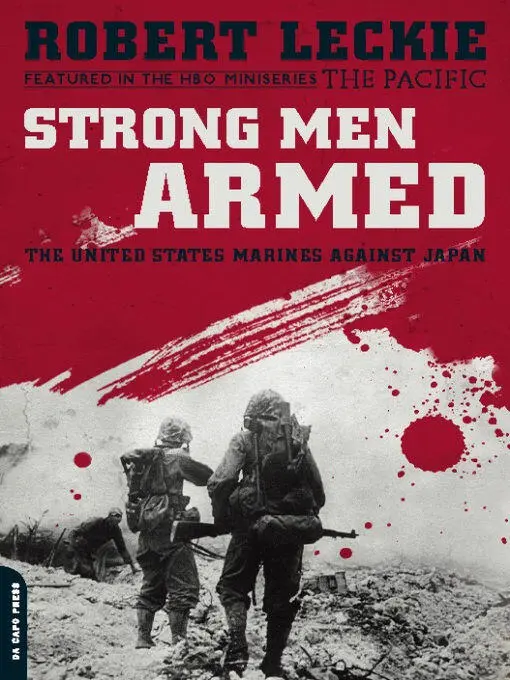
- Название:Strong Men Armed
- Автор:
- Издательство:Da Capo Press
- Жанр:
- Год:2010
- Город:Cambridge
- ISBN:978-0-786-74832-7
- Рейтинг книги:3 / 5. Голосов: 1
-
Избранное:Добавить в избранное
- Отзывы:
-
Ваша оценка:
Strong Men Armed: краткое содержание, описание и аннотация
Предлагаем к чтению аннотацию, описание, краткое содержание или предисловие (зависит от того, что написал сам автор книги «Strong Men Armed»). Если вы не нашли необходимую информацию о книге — напишите в комментариях, мы постараемся отыскать её.
Strong Men Armed — читать онлайн бесплатно полную книгу (весь текст) целиком
Ниже представлен текст книги, разбитый по страницам. Система сохранения места последней прочитанной страницы, позволяет с удобством читать онлайн бесплатно книгу «Strong Men Armed», без необходимости каждый раз заново искать на чём Вы остановились. Поставьте закладку, и сможете в любой момент перейти на страницу, на которой закончили чтение.
Интервал:
Закладка:
Such scenes were repeated all the way up the island, while General Geiger drove his attacking divisions forward.
There were battles along the way. On August 3 the Ninth Marines reached a place called Finegayen near Tumon Bay on the west coast. On that morning a good-humored youth with a flashing white smile and the name of Frank Witek said to his friends, “I think this is my day.” It was surely so, although Pfc. Witek did not see its end. He fought tigerishly in the attack at Finegayen, exposing himself repeatedly to cover his squad. He shot 16 of the enemy. But as so often happens to the brave, he made his last charge and fell dead. As does not so often happen, he won the Medal of Honor. The next day the gallant Captain Shoemaker fell. He was sitting beside the road when a Japanese 75 shell swooshed in and blotted out his life. “All the good ones go,” a Marine said sadly, unashamed of the tears streaking his dusty cheeks. Next day Finegayen fell. Two days later, on August 7, General Geiger put the First Brigade on the line. With the brigade on the left, Third Marines in the center, 77th on the right, the assault rolled north until it reached Ritidian Point on August 10 and Guam was declared conquered.
But the southward streaming of the Chamorros did not stop. A Civil Affairs Section had been set up to care for them. Stockades were built. Captured Japanese food was issued. Some Chamorros came to the stockades to eat, to regain a little strength, to find a bayonet or a machete and slip back into the northern hills for vengeance. But most of them stayed, among them an emaciated old man with snow-white hair. He came to the stockade and introduced himself as Gaily R. Kamminga, a former member of the Guam Congress. He found old friends among some of the Navy officers who had landed with the Marines. He showed them a little pillow he was carrying. It was the only article of comfort which the Japanese had allowed him to take to the penal camp. Suddenly he ripped it open. Inside it was a faded American flag which had flown over the Piti Naval Yard the day of the Japanese invasion.
Down at Orote a new American flag flew over the rubble that had once been the Marine Barracks. It had been raised on July 29. General Geiger had been there, with his chief of staff, Colonel Merwin Silverthorn. General Shepherd had spoken quickly, while shells whistled east toward Orote’s tip.
“On this hallowed ground,” Shepherd said, “you officers and men of the First Marine Brigade have avenged the loss of our comrades who were overcome by a numerically superior enemy three days after Pearl Harbor. Under our flag this island again stands ready to fulfill its destiny as an American fortress in the Pacific.”
Colonel Silverthorn stepped forward.
“Hoist the American colors,” he commanded.
Old Glory fluttered up the pole.
“To the Colors!” commanded Geiger.
A Marine blew the quick-sweet, slow-sad notes on a captured Japanese bugle.
The Marines saluted.
It had cost 7,800 Americans killed and wounded—839 soldiers, 245 sailors, 6,716 Marines—but Uncle Sam had come back to Guam.
14
The sign had been raised outside a billet on Kwajalein Atoll. But, like that “PAVUVU RIFLE AND GUN CLUB, WHERE LIFE IS A THIRTY CALIBER BORE,” it had its cousins by the dozen from Camp Tarawa in Hawaii to the newly built Second Marine Division encampments on Saipan.
Tedium had taken hold in the Pacific. Except on Guam, where the Third Marine Division was still mopping up, life had become an unutterable yawn. The blaze of battle had flickered out and would not flare up again until mid-September.
There were occasional thrilling spectacles, such as that of the morning of August 28 at Eniwetok, when Admiral Halsey took Task Force 38 out of the lagoon for a westward-ranging strike at the Palaus, later to swing north and strike at Mindanao in the Southern Philippines. But generally there was a lull. There had not even been much news from Europe since the announcement that the Allies had landed in Southern France on August 15.
On Pavuvu, it was a time when the men of the First Marine Division “trained” by walking around and around their tiny rattrap of an island, one outfit marching clockwise, the other counterclockwise, so as not to clog the single coastal road, exchanging cordial insults as they passed each other, cursing the pervasive odor of rotten coconut and those constantly falling nuts which made it necessary to wear helmets at all times—either when going to chow for that unvarying “rest and rehabilitation” diet of powdered eggs, spam and dehydrated potatoes, or when watching a grade-B movie in what was hopefully called an “open-air theater” but was actually a clearing in which men sat on fallen logs and watched a screen, yelling like sex-starved satyrs the moment any human being in skirts skipped, swished or staggered across it. There was no beer issue on Pavuvu for the men, as there was in the plush Army and Navy bases on surrounding islands. But the men of the First knew how to strain a bottle of after-shave lotion through a loaf of bread to make it palatable; they could cook up inebriate delights with raisins, sugar and coconut milk, or vanilla extract stolen from the galley—and those men invalided across the bay to the naval hospital on Banika could be counted upon to return with stores of medical alcohol bought with battle souvenirs. So supplied, the men could drink and sing.
The coffee that they give us, they say is mighty fine,
It’s good for cuts and bruises, in place of iodine.
I don’t want no more of the U. S. Marines,
Gee, but I wanna go home.
They say when you’re enlisted, promotions are mighty fine,
Well, I’m a goddam private, I been in over nine.
I don’t want no more of the U. S. Marines,
Gee, but I wanna go home.
The bedsacks that they give you, they say are mighty fine,
Well, how in hell should I know, I never slept in mine.
The officers they give us, can stand up to the worst,
You find ‘em every weekend, shacked up with a nurse.
I don’t want no more of the U. S. Marines,
Gee, but I wanna go, right back to Quantico,
Gee, but I wanna go home.
There was little of such diversion on Saipan-Tinian. The Fourth Marine Division had already departed, sailing back to its old base on Maui in the Hawaiian Islands, and leaving the Second Marine Division sole proprietors of islands made dismal by the August monsoon and mosquitoes carrying dengue or “breakbone” fever. There were also close to 1,000 Japanese still holed up in the hills, and there were Marines being killed in cleaning them out. But for the Second’s veterans, as with those of the First Division, there was the blessed rotation system which was taking many of them home. Close to 1,300 Marines who could claim service back to Guadalcanal were shipped Stateside. Some of their comrades painted gold stars on their tents in sardonic mockery of the American penchant for taking bows. If a man’s school, church, community, club, factory or office could put his name on a plaque headed, “Our Men in Service,” why couldn’t a man’s squad commemorate his entry in the ranks of the rear-echelons? So they put up signs like this:
Back at the Second’s old Camp Tarawa in Hawaii, the new Fifth Marine Division was getting accustomed to training overseas—adjusting to such novel nuisances as censorship. But there was one private who had cause to bless the censor. He had received a note: “Letter at mail desk. Name on envelope Dorothy, name on letter Bettye. Check and if correct, mail.”
Читать дальшеИнтервал:
Закладка:
Похожие книги на «Strong Men Armed»
Представляем Вашему вниманию похожие книги на «Strong Men Armed» списком для выбора. Мы отобрали схожую по названию и смыслу литературу в надежде предоставить читателям больше вариантов отыскать новые, интересные, ещё непрочитанные произведения.










Обсуждение, отзывы о книге «Strong Men Armed» и просто собственные мнения читателей. Оставьте ваши комментарии, напишите, что Вы думаете о произведении, его смысле или главных героях. Укажите что конкретно понравилось, а что нет, и почему Вы так считаете.