Robert Leckie - Strong Men Armed
Здесь есть возможность читать онлайн «Robert Leckie - Strong Men Armed» весь текст электронной книги совершенно бесплатно (целиком полную версию без сокращений). В некоторых случаях можно слушать аудио, скачать через торрент в формате fb2 и присутствует краткое содержание. Город: Cambridge, Год выпуска: 2010, ISBN: 2010, Издательство: Da Capo Press, Жанр: nonf_military, на английском языке. Описание произведения, (предисловие) а так же отзывы посетителей доступны на портале библиотеки ЛибКат.
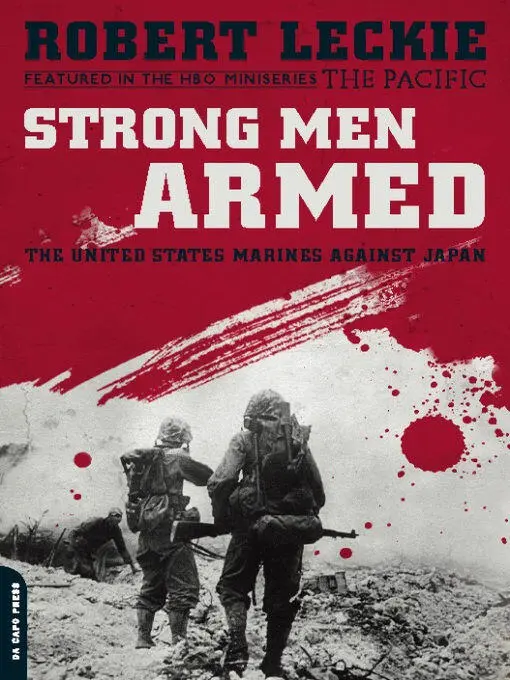
- Название:Strong Men Armed
- Автор:
- Издательство:Da Capo Press
- Жанр:
- Год:2010
- Город:Cambridge
- ISBN:978-0-786-74832-7
- Рейтинг книги:3 / 5. Голосов: 1
-
Избранное:Добавить в избранное
- Отзывы:
-
Ваша оценка:
Strong Men Armed: краткое содержание, описание и аннотация
Предлагаем к чтению аннотацию, описание, краткое содержание или предисловие (зависит от того, что написал сам автор книги «Strong Men Armed»). Если вы не нашли необходимую информацию о книге — напишите в комментариях, мы постараемся отыскать её.
Strong Men Armed — читать онлайн бесплатно полную книгу (весь текст) целиком
Ниже представлен текст книги, разбитый по страницам. Система сохранения места последней прочитанной страницы, позволяет с удобством читать онлайн бесплатно книгу «Strong Men Armed», без необходимости каждый раз заново искать на чём Вы остановились. Поставьте закладку, и сможете в любой момент перейти на страницу, на которой закончили чтение.
Интервал:
Закладка:
Such ability was reflected in the “Palau Sector Group Training for Victory” plan issued by Inoue on July 11. It began:
“Victory depends on the officers and men of the entire army concentrating on our thorough application of recent battle lessons, especially those of Saipan.”
Less than startling to Western ears, this was unorthodox in Japan. For years the doctrine of defense had been simply and inflexibly “annihilation at the water’s edge.” Hold the beach and you hold all. More, the invading American Marines had not been in the habit of allowing anyone to survive to challenge it. But there had been a few officers who escaped from Saipan, where General Saito’s artillery had punished the Americans. They came to Inoue’s command. They passed along their observations. The result:
“If the situation becomes bad we will maintain a firm hold on the high ground and prevent the enemy from establishing or using an air base by a daring guerrilla warfare with our artillery .”
Peleliu was made for such defense.
It was six miles long south-north and two miles wide at its broadest west-east. It was shaped like a lobster’s claw. It was, in fact, a pair of peninsulas joined on the east coast about one-third up its length. On the east coast were shoals and mangrove swamps and a series of islets extending the lower prong eastward. On the west were narrow beaches of white coral sand, fortified and defended in the accustomed manner. Both coasts were encompassed by the reef surrounding all the Palaus but Angaur. In the south was Peleliu’s excellent airfield, one which had been in use since before the war. Rising above it and running north about two miles was a low wooded ridge which the Japanese called the Momiji Plateau, which the Micronesians called Umurbrogal Mountain and which the American Marines would call Bloody Nose Ridge.
It was this high ground which made Peleliu so perfectly adaptable to defense-in-depth, for it was neither ridge nor mountain but an undersea coral reef thrown above the surface by a subterranean volcano. Sparse vegetation growing in the thin topsoil atop the bedrock had concealed the Umurbrogal’s crazy contours from the aerial camera’s eye. It was a place that might have been designed by a maniacal artist given to painting mathematical abstractions—all slants, jaggeds, straights, steeps and sheers with no curve to soften or relieve. Its highest elevation was 300 feet in the extreme north overlooking the airfield-islet of Ngesebus 1,000 yards offcoast there. But no height rose more than 50 feet before splitting apart in a maze of peaks and defiles cluttered with boulders and machicolated with caves. For the Umurbrogal was also a monster swiss cheese of hard coral limestone pocked beyond imagining with caves and crevices. They were to be found at every level, in every size—crevices small enough for a lonely sniper, eerie caverns big enough to station a battalion among its stalactites and stalagmites.
It was here that Colonel Nunio Nakagawa and his engineers set to work widening, improving and fortifying the caves. When Colonel Nakagawa reported to General Inoue on Babelthuap that Vice Admiral Itou was interfering with his work, Inoue sent Major General Kenjiro Murai down to Peleliu. He was not to take command, he was only, in that friction between the Anchor and the Star, to match rank with Admiral Itou. Beneath the cover of this stalemate, Nakagawa continued his fortifying, and by the end of August he had 500 caves completed.
Nearly all were connected by interior tunnels. Most had entrances on more than one level and all had entrances on both sides of the mountain. Log-and-sandbag barricades protected the entrances, and their tunnels ran only a few feet inside the mountain before turning sharply to escape both direct gunfire and the terrible American flame-throwers. Some of the caverns were five and six stories deep. They contained barracks and kitchens. If the top of the Umurbrogal were to be lifted off, some of these tunnel networks would appear like monster H’s or series of E’s laid back to back. And this would be repeated for five and six levels down.
Within these caves Colonel Nakagawa placed all of his artillery except his coastal guns, all of his mortars and also the new 200-millimeter rocket-launchers just received from Japan. The guns fired from cave mouths equipped with sliding doors of armored steel. They could hit the beaches, the airfield to the south and Ngesebus to the north. They were protected by squads of riflemen and machine-gunners firing through the slits of natural crevices. All of these strong-points were covered by interlocking fire. For the Americans to attack one of them would be to bring down the fire of two or three others on them, to say nothing of those which would remain silent until the Americans advanced under the delusion that they had knocked out the entire system. Then, as Hercules had found with Hydra, they would find the beheaded stump sprouting two fresh heads to bite at them.
The Umurbrogal was the Pacific’s masterpiece of defensive engineering, and it was going to be manned by a new Japanese warrior. For Lieutenant General Inoue’s training plan instructions had also killed the banzai. Inoue had agreed that “We are ready to die honorably,” but he had also gone on to suggest, in that imprecise language which was as great a military drawback as the banzai itself, that mere dying was not enough. It had to have that exotic Western thing: purpose. Otherwise: “We must preserve personnel and ordnance.” Nor was “spiritual power” any longer vaunted over material power.
“It is certain that if we repay the Americans (who rely solely upon material power) with material power it will shock them beyond imagination….”
Unlike the crimson imagery with which commanders such as Haruyoshi Hyakutate urged the Japanese soldier to eat three of the American devils with each morning’s bowl of rice, this remark had the quality of reality. A bursting shell, as Saipan had shown, did have more effect than a banzai scream. Clearly, General Inoue agreed with Napoleon’s cynical dictum that “God is on the side of the heavy artillery.” In a Japanese paraphrase, he said:
“Heavenly aid on the road to victory falls only to those commanders who have a thorough control of command….”
Nor did Inoue fear naval gunfire. He told his men:
“Without concerning ourselves with the great explosive bursts or the strong local effect of naval firing, the destructive power wrought upon personnel is not very great…. Aerial bombardment is almost identical…. By observing very carefully the activity of enemy planes and the bombs while they are falling, avoiding thereby instantaneous explosions, and by taking advantage of gaps in bombardment in order to advance, it can cause no great damage.”
In proof, Inoue ordered his men to practice crawling through the bombs dropped during the light American raids of the spring and summer. But he ordered them to the antiaircraft guns when Admiral Halsey’s warbirds struck at the Palaus from Task Force 59 carrier decks on September 6 through September 8. When the bombardment force of battleships and cruisers showed up under Rear Admiral Jesse Oldendorf in the pale moonlight of early morning, September 12, all Palau troops got under cover.
At Peleliu, Colonel Nakagawa left about a battalion south of the airfield, perhaps another battalion along the western beaches, while withdrawing the rest of his men and tanks into the Umurbrogal.
Up at Babelthuap, General Inoue prepared to receive the main American attack.
It was his only mistake.
16
The American plan in the waning summer of 1944 was to commence the invasion of the Philippines by stages.
The first stage was to open the gates: Morotai on New Guinea in the west, Peleliu-Angaur in the Palaus on the west. This would be followed by invasion of Yap on October 5, and after that, the seizure of Ulithi.
Читать дальшеИнтервал:
Закладка:
Похожие книги на «Strong Men Armed»
Представляем Вашему вниманию похожие книги на «Strong Men Armed» списком для выбора. Мы отобрали схожую по названию и смыслу литературу в надежде предоставить читателям больше вариантов отыскать новые, интересные, ещё непрочитанные произведения.










Обсуждение, отзывы о книге «Strong Men Armed» и просто собственные мнения читателей. Оставьте ваши комментарии, напишите, что Вы думаете о произведении, его смысле или главных героях. Укажите что конкретно понравилось, а что нет, и почему Вы так считаете.