Robert Leckie - Strong Men Armed
Здесь есть возможность читать онлайн «Robert Leckie - Strong Men Armed» весь текст электронной книги совершенно бесплатно (целиком полную версию без сокращений). В некоторых случаях можно слушать аудио, скачать через торрент в формате fb2 и присутствует краткое содержание. Город: Cambridge, Год выпуска: 2010, ISBN: 2010, Издательство: Da Capo Press, Жанр: nonf_military, на английском языке. Описание произведения, (предисловие) а так же отзывы посетителей доступны на портале библиотеки ЛибКат.
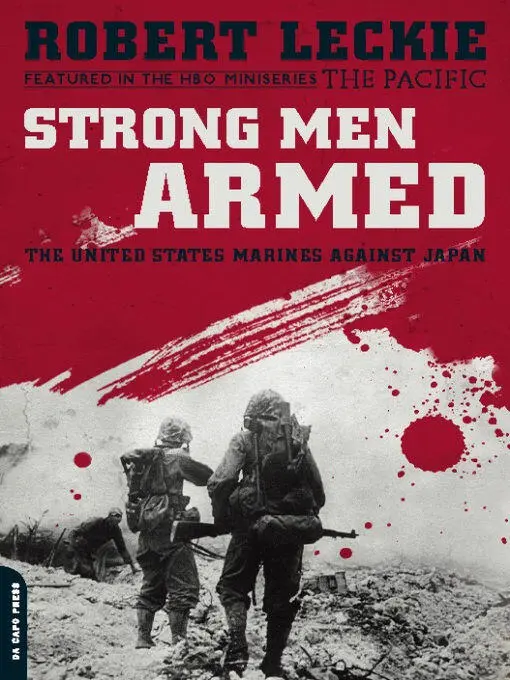
- Название:Strong Men Armed
- Автор:
- Издательство:Da Capo Press
- Жанр:
- Год:2010
- Город:Cambridge
- ISBN:978-0-786-74832-7
- Рейтинг книги:3 / 5. Голосов: 1
-
Избранное:Добавить в избранное
- Отзывы:
-
Ваша оценка:
Strong Men Armed: краткое содержание, описание и аннотация
Предлагаем к чтению аннотацию, описание, краткое содержание или предисловие (зависит от того, что написал сам автор книги «Strong Men Armed»). Если вы не нашли необходимую информацию о книге — напишите в комментариях, мы постараемся отыскать её.
Strong Men Armed — читать онлайн бесплатно полную книгу (весь текст) целиком
Ниже представлен текст книги, разбитый по страницам. Система сохранения места последней прочитанной страницы, позволяет с удобством читать онлайн бесплатно книгу «Strong Men Armed», без необходимости каждый раз заново искать на чём Вы остановились. Поставьте закладку, и сможете в любой момент перейти на страницу, на которой закончили чтение.
Интервал:
Закладка:
Then, in mid-November, General MacArthur would land on Mindanao in the Southern Philippines. Victory here would lead to December invasion of Leyte in the Central Philippines.
By March of 1945 the American forces in the Pacific would combine to secure either Luzon in the Northern Philippines, or to capture Formosa and ports on the China Coast. On either of these land masses the necessary large bodies of troops could be staged for the final assault on Japan.
Then the tides of war began shifting and the plan changed.
The Japanese in China launched their inevitable attacks on American air bases there and the Fourteenth Air Force had to retire from its forward fields. Soon the Japanese would make the China coast difficult to invade. For these reasons, and because no more American troops could be spared from Europe, the Formosa-China route to Japan was about to be canceled out.
And then, on September 13, Admiral Bull Halsey made his electrifying discovery that Japanese air power in the Philippines was on its last leg. On September 12, the carriers of Task Force 58 stood within sight of the mountains of Samar in the Central Philippines. They flew off 2,400 sorties. They destroyed 200 enemy planes. They sank ships. They bombed installations. They roved with such impunity that Halsey suggested to Admiral Nimitz, and thence to the Joint Chiefs of Staff, that all the Palau, Yap, Morotai and Mindanao landings be called off in favor of an immediate bold thrust into Leyte in the Central Philippines.
But General MacArthur was already headed for Morotai aboard the cruiser Nashville —and the ship was maintaining radio silence. Two days of messages shooting back and forth among Nimitz in Hawaii, the Combined Joint Chiefs of Staff attending the Octagon Conference in Quebec, and Lieutenant General R. K. Sutherland speaking for MacArthur in New Guinea produced these changes:
Instead of landing on Mindanao in November and then on Leyte in December, MacArthur would go directly to Leyte in October.
The Yap landing would be called off, and the Twenty-fourth Corps would be used at Leyte instead.
The Morotai landing by the 31st Infantry Division would go forward as planned, as would the landings on Angaur, Ulithi and Peleliu. The last three, considered necessary to obtain the air bases and anchorage which Admiral Nimitz wanted to support the Philippine landings, were to be made by troops of the Third Corps under Major General Geiger; the 81st Infantry (Wildcat) Division to hit Angaur and after that Ulithi, the First Marine Division to take Peleliu.
Peleliu, it had been known for months, was going to be a tough nut. The Marines had asked for heavy preinvasion bombardment there. And yet, off Peleliu on September 14, Admiral Oldendorf got off this message from his bombardment force:
“We have run out of targets!”
That same day, correspondents and unit commanders aboard the transports broke open sealed envelopes given them by Major General Rupertus, still commanding the First Marine Division. They read that Peleliu would be tough, like Tarawa, but also just as short.
It would take, said General Rupertus, something like four days.
17
On the morning of September 15 the First Marine Division struck at Peleliu’s western beaches three regiments abreast.
On the left or north was the First Marines, using the code word Spitfire; in the center opposite the airfield was the Fifth or Lonewolf; on the right moving against the southern tip was the Seventh or Mustang.
The Marines were almost gay going in, for General Rupertus’ prediction of four days had made them cocky, but once their amtracks had bumped over the fringing reef, once Colonel Nakagawa’s thousand-eyed mountain stuffed with men and guns had begun to flash, they stopped calling to one another, stopped throwing kisses, stopped wagging four confident fingers. They ducked beneath the gunwales and began to pray.
“Playmate, this is Spider. The First Waves are on the beach. Repeat: The first waves are on the beach. Over.”
“Spider, this is Playmate. What resistance do they seem. to be meeting? Over.”
“Playmate, this is Spider. Hard to tell much through this smoke. Over.”
All that could be seen to shoreward was a great pall of twisted, drifting smoke, sometimes suffused with a pinkish glare by the shivering of flames beneath or within it. It was a fiery Moloch of a cloud, created by the thundering of the great naval shells exploding beneath it, the clash-crashing of thousands of rockets and the whuffling thump of the bombs which screaming dive-bombers dropped through it. It was so impressive that the skipper of Colonel Chesty Puller’s transport rushed up to the veteran Marine commander as he began to go over the side to join his men.

“Coming back for supper?” he called out cheerfully.
“Why?” Puller growled.
The skipper waved an airy hand shoreward.
“Hell, everything’s done over there. You’ll walk in.”
“If you think it’s so easy,” Puller snapped, “why don’t you come on the beach at five o’clock? We could have dinner together and maybe you could pick up a couple of souvenirs.”
Then Spitfire’s commander went ashore, losing all of his communications amtracks on the way.
“Playmate, this is Spider. Resistance moderate to heavy, I’d say. There are amtracks burning on the reef. Repeat: There are amtracks burning on the reef. Over.”
“Spider, this is Playmate. Where are our front lines?”
“Lines well inland on the right and center, but left of Spitfire is still on beach. They seem to be pinned down…. I’m going lower to try and see what’s to their front….”
They were pinned down. The Marines of Captain George Hunt’s K Company, First, had come in jauntily singing, “Give My Regards to Broadway,” until the amtracks began to lurch and odd bumping, strangling noises against their sides signaled the arrival of Japanese mortars. The Marines fell silent, their faces paling beneath the outlandish streaking of their camouflage paint. Captain Hunt’s amtracks crunched ashore, his men jumped out—and they were struck from their left by a terrible enfilading fire.
On that left stood The Point, a mass of coral rising 30 feet from the sea, a natural fort made of crevices, boulders and pinnacles, fortified at its base with five pillboxes of ferro-concrete, sprinkled with others protected by coral-and-concrete roofs six feet thick, and salted with spider holes. Within the pillboxes were heavy machine guns and one of them held a 47-millimeter antiboat gun.
Even now that gun was dropping shells among the First Marines on the beaches. For The Point stood on the division’s extreme left or northern flank and it had the First’s landing zone clearly in view beneath it. Over a rocky corridor between The Point and the sea, the Japanese could launch a counterattack almost any time they chose. Clearly, The Point must fall.
Captain Hunt ordered two platoons up against it. They turned left from the coconut grove and attacked. They were riddled. Hunt called battalion.
“We’re pretty well shot up and there’s a gap between my two assault platoons. I’m throwing the first platoon in to take The Point. The goddam naval gunfire didn’t faze the Japs ! We need stretcher-bearers!”
“All right, bub,” said Major William McNulty. “I’ll have L Company fill in the gap. I’ll send up everybody I can spare with stretchers.”
But L Company did not plug the gap, nor did A or B Company from the First Battalion, nor were the stretchers able to reach the stricken during that incredible and impetuous assault which did, in fact, storm The Point.
Читать дальшеИнтервал:
Закладка:
Похожие книги на «Strong Men Armed»
Представляем Вашему вниманию похожие книги на «Strong Men Armed» списком для выбора. Мы отобрали схожую по названию и смыслу литературу в надежде предоставить читателям больше вариантов отыскать новые, интересные, ещё непрочитанные произведения.












Обсуждение, отзывы о книге «Strong Men Armed» и просто собственные мнения читателей. Оставьте ваши комментарии, напишите, что Вы думаете о произведении, его смысле или главных героях. Укажите что конкретно понравилось, а что нет, и почему Вы так считаете.