Robert Leckie - Strong Men Armed
Здесь есть возможность читать онлайн «Robert Leckie - Strong Men Armed» весь текст электронной книги совершенно бесплатно (целиком полную версию без сокращений). В некоторых случаях можно слушать аудио, скачать через торрент в формате fb2 и присутствует краткое содержание. Город: Cambridge, Год выпуска: 2010, ISBN: 2010, Издательство: Da Capo Press, Жанр: nonf_military, на английском языке. Описание произведения, (предисловие) а так же отзывы посетителей доступны на портале библиотеки ЛибКат.
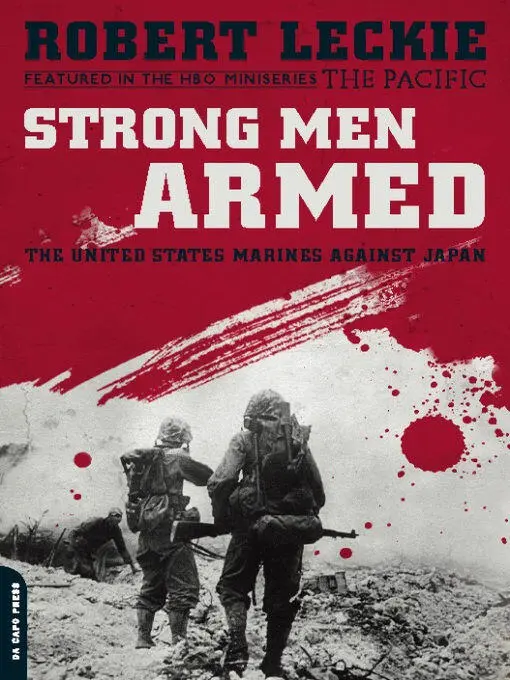
- Название:Strong Men Armed
- Автор:
- Издательство:Da Capo Press
- Жанр:
- Год:2010
- Город:Cambridge
- ISBN:978-0-786-74832-7
- Рейтинг книги:3 / 5. Голосов: 1
-
Избранное:Добавить в избранное
- Отзывы:
-
Ваша оценка:
Strong Men Armed: краткое содержание, описание и аннотация
Предлагаем к чтению аннотацию, описание, краткое содержание или предисловие (зависит от того, что написал сам автор книги «Strong Men Armed»). Если вы не нашли необходимую информацию о книге — напишите в комментариях, мы постараемся отыскать её.
Strong Men Armed — читать онлайн бесплатно полную книгу (весь текст) целиком
Ниже представлен текст книги, разбитый по страницам. Система сохранения места последней прочитанной страницы, позволяет с удобством читать онлайн бесплатно книгу «Strong Men Armed», без необходимости каждый раз заново искать на чём Вы остановились. Поставьте закладку, и сможете в любой момент перейти на страницу, на которой закончили чтение.
Интервал:
Закладка:
“We’re up here,” reported the single company commander who had survived. “But we’re knee-deep in Purple Hearts.”
In the morning, there were more casualties all along the line, for the Second Battalion’s salient in fact had made a shallow W of the entire front from west to east coast. The Japanese took advantage of the W and hammered hard at its joints, counterattacking and shooting the gaps where they found them. Hill 200 shook to constant battle, and Colonel Puller was forced to take G Company from the Second Battalion, Seventh, given him as a reserve, and rush it up to bolster the line. The Marines held, and in the morning of September 18, the attack went forward in an attempt to straighten out the W. It went forward at seven o’clock with the thermometer already rising to 115 degrees, and each man issued a dozen salt tablets and two canteens of water to resist the Umurbrogal’s horrible heat. The guns of both armies had stripped the battleground of all shade. Everything lay open to the sun, which hung in the sky like a burning ball above a jumble of blinding white coral rubble. The Marines were lying out on this like fish gasping on a skillet. The enemy was in his caves, cool and covered.
Marines dropping of heat exhaustion were helped to the rear to be revived with intravenous feedings of normal saline. Then they returned to battle, their camouflage nets pulled out from beneath their helmets and hanging over the back of their necks like the kepis of the French Foreign Legion.
In this heat, Chesty Puller roamed his command post stripped to the waist, his pipe stuck in one corner of his mouth while he issued his orders from the other. Puller had already relieved his badly mauled First Battalion and placed the Second Battalion, Seventh, in the center of his line. He had fed 115 men from the First Pioneer Battalion into the other depleted battalions. His own regiment’s casualties were 1,236, not counting combat fatigue or heat exhaustion, or about one-third—and most of these were among Marines of the line. But Puller was optimistic, as was Major General Rupertus. High ground had been reached the day before, had been held during the night, and now the enemy collapse was imminent.
It had always happened that way. Once the Marines had fought into dominating terrain, Japanese resistance had weakened until it had been utterly broken by a last banzai. Although there had been no banzai as yet, there was no reason not to expect one.
Nor could Puller or anyone else conceive of the depth of the position under attack. There had been a few uneasy reflections on the 35 unmapped caves which the First Battalion had been forced to knock out the day before, but no one dreamed that so many hundreds more awaited them in the higher ridges, as no one doubted the efficacy of the naval gunfire, artillery and air strikes preceding each assault, laying bare more and more of the Umurbrogal’s ugly white pate.
But on this September 18 there were so many more caves, so many more troops and guns in those higher ridges that the attacks of the Second Battalions, Seventh and First, were quickly fragmented center and left. Though the object was to pinch out the Japanese on Hill 210 inside the first V of the W, the Marines were attacking in every direction of the compass, for they were under fire from every direction. It was a bloody scramble of squads or platoons, with here and there a surviving officer rounding up the remnants of a company and leading them on until the Hill 210 bulge was erased. And the Japanese in surrounding ridges retaliated by bringing down such a murderous fire on the Second Battalion, First, and by mounting a series of counterattacks so savage that Lieutenant Colonel Russell Honsowetz reported that he might not be able to hold.
“What d’yuh mean, cain’t hold?” Puller roared. “You’re there, ain’t you, Honsowetz?”
Then, while a smoke barrage was laid down to conceal Honsowetz’ position, Puller ordered B Company out of the First Battalion reserve to a point forward and right of besieged Hill 200. B Company went up it in a rush. But it was only an isolated ridge. It did not relieve much of the pressure on the Second Battalion, First. B Company pushed on. They came to a system of peaks and palisades called The Five Sisters, a complex running transverse to the entire Umurbrogal. They attacked it.
They were hurled to the ground.
They had come to the heart of Colonel Nakagawa’s infernal mountain, and because they had been stopped so abruptly by what had seemed a single, roundhouse punch, they gave it the name which would describe the entire Umurbrogal—the name of Bloody Nose Ridge.
They did not take it that day, nor that month, nor the next. It was to be the final pocket of Japanese resistance on Peleliu, and it would not fall until November 25.
In the meantime, the First’s attack had fared better on the flanks. The Third Battalion had moved again on the west or left coast, and again had to halt to mark time. On the right flank, the Second Battalion had sent troops over the low ground between Hill 200 and the village of Asias on the east. They tied in with the left-flank company of the Fifth Marines. Between this company and the rest of the Fifth lay a deep swamp which would divide them until a new phase of the offensive began on September 23.
By dusk, that uncomfortable W formation had been erased. Puller’s command at Bloody Nose Ridge now held the enemy in a very shallow U. The regiment’s casualties, exclusive of those of the attached troops, were now at 1,500, or half its strength. But the report to Division said that although gains were slight, “the center of Japanese resistance has been detected and the weakest spots probed.”
“Let’s go git killed on that high ground up there!” the red-haired sergeant yelled, and he and his men went up the sides of Bloody Nose Ridge and many of them were killed.
That was the morning of September 19, when the First Regiment’s Second Battalion was broken on that evil coral complex and the First Battalion all but disappeared.
Everything was hurled against the ridge’s sheer southern face—all the big guns of land and sea, along with aerial bombs, tank weapons, bazookas, flame-throwers, mortars and machine guns and the hand-weapons of attacking riflemen. And Colonel Puller had also reinforced the Second Battalion with the Division Reconnaissance Company and Company C of the First Battalion. All that the First Battalion had left in reserve was A Company, plus a machine-gun platoon composed of men from the Battalion Intelligence Section, cooks, clerks and jeep drivers. In Lieutenant Colonel Honsowetz’ Second Battalion command post, an ominous sequence of orders and reports began:
0545
Heavy mortar fire fell all though our lines during the night. Lieutenant Mercer was killed and his platoon hit hardest.
0605
Enemy rockets firing on E Company lines.
0610
Mortats notified to fire on rocket launchers in 141U.
0715
F Company reports enemy mortars falling on our lines, requests amtracks to evacuate wounded.
0745
The attack is proceeding.
0752
Enemy artillery shelling front lines heavily.
0805
FROM REGIMENT: “Pratically all dead enemy officers are boody-trapped. Use caution.”
0815
Observation Post resquest naval gunfire and bombing on east side of island at Phase 0-4 line.
0818
Heavy enemy artillery fire on Observation Post. Stretcherbearers and corpsmen dispatched requested.
0850
Thanks moving forward.
0902
FROM F COMPANY: “I have approximately 60 men left and four officiers including myself. Lieutenant Russo has three pieces of sharpnel in his back. Lieutenant Maples has been wounded in the shoulder. We are still in the fight.”
Читать дальшеИнтервал:
Закладка:
Похожие книги на «Strong Men Armed»
Представляем Вашему вниманию похожие книги на «Strong Men Armed» списком для выбора. Мы отобрали схожую по названию и смыслу литературу в надежде предоставить читателям больше вариантов отыскать новые, интересные, ещё непрочитанные произведения.











Обсуждение, отзывы о книге «Strong Men Armed» и просто собственные мнения читателей. Оставьте ваши комментарии, напишите, что Вы думаете о произведении, его смысле или главных героях. Укажите что конкретно понравилось, а что нет, и почему Вы так считаете.