Robert Leckie - Strong Men Armed
Здесь есть возможность читать онлайн «Robert Leckie - Strong Men Armed» весь текст электронной книги совершенно бесплатно (целиком полную версию без сокращений). В некоторых случаях можно слушать аудио, скачать через торрент в формате fb2 и присутствует краткое содержание. Город: Cambridge, Год выпуска: 2010, ISBN: 2010, Издательство: Da Capo Press, Жанр: nonf_military, на английском языке. Описание произведения, (предисловие) а так же отзывы посетителей доступны на портале библиотеки ЛибКат.
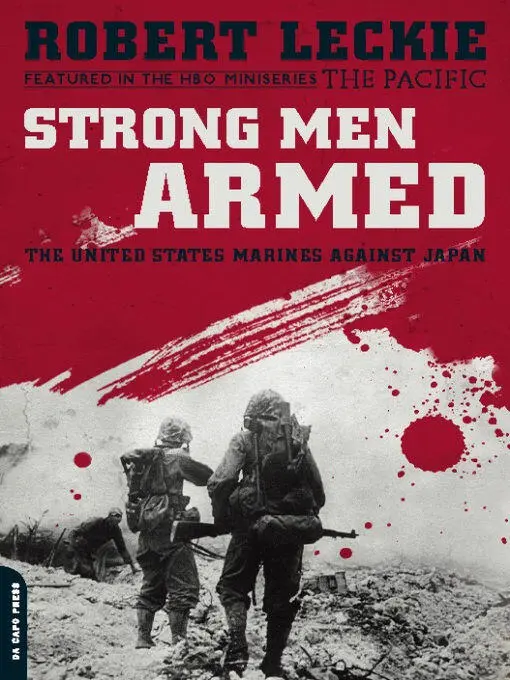
- Название:Strong Men Armed
- Автор:
- Издательство:Da Capo Press
- Жанр:
- Год:2010
- Город:Cambridge
- ISBN:978-0-786-74832-7
- Рейтинг книги:3 / 5. Голосов: 1
-
Избранное:Добавить в избранное
- Отзывы:
-
Ваша оценка:
Strong Men Armed: краткое содержание, описание и аннотация
Предлагаем к чтению аннотацию, описание, краткое содержание или предисловие (зависит от того, что написал сам автор книги «Strong Men Armed»). Если вы не нашли необходимую информацию о книге — напишите в комментариях, мы постараемся отыскать её.
Strong Men Armed — читать онлайн бесплатно полную книгу (весь текст) целиком
Ниже представлен текст книги, разбитый по страницам. Система сохранения места последней прочитанной страницы, позволяет с удобством читать онлайн бесплатно книгу «Strong Men Armed», без необходимости каждый раз заново искать на чём Вы остановились. Поставьте закладку, и сможете в любой момент перейти на страницу, на которой закончили чтение.
Интервал:
Закладка:
The last of the Marine divisions—the Sixth—was being formed on Guadalcanal. Its nucleus was the First Brigade and its commander was the brigade’s old leader, but Lemuel Shepherd now wore the twin stars of a major general. To the brigade’s Fourth and Twenty-second Marines—units of which had fought at Guadalcanal, Makin, Bougainville and Eniwetok —was added the Twenty-ninth Marines. The First Battalion, Twenty-ninth, had captured Mount Tapotchau on Saipan, but its Second and Third Battalions were newly formed in the States.
Though the Sixth Marine Division also got an artillery regiment, the Fifteenth, it got almost none of the specialists characteristic of Marine amphibious divisions of the past. For the Fleet Marine Force, Pacific, had been divided into two corps—the Third under Major General Geiger, the Fifth under Major General Schmidt—and all the special functions were now taken over by the corps. A Marine division was now streamlined to about 18,000 men, although the First, scheduled for a one-division landing, remained at a strength of above 20,000.
Training of the new Sixth Division began in late August with the arrival of the First Brigade from Guam, and it was made difficult by the Guadalcanal base commander’s insistence that Marine divisions furnish 1,000 men daily for base working parties. It had been to avoid this typical harassment of line divisions by rear-echelon generals that the First Division had been assigned to its private “little-ease” on Pavuvu.
To some of the Sixth’s veterans who had known Guadalcanal in the days of the Tokyo Express and Pistol Pete or Washing-Machine Charley, the island had become a placid fat cow of a place with its officers’ clubs, its hospitals, its warehouses, its roads and piers and libraries and theaters and indoor mess halls and quonset huts, its battalions of military police required to guard its Red Cross girls and nurses and to enforce the numerous regulations clattering off the typewriters of those ubiquitous clerk-typists who had become the new heroes of Guadalcanal. The Marines did not like it there, nor could they take the new Guadalcanal seriously when, at night, with the open-air theaters going full blast, the MP’s got around to playing air-raid-precaution.
“Put those goddam lights out!” an MP called to a Marine driving a jeep one night.
The driver obeyed. But he happened to be a general’s driver, and the general said evenly:
“Put those goddam lights back on.”
The driver obeyed.
“Put those goddam lights out!” the MP shrieked.
“I can’t,” the Marine yelled back. “I got the goddam general with me!”
If late August and early September meant a time of lull to the Marines on the ground, it marked the end of the doldrums for the Marines in the air. They would soon get the escort carriers from which they would launch close-up aerial support of their foot-slogging comrades. They would also send 17 squadrons into the Philippines to place this tactic at the service of Army divisions. And the “forgotten war” they had been fighting over the Marshalls would be over.
Having shown how to knock out a base at Rabaul, the Marine fliers had been assigned a repeat performance over the bypassed atolls of Wotje, Maloelap, Milli and Jaluit. Resistance had been fierce at first. Thirty-six planes had been shot down. But then the fearful accuracy of such dive-bomber pilots as Major Elmer (Iron Man) Glidden—who set the record of 107 combat dives in the Pacific—gradually eliminated the Japanese antiaircraft guns and the Marshalls mission became a boring “milk run.”
All of the glory, all of the glamour, had moved westward with the invasion timetable. Except for the Marshalls siege and the occasional appearance of squadrons flying by stages to the Marianas, life on Eniwetok, Kwajalein and Majuro could be the perfection of tedium. It was worse at Tarawa, now the backwater of the Pacific War.
Only the cemetery on Betio served to remind the atoll’s garrison of the savage four-day battle fought there less than a year before. It was a place of shining coral and slender white crosses, surrounded by a neat coconut-log wall which the Seabees had built. Here a lieutenant colonel lay between privates. Here was so often the word “Unknown.” And here, on a white plaque raised above the cemetery gate, was inscribed the sadly beautiful epitaph which Captain Donald Jackson wrote for his comrades.
We, who remain, pay tribute of a pledge,
That, dying thou shalt surely not
Have died in vain.
That when again bright morning dyes the sky
And waving fronds above shall touch the rain,
We give you this—that in those times
We will remember.
And sought to keep the flickering torch aglow
That all our loved ones might forever know
The blessed warmth exceeding flame,
The everlasting scourge of bondsman’s chains,
Liberty and light.
That was for moments short to couch thy form,
We did not bid a last and sad farewell
But only, “Rest ye well.”
Then with this humble, heartfelt epitaph
That pays thy many virtues sad acclaim
We marked this spot, and, murm’ring requiem,
Moved on to westward.
Westward they had moved, until, by mid-September, 1944, full 40 degrees of longitude lay between Tarawa and another coral island called Peleliu.
15
The Palau Islands, of which Peleliu was one of two chief bastions, were to be held at all costs.
Imperial General Headquarters had made this clear to Lieutenant General Sadae Inoue when he had taken command there in March. For the Palaus, a series of volcanic islands inside a coral reef 77 miles long and 20 wide, provided the anchorage and air bases no longer available at Truk. They were only about 550 miles east of the Southern Philippines.
In March, Imperial General Headquarters had wrongly guessed that the Americans would strike the Palaus and not the Marianas. The Japanese had expected General MacArthur’s invasion of the Philippines to take precedence over the Marianas route to Japan. Having used the Palaus to stage their own Philippines invasions of 1941, it seemed to them likely that the Americans would want them for the same reasons in 1944.
After the surprise at Saipan, after the disaster of the Battle of the Philippine Sea and the agony of the Marianas losses, Headquarters regarded a Palaus invasion as inevitable. So did Inoue. The commander of the “Palau Sector Group,” which also included Yap and Ulithi Atolls, decided to make his defense so tenacious as to gain months of time during which the Empire could recover from the air and fleet losses of the Marianas fighting.
To do this he withdrew all troops from Ulithi and began concentrating his 30,000 to 40,000 men in the Palaus, in little Peleliu just inside the southern end of the reef, and on big Babelthuap just within the northern end. Another island, Angaur, was 10 miles south of Peleliu but outside the reef. It got only about 1,400 men.
Peleliu got between 10,000 and 11,000 men—the 2nd Infantry Regiment, a battalion of the 15th Infantry, a battalion of the 54th Independent Mixed Brigade, a Naval Guard Force and a tank battalion—all commanded by Colonel Kunio Nakagawa. Most of these units were from the 14th Infantry Division, Inoue’s own outfit and the nucleus of his force. It was a proud old division with a service record running back through four years in Manchuria to the Russian War. In General Inoue and his chief of staff, Colonel Tokechi Tada, at Babelthuap, and in Colonel Nakagawa at Peleliu, the 14th Division possessed three of the finest officers in the Japanese Army.
Читать дальшеИнтервал:
Закладка:
Похожие книги на «Strong Men Armed»
Представляем Вашему вниманию похожие книги на «Strong Men Armed» списком для выбора. Мы отобрали схожую по названию и смыслу литературу в надежде предоставить читателям больше вариантов отыскать новые, интересные, ещё непрочитанные произведения.












Обсуждение, отзывы о книге «Strong Men Armed» и просто собственные мнения читателей. Оставьте ваши комментарии, напишите, что Вы думаете о произведении, его смысле или главных героях. Укажите что конкретно понравилось, а что нет, и почему Вы так считаете.