Robert Leckie - Strong Men Armed
Здесь есть возможность читать онлайн «Robert Leckie - Strong Men Armed» весь текст электронной книги совершенно бесплатно (целиком полную версию без сокращений). В некоторых случаях можно слушать аудио, скачать через торрент в формате fb2 и присутствует краткое содержание. Город: Cambridge, Год выпуска: 2010, ISBN: 2010, Издательство: Da Capo Press, Жанр: nonf_military, на английском языке. Описание произведения, (предисловие) а так же отзывы посетителей доступны на портале библиотеки ЛибКат.
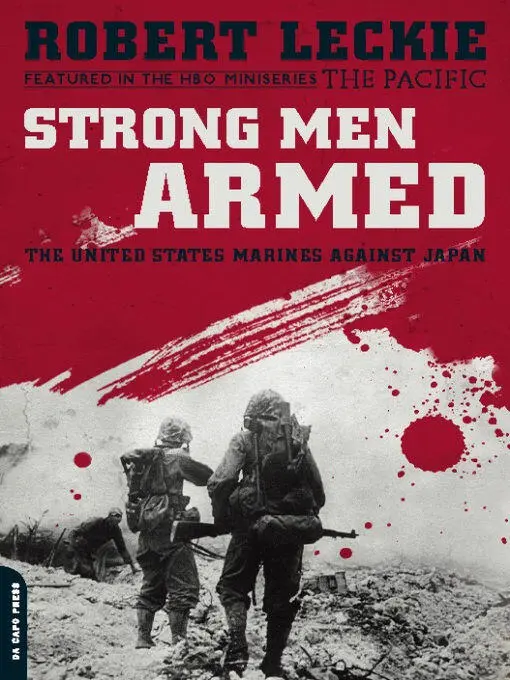
- Название:Strong Men Armed
- Автор:
- Издательство:Da Capo Press
- Жанр:
- Год:2010
- Город:Cambridge
- ISBN:978-0-786-74832-7
- Рейтинг книги:3 / 5. Голосов: 1
-
Избранное:Добавить в избранное
- Отзывы:
-
Ваша оценка:
Strong Men Armed: краткое содержание, описание и аннотация
Предлагаем к чтению аннотацию, описание, краткое содержание или предисловие (зависит от того, что написал сам автор книги «Strong Men Armed»). Если вы не нашли необходимую информацию о книге — напишите в комментариях, мы постараемся отыскать её.
Strong Men Armed — читать онлайн бесплатно полную книгу (весь текст) целиком
Ниже представлен текст книги, разбитый по страницам. Система сохранения места последней прочитанной страницы, позволяет с удобством читать онлайн бесплатно книгу «Strong Men Armed», без необходимости каждый раз заново искать на чём Вы остановились. Поставьте закладку, и сможете в любой момент перейти на страницу, на которой закончили чтение.
Интервал:
Закладка:
At five minutes before midnight, a Japanese officer staggered out of the swamp. He waved a saber in one hand, a big flare in the other. Stumbling into view behind him, wielding their rifles and light machine guns, as well as pitchforks, idiot sticks, baseball bats and broken bottles, came his saki -mad followers. A Marine spoke into a telephone:
“Commence firing!”
Maniacal voices began bellowing over the mouth of Orote Peninsula. The ground shook. Flares cast their ghostly light. Puttee-taped legs, khaki-clad arms, went flying through the air. The ground to the left front became a slaughter-pen. Within it the Japanese began to run amuk. They screamed in terror. Those who survived fled back into the mangroves, where the Marine artillery pursued and punished. Between midnight and two in the morning, 26,000 shells were poured into the swamp.
Forty-five minutes later another banzai began on the far right flank with the cry of, “Marines, you die!”
The Japanese rushed in among the Marine foxholes, where flares and star-shells displayed them in all their drunken madness. They reeled about. They tossed grenades into foxholes with the giggling cry, “Fire in the hole!”—and lurched crazily on. They clambered over heaps of their own dead to jump into the holes with the Marines, to die there—and often to kill as they died. Waves of attackers following them were caught in a crossfire and cut to pieces. Morning showed 400 Japanese bodies strewn in front of this position. On the First Brigade’s left, a single platoon killed 258 Japanese without the loss of a single man.
Commander Tamai’s attack had failed utterly.
But up in the north, Lieutenant General Takashina’s counterattack was breaking through.
Takashina’s grand banzai came in three columns, and it was only the first—and strongest—of these which had no success.
This stroke was made around midnight by the full force of the 48th Brigade on the left of the American line, the sector held by the Third Marines reinforced by the Second Battalion, Ninth Marines. It was against this last battalion that the 48th Brigade struck.
But the 48th never got through.
Seven times the Japanese attacked the American left, and seven times they were hurled back.
The fight raged for ten hours and was not spent until around nine in the morning of July 26. Before it was over the Second Battalion, Ninth Marines, was cut in half—but its men had killed 950 Japanese. Captain Louis Wilson of F Company was wounded three times, but stayed to rally his men and win a Medal of Honor. Once the bull-chested Wilson ran 50 yards in front of his lines to rescue a helpless Marine. As the battle began to go against the enemy, he gathered 17 men and led them in a rush on high ground commanding his own position. Thirteen of those men fell, but Wilson and the others took the hill.
In the morning they pursued the retreating Japanese from there, moving through assembly areas cluttered with empty bottles and saki-sour canteens.
Takashina’s second column was formed by the 2nd Battalion, 18th Regiment, led by Major Chusa Maruyama.
Maruyama brought his men up to the soft spot discovered by the probes of earlier patrols. It was held by a 50-man company of the First Battalion, Twenty-first Marines, and stood at the left-center of the American line. At four in the morning of July 26, Maruyama ordered his men to throw grenades.
They fell in a hissing volley behind and among the Marines.
“Wake up, American, and die!” the Japanese yelled, and rushed.
So tightly were they bunched, so oblivious were they to the death that swept among them, that they overwhelmed that undersized company and ripped a hole in the lines. The flanking Marine companies bent back their flanks. The left held by Captain William Shoemaker’s A Company beat back Maruyama’s attempts to widen the hole. Shoemaker went among his men. “If we go, the whole beachhead goes,” he told them. But a rumor swept the lines. Company A was being ordered to withdraw, some men whispered. Shoemaker heard it. He leaped to his feet, a big man bulging at the seams of his captured Japanese raincoat. His voice roared out in the dark.
“By God, we hold here!”
They held. On the right of the opening, Captain Henry Helgren’s C Company was also holding. Both outfits began pouring an enfilading fire into Maruyama’s men racing through the narrow hole. The Japanese were dashing for the beach and the massed American equipment back there. Some of them ran with land mines in their hands. Others had packs stuffed with 20 pounds of explosives or had charges strapped to their legs or wound around their waists. The Marine fire struck them and the rain-swept blackness was illuminated with blinding white flashes as these human bombs blew up. But many others got through, sweeping down on Marine tanks parked to the rear.
They attacked the tanks with their bare hands. They kicked them, beat upon them with their fists, backed off and fired useless rifle rounds against them—all in an effort to get at the crewmen within—Marines who were even then swiveling machine guns to shoot the squat tan men off each other’s tanks with the aplomb of cows mutually switching flies off one another’s backs.
Unable to destroy the tanks, Maruyama’s men ran farther down the draw. They came to the cliff, destroyed two platoons of Marine mortars, and began attacking the First Battalion’s CP, their drunken yells and the booming of their grenades counterpointing the shouts and firing of a pick-up force of Marine cooks, clerks and communicators which had been assembled to counterattack them. The CP fight—in which Maruyama was killed—ended at daylight with the destruction of the Japanese soldiers who had broken through.
Up at the opening which they had torn in the Marine line, Captain Shoemaker and Captain Helgren were counterattacking. They fought back across the hole, slamming it shut like a pair of swinging doors. A company of engineers and three weapons platoons were sent to reinforce them. They arrived just before Maruyama’s reserve struck at the restored line in a second thrust.
Howling, stumbling, waving sabers, bayonets and long poles, the Japanese rushed at Shoemaker’s and Helgren’s men and were destroyed.
The left-center of the Marine line was now safe.

The third column of Takashina’s banzai was formed by the 3rd Battalion, 18th Regiment, under Major Setsuo Yukioka.
Shortly after Maruyama’s stroke began, at about a quarter after four in the morning, Yukioka’s men struck a company of the Twenty-first Marines on the center-right. They captured two machine guns, but then the Americans re-formed and drove them out. Yukioka took his battalion sliding along the Marine front, and it was then that they blundered into that 800-yard gap between the Twenty-first Marines in the center and the Ninth Marines on the right.
They swarmed through, following lantern-bearing scouts.
A Marine roadblock began firing on the right flank of the Japanese column, and Yukioka’s men wheeled right and overran the roadblock. They moved farther to the rear, the main body setting up a position on high ground behind the Third Battalion, Twenty-first, the men of the demolition squads continuing to move down the ravines toward the beach and the Division Hospital.
The Japanese soldiers on the high ground began striking the rear of the Third Battalion, Twenty-first, commanded by Lieutenant Colonel Wendell Duplantis. Duplantis asked Division for artillery. It was refused, for it might fall on friendly troops. Instead, Company L was taken out of the Ninth Marines reserve and ordered to counterattack Yukioka.
Читать дальшеИнтервал:
Закладка:
Похожие книги на «Strong Men Armed»
Представляем Вашему вниманию похожие книги на «Strong Men Armed» списком для выбора. Мы отобрали схожую по названию и смыслу литературу в надежде предоставить читателям больше вариантов отыскать новые, интересные, ещё непрочитанные произведения.











Обсуждение, отзывы о книге «Strong Men Armed» и просто собственные мнения читателей. Оставьте ваши комментарии, напишите, что Вы думаете о произведении, его смысле или главных героях. Укажите что конкретно понравилось, а что нет, и почему Вы так считаете.