Robert Leckie - Strong Men Armed
Здесь есть возможность читать онлайн «Robert Leckie - Strong Men Armed» весь текст электронной книги совершенно бесплатно (целиком полную версию без сокращений). В некоторых случаях можно слушать аудио, скачать через торрент в формате fb2 и присутствует краткое содержание. Город: Cambridge, Год выпуска: 2010, ISBN: 2010, Издательство: Da Capo Press, Жанр: nonf_military, на английском языке. Описание произведения, (предисловие) а так же отзывы посетителей доступны на портале библиотеки ЛибКат.
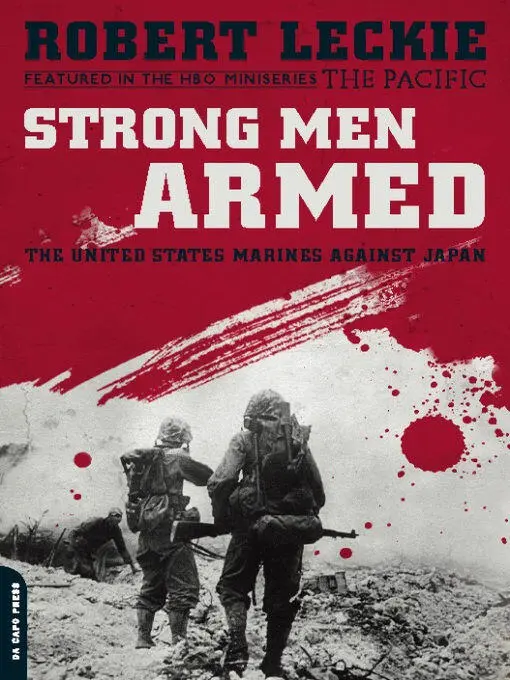
- Название:Strong Men Armed
- Автор:
- Издательство:Da Capo Press
- Жанр:
- Год:2010
- Город:Cambridge
- ISBN:978-0-786-74832-7
- Рейтинг книги:3 / 5. Голосов: 1
-
Избранное:Добавить в избранное
- Отзывы:
-
Ваша оценка:
Strong Men Armed: краткое содержание, описание и аннотация
Предлагаем к чтению аннотацию, описание, краткое содержание или предисловие (зависит от того, что написал сам автор книги «Strong Men Armed»). Если вы не нашли необходимую информацию о книге — напишите в комментариях, мы постараемся отыскать её.
Strong Men Armed — читать онлайн бесплатно полную книгу (весь текст) целиком
Ниже представлен текст книги, разбитый по страницам. Система сохранения места последней прочитанной страницы, позволяет с удобством читать онлайн бесплатно книгу «Strong Men Armed», без необходимости каждый раз заново искать на чём Вы остановились. Поставьте закладку, и сможете в любой момент перейти на страницу, на которой закончили чтение.
Интервал:
Закладка:
“Men, this is General Geiger. The eyes of a nation watch you as you go into battle to liberate this former American bastion from the enemy. Make no mistake, it will be a tough, bitter fight against a wily, stubborn foe who will doggedly defend Guam against this invasion. May the glorious traditions of the Marine esprit de corps spur you to victory. You have been honored.”
The general’s voice ceased. “The Marines’ Hymn” crashed out and the men began to go over the side.
It was an unusual D-Day morning, almost a theatrical one, but the Marines wanted Guam badly. Some of the NCO’s and officers going over the side had served there. Many of them had buddies among the 153 Marines who were taken prisoner when Guam surrendered. The recapture of Guam would heal an old hurt.
At eight o’clock the Third Division’s first wave had made the transfer from landing boats to amtracks. The men crouched low as the ungainly craft fanned out and roared ashore, heading for those beaches lying between the “devil’s horns” of Adelup Point on the left, Asan Point on the right. At eight-twenty an air observer reported:
“The rockets are landing and giving them hell. Good effect on beach. Landing craft seem to be about one thousand yards from beach.”
Seven minutes later came this report:
“First wave two hundred yards from beach.”
Naval gunfire lifted and began pounding targets inland. At eight thirty-three the air observer reported:
“Troops ashore on all beaches.”
The Marines had returned to Guam, and already, the sands below the bleak white face of Chonito Cliff were streaked crimson with their blood.
About six miles to the south, underneath Orote Peninsula, which formed the lower land arm of Apra Harbor, the First Brigade attacked with both regiments abreast. And heavy as the Guam bombardment had been, it had not knocked everything out. Japanese 75’s and 37’s were firing as the men of the Fourth and Twenty-second Marines rode their amtracks shoreward. Before the amphibians had waddled up on the sand, 24 of them were knocked out. Casualties mounted, and there was no one to care for them. Doctors and corpsmen were the heaviest hit. One battalion’s aid station took a direct hit from a 75 which killed and wounded all but one man.
Corpsman Robert Law saw a shellburst spread eight Marines around him. One of the men had a shattered leg and his life’s blood was spouting carmine from it. Law gave the man morphine. The man smiled and asked for something to hold. Law shoved clods of earth into his hands. He pulled out his combat knife and began to amputate the leg. The Marine squeezed the clods of earth to dust. But he made no sound. Law bandaged the stump. When he glanced up, the Marine smiled at him again. Then he sank into unconsciousness.
On the left, the Twenty-second Marines under Colonel Merlin Schneider were charging toward the rubble of Agat Village. Captain Charles Widdecke began to lead his company around Bob’s Hill, a mound overlooking the town. Machine-gun fire knocked them flat. They took cover in a trench. They dug in, expecting to stay there for the night. Down a trail straight toward them marched a dozen Japanese carrying the very machine guns which had pinned the Marines down. There was the crackling of American guns. The Japanese were slammed to earth and the way to the village was clear.

On the right, Colonel Alan Shapley’s Fourth Marines drove toward Mount Alifan, about 2,000 yards inland. They passed through a grove of palm trees and concealed snipers. Sherman tanks led them through a maze of pillboxes and blockhouses. They sprinted through the slippery muck of a rice paddy, leaping across its myriads of tiny interlacing streams. They ran the gantlet of machine-gun fire and mortar shells, they threaded the strong points of Alifan’s foothills while the lumbering tanks bucked and roared and sealed off cave after cave, and by nightfall they held a beachhead a mile deep.
Behind that beachhead, “The Old Bastards” were wading ashore.
They were not really so old, these dogfaces of the 77th Division’s 305th Infantry Regiment. But they were in their late twenties, something like an average of four to six years older than their youthful comrades in the First Marine Brigade.
They had to wade into the southern beaches from the reef simply because the Marine amtracks had suffered heavy losses and they had none of their own. Fortunately, the young bastards ahead of them were busily cleaning out the enemy. The soldiers had only the discomfort of waist-high water and occasional potholes to hinder their walk ashore. The entire regiment was on land by nightfall, the last to arrive being its commander, Colonel Vincent Tanzola, who was saved from being stranded on the reef when a rubber boat drifted by. He grabbed it and paddled ashore.
The southern force had the situation in hand.
“Our casualties about 350,” General Shepherd signaled General Geiger at half-past six. “Critical shortage fuel and ammunition all types. Think we can handle it.”
But up north, the Third Division was fighting hard for its beachhead.
By noon of July 21, there were two battalions of the Twenty-first Marines atop the central height which frowned down on the Asan-Adelup beachhead.
Colonel Arthur Butler had discovered a pair of defiles to either side of the hill. He sent a battalion up each of these passes while a third battalion swept the ground below the cliff.
It was a fight all the way up, the men of the ascending battalions all but melting under the combination of fierce heat and the long debilitating weeks aboard ship. Gasping for breath, their dungarees dark with sweat, they tumbled among the rocks and boulders and lay where they fell. NCO’s and officers dragged them erect and sent them climbing again-to be savaged by crisscrossing Japanese machine-gun fire or blown to bits by the grenades which the enemy rolled among them.
But they reached the top, linked up, and drove forward.
On their right, the Ninth Marines were moving swiftly through easier terrain, and lighter resistance. They attacked with artillery firing in support, for the northern landings had been such near-perfection that there were 105’s ashore by noontime. They had been brought over the reef in “ducks”—those amphibian trucks developed by the Army-and unloaded by A-frames mounted on accompanying ducks. By midafternoon Chonito Cliff had been overrun in the center and the right.
But on the left the Third Marines were being torn apart.
The steep sheer seaward face of Chonito Cliff winked with the muzzle-blasting of Japanese machine guns as the Third moved beneath it toward Adelup Point. The Japanese pulled back only after the Point had fallen, and then the most savage fighting of the Guam campaign began. It was here that the Third Marines lost 815 killed and wounded within forty-eight hours, among them two Medal of Honor winners-Pfc. Leonard Mason, who died destroying a pair of machine-gun posts, and Pfc. Luther Skaggs, whose leg was shattered as he took command of a mortar section and led it forward to annihilate a Japanese pocket.
It took four days for the Third Marines to clean out their sector and make contact with the Twenty-first Marines on their right. It also took four days for all of the division’s regiments to drive forward and establish the Asan-Adelup beachhead to a depth of about a mile and a width of 6,000 yards. By then, the First Brigade to the south had expanded the Agat beachhead, had turned its sector over to the 77th Division and had marched north to the mouth of Orote Peninsula and sealed off the Japanese there.
By then also Lieutenant General Takashina was satisfied that the Americans at Asan-Adelup had all their supplies and equipment ashore and that he could now destroy them at one blow as he had planned to do. Takashina had already begun to assemble his units on the Fonte Plateau just east of the Asan-Adelup perimeter. His suicide troops had infiltrated the Marine lines with explosives strapped around their waists or stuffed in packs. They were, in effect, human bombs. Their mission was to destroy the American artillery, tanks and transport.
Читать дальшеИнтервал:
Закладка:
Похожие книги на «Strong Men Armed»
Представляем Вашему вниманию похожие книги на «Strong Men Armed» списком для выбора. Мы отобрали схожую по названию и смыслу литературу в надежде предоставить читателям больше вариантов отыскать новые, интересные, ещё непрочитанные произведения.












Обсуждение, отзывы о книге «Strong Men Armed» и просто собственные мнения читателей. Оставьте ваши комментарии, напишите, что Вы думаете о произведении, его смысле или главных героях. Укажите что конкретно понравилось, а что нет, и почему Вы так считаете.