Robert Leckie - Strong Men Armed
Здесь есть возможность читать онлайн «Robert Leckie - Strong Men Armed» весь текст электронной книги совершенно бесплатно (целиком полную версию без сокращений). В некоторых случаях можно слушать аудио, скачать через торрент в формате fb2 и присутствует краткое содержание. Город: Cambridge, Год выпуска: 2010, ISBN: 2010, Издательство: Da Capo Press, Жанр: nonf_military, на английском языке. Описание произведения, (предисловие) а так же отзывы посетителей доступны на портале библиотеки ЛибКат.
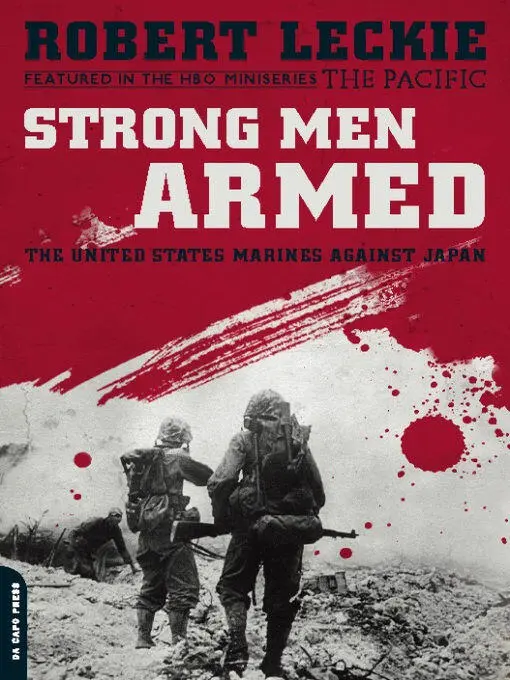
- Название:Strong Men Armed
- Автор:
- Издательство:Da Capo Press
- Жанр:
- Год:2010
- Город:Cambridge
- ISBN:978-0-786-74832-7
- Рейтинг книги:3 / 5. Голосов: 1
-
Избранное:Добавить в избранное
- Отзывы:
-
Ваша оценка:
Strong Men Armed: краткое содержание, описание и аннотация
Предлагаем к чтению аннотацию, описание, краткое содержание или предисловие (зависит от того, что написал сам автор книги «Strong Men Armed»). Если вы не нашли необходимую информацию о книге — напишите в комментариях, мы постараемся отыскать её.
Strong Men Armed — читать онлайн бесплатно полную книгу (весь текст) целиком
Ниже представлен текст книги, разбитый по страницам. Система сохранения места последней прочитанной страницы, позволяет с удобством читать онлайн бесплатно книгу «Strong Men Armed», без необходимости каждый раз заново искать на чём Вы остановились. Поставьте закладку, и сможете в любой момент перейти на страницу, на которой закончили чтение.
Интервал:
Закладка:
In two groups, one bound for the western beaches, the other for those on the east, they paddled softly to within 500 yards of their objectives. Then they slipped into the water and swam the rest of the way, floating silently past parties of Japanese engaged in mining work.
They found that the eastern beaches were a wicked labyrinth of boat-blocks, underwater mines and barbed wire, set among natural obstacles of boulders, potholes and 20-foot cliffs. But on the west were two narrow beaches to either side of a cliff. One was 60 yards wide, the other 150 yards.
It did not seem possible to land a regiment, let alone two full Marine divisions, on such abbreviated beaches, but they were judged acceptable by the new Fifth Corps commander, Major General Harry Schmidt.
Schmidt had taken over after Lieutenant General Smith had been made commander, Fleet Marine Force, Pacific. Schmidt had handed his Fourth Division over to the aristocratic Major General Clifton Cates, a veteran of World War One and a regimental commander on Guadalcanal. The Fourth would be in assault while the Second Marine Division sailed down to Tinian Town to make a feint off the fortified southwest beaches. Then the Second would turn around and land behind the Fourth.
Schmidt was making an armored battering ram of that Fourth Division. He gave it the Second’s tanks and artillery, and he would send it in with all of Saipan’s guns banging away. The Marines would move from shore to shore in landing boats. The invasion was scheduled for July 24, which was three days after the assault on Guam.
“Guam? Goddamit, man, these men have had Guam until it’s been comin’ out their ears!”
So spoke a Marine officer to a war correspondent, and he spoke the truth. For weeks and weeks on end these men of the Third Marine Division and First Marine Brigade had looked at maps of Guam and listened to lectures on it. They knew by heart, now, that Guam had been American for forty years before the Japanese landed there on December 10, 1941; that this peanut-shaped island 32 miles long and four to eight miles wide was the biggest and most populous of the Marianas; and that its Chamorro inhabitants were deeply loyal to the United States, for which fidelity-including their reluctance to learn Japanese or to use the official new name of Omiya Jima, “Great Shrine Island”—they had come under fierce persecution, their schools and churches closed, their priests tortured and murdered, their men beheaded for so much as a smile at the sight of a U.S. plane. The Marines also learned that the general objectives of their assault were all on Guam’s west coast—the former U. S. Navy Yard at Piti, the old Marine barracks and airfield on Orote Peninsula, Apra Harbor and the coastal city of Agana. By the time the news of the fall of Saipan reached them, they had become so familiar with their individual objectives that they talked of them with the familiarity of hometown landmarks.
News of Saipan’s fall, however, did not immediately release the Guam invasion force from the slack-jawed tedium of shipboard life in Eniwetok Lagoon. The high casualties suffered at Saipan had impressed Major General Roy Geiger, the Guam commander. He thought he would need about 40,000 troops to overwhelm the 19,000 men comprising the Japanese 29th Infantry Division and other units commanded by Lieutenant General Takeshi Takashina. Geiger asked for and was given the 77th Infantry Division then in Hawaii. It would take two weeks for the 77th to reach Eniwetok, but Geiger did not chafe at the delay. It meant that Guam would receive fourteen full days of naval and aerial bombardment-the heaviest preparation of the war-and there would also be time for the Underwater Demolition Teams to clear the landing beaches.
Geiger planned landings on either side of Apra Harbor, just as the Japanese had landed. Major General Allen Turnage’s Third Division would land above Apra on the north. Below it, on the south, the First Brigade was to come ashore under Brigadier General Lemuel Shepherd of Cape Gloucester fame. When the two outfits joined, all of Guam’s military facilities would have been enveloped, and the way would be clear for the First Brigade to push out on Orote Peninsula to the west. The 77th Division would be in reserve.
And while that 77th Division was sailing for Eniwetok, the men who were already there had turned the lagoon into a floating slum. All over the weather decks of the LST’s the Marines had set up tents, or slung ponchos and spread tarpaulins between themselves and the blistering sun. Their bedding was strewn everywhere. Men gasped in the heat and scratched prickly rashes. They made betting pools on the number of days they would be aboard ship before they landed (those holding numbers 48 to 52 were the winners) and they imposed careful cigarette rationing on themselves, while giving the clothes they wore fewer and fewer washings, for they had begun to fray.
Each day officers herded these bored and enervated Marines together and took them ashore in landing boats. They ran up to the reef and piled out. They waded ashore. They walked over the little islets and felt the burning coral through the thinning soles of their boondockers. Then they waded out to the reef again and went back to the ships—to ennui relieved only by a surprisingly inexhaustible supply of ice cream or an occasional good joke.
Such as that morning on which a group of Marines waded back to their boat:
“Anyone here from Texas?” one of the coxswains called.
A corporal brightened and pushed back his helmet.
“Ah’m from Lubbock,” he said, his voice proud and expectant.
The coxswain grinned impishly.
“You can swim out, mate,” he said.
They were laughing, too, on Pavuvu.
Chesty Puller had contributed another Pullerism to his legend. He had been made a full colonel and had taken command of the First Marine Regiment. And then some comfort-loving clod of a quartermaster officer had issued Chesty Puller’s men sleeping pads. They were all of a half-inch thick and to the comfort-hating Puller they were as corrosive and beguiling as the soft voices of sirens in the ears of Ulysses’ men. Chesty Puller ordered the pads gathered up and thrown into the bay.
“Goddamit,” he raged, “are they trying to make sissies out of my men?”
There were rubber boats standing off Tinian’s southern shore. There were 12 of them. They were filled with Japanese officers. Among them was a huge figure. Vice Admiral Kakuji Kakuda was more than six feet tall and his bulk of more than 200 pounds was big even by Western standards. By all standards, bald and burly Kakuda was a coward and a drunk.
He was the commander of the First Air Fleet on Tinian, but Kakuda could no more command than he could stop swilling saki or scheming for his own safety.
On this night of July 15 he had collected his headquarters staff and begun to paddle south toward Aguijan Island and the rendezvous he had arranged with a Japanese submarine. But the sub did not show up.
Admiral Kakuda paddled back to Tinian. He tried again for three more nights. Still the submarine did not appear. On the night of July 20 an American gunboat almost sent Kakuda’s rubber-boat flotilla to the bottom. The admiral retired in dismay. He hastened to a well-armored dugout on the eastern side of the island, and was never heard from again.
That was on July 21, the day the Americans came back to Guam.
10
There had been a typhoon scare.
Admiral Spruance had asked Close-in Conolly if he planned to postpone the Guam landings to avoid the typhoon headed his way. But Conolly’s weather officer assured him that July 21 would be a perfect day for landings.
It was. It dawned clear and slightly overcast, with a light wind and calm sea, and in that dawn a voice came over the bullhorns of the transport ships.
Читать дальшеИнтервал:
Закладка:
Похожие книги на «Strong Men Armed»
Представляем Вашему вниманию похожие книги на «Strong Men Armed» списком для выбора. Мы отобрали схожую по названию и смыслу литературу в надежде предоставить читателям больше вариантов отыскать новые, интересные, ещё непрочитанные произведения.











Обсуждение, отзывы о книге «Strong Men Armed» и просто собственные мнения читателей. Оставьте ваши комментарии, напишите, что Вы думаете о произведении, его смысле или главных героях. Укажите что конкретно понравилось, а что нет, и почему Вы так считаете.