Robert Leckie - Strong Men Armed
Здесь есть возможность читать онлайн «Robert Leckie - Strong Men Armed» весь текст электронной книги совершенно бесплатно (целиком полную версию без сокращений). В некоторых случаях можно слушать аудио, скачать через торрент в формате fb2 и присутствует краткое содержание. Город: Cambridge, Год выпуска: 2010, ISBN: 2010, Издательство: Da Capo Press, Жанр: nonf_military, на английском языке. Описание произведения, (предисловие) а так же отзывы посетителей доступны на портале библиотеки ЛибКат.
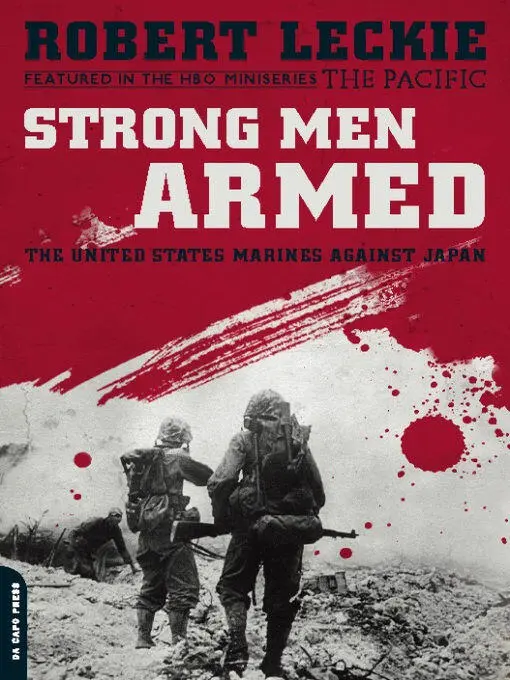
- Название:Strong Men Armed
- Автор:
- Издательство:Da Capo Press
- Жанр:
- Год:2010
- Город:Cambridge
- ISBN:978-0-786-74832-7
- Рейтинг книги:3 / 5. Голосов: 1
-
Избранное:Добавить в избранное
- Отзывы:
-
Ваша оценка:
Strong Men Armed: краткое содержание, описание и аннотация
Предлагаем к чтению аннотацию, описание, краткое содержание или предисловие (зависит от того, что написал сам автор книги «Strong Men Armed»). Если вы не нашли необходимую информацию о книге — напишите в комментариях, мы постараемся отыскать её.
Strong Men Armed — читать онлайн бесплатно полную книгу (весь текст) целиком
Ниже представлен текст книги, разбитый по страницам. Система сохранения места последней прочитанной страницы, позволяет с удобством читать онлайн бесплатно книгу «Strong Men Armed», без необходимости каждый раз заново искать на чём Вы остановились. Поставьте закладку, и сможете в любой момент перейти на страницу, на которой закончили чтение.
Интервал:
Закладка:
“Blow up, you son of a bitch!” a Marine yelled.
The bomber did blow up, and a yell of fierce delight rose from the throats of thousands of Americans who had been watching the plane’s descent. Then the crackling of small arms and the booming of artillery signaled that the attack to the north was still running into enemy resistance.
6
Even with Tapotchau captured, the attack to the north could not become an all-out lunge until the three divisions had spent some time shifting, pinching out, and tidying up the front.
In the days between the mop-up of Nafutan Point on June 27 and resumption of full-scale attack on July 1, the Fourth Marine Division on the right or eastern flank had to clean out Kagman Peninsula before it pushed still farther north.
In the center the 27th Infantry Division still had difficulty moving, and General Jarman relieved one of his regimental commanders. By July 1, however, the 27th had drawn even with the Marines on both flanks and had also received a new commander-Major General George Griner.
On the left the Second Marine Division held fast on the coast beneath Garapan while it hit slowly through The Pimples, the four hills north of Tapotchau. Once The Pimples had been passed, the Second would hurl one regiment into Garapan—now flattened by naval gunfire-while the other units swung left or northwest into Tanapag Harbor just above the city.
Also during this interval the Guam invasion was postponed and the Third Marine Division was sent back to Eniwetok Lagoon while the First Marine Brigade was held in floating reserve. Saipan had been much too tough to allow the Guam landings to proceed. The Japanese had fought with a doggedness and skill which had slowed the American advance beyond expectation. Without water, forced to chew leaves and eat snails or hunt big tree frogs, the Emperor’s soldiers had made the invaders’ life a hell of exploding shells and flying rock splinters.
But the invaders had also taken a fierce toll among the defenders and Howlin’ Mad Smith was confident that his renewed assault would quickly overrun the northern half of Saipan. On June 29, Smith and General Watson of the Second Division went up to Mount Tapotchau to study the terrain Watson’s men would be attacking two days later. It was nearly their last look at any terrain, for Japanese mortars began crashing around them. They jumped from their jeep and ran for a foxhole, waiting there until the barrage stopped-and then quickly departing Tapotchau.
Next day a fierce American mortar barrage produced the same effect upon Lieutenant General Saito. He pulled back to his sixth and last headquarters, another cave, and the main body of his, troops began retreating north to new positions.
The following day—July 1—the Second Marines attacked Garapan and found hardly a building intact in a city that had once housed 15,000 people. Hanging everywhere among the ruins, making a poignance of the desolation, were thousands of bright silk obis, the sashes which Japanese women bind about their midriffs and which the women of Garapan left behind in their flight to the north. Only occasional snipers hidden beneath scraps of iron roofing, or machine guns holed up in ruined buildings, delayed the first day’s advance of the Third Battalion, Second, commanded by Major Harold Throneson. But during the night 200 Japanese slipped back into Garapan’s rubble to set up machine guns.
Throneson’s men routed them next day after vicious fighting. By dusk the Marines held the lower half of the city. A command post had been set up on “Broadway” across the street from the ruined Bank of Taiwan and alongside a Spanish-style Catholic Church which was one of the few buildings still undamaged. Some of the Marines went in. They paused, shocked. Up on the altar was a plaster statue of Christ with the face blown away.
Underneath Sugar Loaf Hill in the foothills to the right or east of Garapan the face of a young Marine had been blown away. An enemy gunner had shot him as he slithered forward over a rock. The bullet tore off the top of his head and sent his helmet clanging against the rocks. Blood spattered on a nearby sergeant.
“Goddam it, Mac!” the sergeant roared to everyone with hearing. “Let’s go up and get those bastards!”
They went up, hanging onto stone knobs with one hand, hurling grenades with the other-sometimes shot from their holds and dropped to the boulders below-but going up, up and over, cleaning out the caves and taking Sugar Loaf Hill.
Then they descended on Garapan to the west. They fought into Royal Palm Park and gaped at the 40-foot stone shaft supporting the figure of a Japanese statesman. He wore western dress. He was 10 feet tall.
“Hell’s fire!” a Marine swore with fervent irreverence. “This must be the guy that told ‘em they was bullet-proof!”
The conquerors of Tapotchau and The Pimples were coming down from the mountains. Their faces were smeared with dirt and grimy with beard stubble. Their dungarees were stiff with sweat and dried earth. Their hands were black. They were walking as wooden men with leaden feet. But now, those dull sunken eyes were beginning to gleam. For they had seen the blue beckoning water of Tanapag Harbor, and the tanks had begun to lead them down the last hills to the canefields below.
And there were the Japanese-running.
They were being flushed from their foxholes by the roaring 75’s of the Shermans. They were in full view, and the Marines were rushing down the hill, dropping to their knees, firing, jumping up and running forward to fire again, their gaunt faces suddenly alive with victory, their eyes glittering with a fierce joy.
They came down the hill and swept through the canebrake and halted a few hundred yards short of the harbor, while to their left rear the Marines in Garapan began attacking up to them.
“Slaughterhouse is back!” a Marine sergeant in Garapan yelled, and the men of the Third Battalion, Second, understood him to mean that Lieutenant Colonel Arnold Johnston had returned to command them. Johnston had brought the battalion into Saipan, had been wounded twice and then evacuated. But now, on the morning of July 3, he had rejoined the outfit and taken over from Major Throneson.
“Crazy Gyrene bastard!” the sergeant swore. “He’s dead but he won’t lie down. He’s back there stompin’ around on one gimp leg and a Jap cane.”
He was, and Lieutenant Colonel John Easley had also come back for the attack to the harbor. He had been wounded on D-Day while leading the Third Battalion, Sixth, ashore. There were many men in the ranks like Johnston and Easley fighting up to Tanapag with bandaged bodies, helping to overrun the few snipers standing between themselves and the big seaplane base the Japanese had built there.
They reached it just before dusk. It was deserted. There were only the darkening burned-out bulks of eight Kawanishi four-engined bombers. There was only silence and offshore the black silhouettes of the transports they had not seen since June 15.
The Marines waded out into the harbor and bathed their faces.
“Son of a bitch!” one of them exclaimed. “If tomorrow ain’t the Fourth of July!”
7
There was no longer any hope for either Lieutenant General Yoshitsugu Saito or Vice Admiral Chuichi Nagumo or the men they commanded. Their food and ammunition were spent-as were their bodies-and by July 5 they held only the northern third of Saipan. The airfield which Saito and Nagumo had ordered completed at Marpi Point was now a shambles.
“General Saito is not going to get away in an airplane if we can help it,” said Howlin’ Mad Smith on July 5, and the American artillery wrecked the little field. Shelling also had destroyed communications between Nagumo and Saito, and yet, on July 6, these separated commanders had come to the same conclusion: it was now time for the samurai or nobleman to make the final gesture.
Читать дальшеИнтервал:
Закладка:
Похожие книги на «Strong Men Armed»
Представляем Вашему вниманию похожие книги на «Strong Men Armed» списком для выбора. Мы отобрали схожую по названию и смыслу литературу в надежде предоставить читателям больше вариантов отыскать новые, интересные, ещё непрочитанные произведения.











Обсуждение, отзывы о книге «Strong Men Armed» и просто собственные мнения читателей. Оставьте ваши комментарии, напишите, что Вы думаете о произведении, его смысле или главных героях. Укажите что конкретно понравилось, а что нет, и почему Вы так считаете.