Robert Leckie - Strong Men Armed
Здесь есть возможность читать онлайн «Robert Leckie - Strong Men Armed» весь текст электронной книги совершенно бесплатно (целиком полную версию без сокращений). В некоторых случаях можно слушать аудио, скачать через торрент в формате fb2 и присутствует краткое содержание. Город: Cambridge, Год выпуска: 2010, ISBN: 2010, Издательство: Da Capo Press, Жанр: nonf_military, на английском языке. Описание произведения, (предисловие) а так же отзывы посетителей доступны на портале библиотеки ЛибКат.
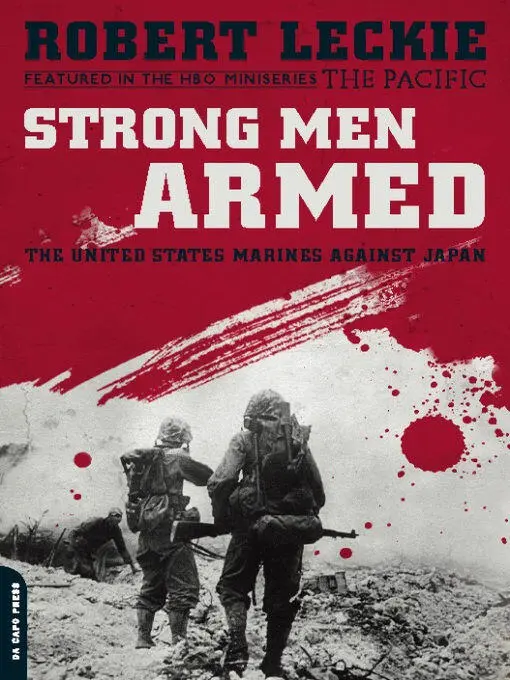
- Название:Strong Men Armed
- Автор:
- Издательство:Da Capo Press
- Жанр:
- Год:2010
- Город:Cambridge
- ISBN:978-0-786-74832-7
- Рейтинг книги:3 / 5. Голосов: 1
-
Избранное:Добавить в избранное
- Отзывы:
-
Ваша оценка:
Strong Men Armed: краткое содержание, описание и аннотация
Предлагаем к чтению аннотацию, описание, краткое содержание или предисловие (зависит от того, что написал сам автор книги «Strong Men Armed»). Если вы не нашли необходимую информацию о книге — напишите в комментариях, мы постараемся отыскать её.
Strong Men Armed — читать онлайн бесплатно полную книгу (весь текст) целиком
Ниже представлен текст книги, разбитый по страницам. Система сохранения места последней прочитанной страницы, позволяет с удобством читать онлайн бесплатно книгу «Strong Men Armed», без необходимости каждый раз заново искать на чём Вы остановились. Поставьте закладку, и сможете в любой момент перейти на страницу, на которой закончили чтение.
Интервал:
Закладка:
Commander Blanchard retracted his periscope and made plans to attack. He calculated the range and ordered a spread of six torpedoes prepared. Then something went wrong with the torpedo data computer. The “Correct Solution” light refused to flash—and Taiho was fast moving out of range.
Blanchard upped periscope and fired by sight.
Then he sent Albacore plunging down deep and awaited the arrival of both the enemy destroyers and the sound of a torpedo explosion.
They came swiftly-three destroyers and one great explosion.
Blanchard was disappointed. He could never hope to sink the biggest enemy carrier he had ever seen with a single torpedo.
The quarter-hour had passed and Cavalla was up to periscope depth.
There were four planes on the starboard bow. But they did not molest Cavalla. Kossler watched. He saw the mast of a destroyer over the horizon. He moved to his right. He saw the mast of a carrier. She was taking on planes. She was not as big as the monster he had seen last night, but she would still rate around the 22,000-ton Shokaku class. Wanting to be sure she was Japanese, Kossler came in closer.
“Goddam!” he exploded when the ship’s flag came into view. “It’s the Rising Sun-big as hell!”
Cavalla began firing torpedoes. She got four off in rapid succession and another pair as she began to submerge.
Going down, Kossler heard three of his fish hit. And then he heard and felt the wrath of the Japanese depth-charges. For two hours the enemy worked Cavalla over, while above the surface mighty Shokaku was a holocaust of burning gasoline and exploding bombs.
At about three o’clock in the afternoon Cavalla’s sound gear picked up monstrous water noises. Kossler and his crewmen heard great concussions.
“That damn thing is sinking,” Kossler said.
He was right. One of Shokaku’s bomb magazines had exploded and the big ship fell apart and sank.
A single torpedo hit did not alarm Admiral Ozawa, nor should it have. Taiho was much too big, much too modern, to be so easily knocked out.
But aboard her was a damage-control officer who was not very experienced, and after Albacore’s fish had ruptured one of Taiho’s gasoline tanks, the damage-control officer ordered all ventilating ducts turned on full blast while the ship tore ahead at 26 knots. He hoped to blow the fumes away, but he only succeeded in distributing them. He filled Taiho with gasoline fumes, and also the vapors of the crude petroleum then being used for fuel, and he turned her into an enormous floating gas-bomb. All that was needed was friction.
It came at half-past three. Taiho’s flight deck blew up, her hangar sides blew out and her bottom blew down. She rolled over on her left side and sank by the stern, taking with her many airplanes and all but 500 of her 2,150 officers and men. Among those who survived were Admiral Ozawa and his staff.
Carrying the admiral’s flag and a framed portrait of the Emperor, Ozawa and his staff were ferried by lifeboat to the destroyer Wakatsuki. From there Ozawa moved to Zuikaku, and it was aboard this carrier that he received the first of those terrible reports that bore upon his head like hammer blows.
Not only was Taiho lost and Shokaku sunk, but his airplanes and aviators were being torn to bits in the battles which the Americans would derisively name “The Marianas Turkey Shoot.” That day alone Ozawa lost 330 planes, against 30 American craft destroyed—the most resounding single day’s defeat in the history of aerial warfare. Next day he lost a third carrier, Hiyo, plus two tankers, and seven more of his ships were damaged. The airfields on Guam were turned into rubble by the American bombers. He himself was forced to flee toward Okinawa, with Admiral Ugaki following.
There was no rescue at Saipan. In the log of the commander who opened battle June 19 with 430 aircraft on his decks, there was this ominous entry on the night of June 20:
“Surviving carrier air power: 35 aircraft operational.”
The disaster had been even greater. With scout planes and land-based air losses added in, Japan’s defeat in the Battle of the Philippine Sea totaled 476 airplanes destroyed and 445 aviators killed. American losses were three ships damaged and 130 planes lost—80 of these during night landings at the conclusion of the pursuit of the Japanese-and 76 airmen dead.
No nation had ever been so badly beaten in the skies. But Tokyo was already telling the world of the customary magnificent victory, just as Lieutenant General Saito had been telling Tokyo of the splendid successes being scored in the hot, shell-blasted hills south of Mount Tapotchau.
4
During the first four days of the fighting on Saipan it was a rare Marine who had not felt himself slammed to earth by concussion or had not heard the whine of flying steel and rock or the nasty peening of the bullets, for the Japanese holding the foothills masking Mount Tapotchau in central Saipan were fighting with tenacity and skill.
In those first four days the First Battalion, Sixth, lost all but two of its captains and Lieutenant Colonel Bill Jones concealed his grief in the grim joke that to save these two, “I guess I’d better bust ‘em down to second looey.”
In the Fourth Marine Division’s sector, the eastern half of the island, a battered rifleman also made a sardonic estimate of the first ninety-six hours.
“Three times in the past four days,” he said, “my wife has been almost a rich woman. I could see them counting out my insurance money ten dollars at a time and the wife riding downtown in a new Packard roadster with a spotlight on each side.”
The following four days were equally harrowing, especially for the Third Battalion, Twenty-fifth Marines, under Lieutenant Colonel Justice Chambers.
Chambers was known as Jumpin’ Joe for his exuberant style in the field. He looked a bit like a buccaneer, big and raw-boned, with a cut-down bayonet knife dangling from his cartridge belt alongside a .38 revolver stuck in a special quick-draw holster. Under his left armpit was a .45 shoulder holster. If it were not true that Jumpin’ Joe had used these weapons, as a Raider captain under Red Mike Edson, at Kwajalein, and latterly on Saipan, the effect might have been a caricature of what is supposed to be a type of Marine commander.
But Jumpin’ Joe was genuine, as were the men who called themselves Chambers’ Raiders and who spent the last half of their eight days on the line overrunning the defenses around Hill 500.
The hill was actually a clutter of rocky peaks which commanded most of southern Saipan and which also covered the approaches to Mount Tapotchau. It was about a mile inland from the eastern coast. It was pocked with caves filled with machine guns carefully sighted in on the flat, approaching plain.
Chambers got his men across the plain and up to the base of the hill by laying down a covering smokescreen. Before they attacked, the hill’s defenses were showered by 4.5-inch rockets fired by rocket trucks, just appearing in the Pacific War. Then Chambers’ men charged. Hunched, bent-over figures shadowy in the thinning smoke, they went up Hill 500 while artillery shells walked briskly up the slopes ahead of them. Six machine guns gathered in a single cave raked them, but by midafternoon they had taken Hill 500.
“We lost fifty men, but we came a’hellin’ and took our objective,” Jumpin’ Joe Chambers said.
Of these 50 casualties, only nine were killed, although there were more that night when the Japanese counterattacked, waving knives and bayonets lashed to poles—“idiot sticks” as the Marines called them.
Читать дальшеИнтервал:
Закладка:
Похожие книги на «Strong Men Armed»
Представляем Вашему вниманию похожие книги на «Strong Men Armed» списком для выбора. Мы отобрали схожую по названию и смыслу литературу в надежде предоставить читателям больше вариантов отыскать новые, интересные, ещё непрочитанные произведения.







Обсуждение, отзывы о книге «Strong Men Armed» и просто собственные мнения читателей. Оставьте ваши комментарии, напишите, что Вы думаете о произведении, его смысле или главных героях. Укажите что конкретно понравилось, а что нет, и почему Вы так считаете.