Robert Leckie - Strong Men Armed
Здесь есть возможность читать онлайн «Robert Leckie - Strong Men Armed» весь текст электронной книги совершенно бесплатно (целиком полную версию без сокращений). В некоторых случаях можно слушать аудио, скачать через торрент в формате fb2 и присутствует краткое содержание. Город: Cambridge, Год выпуска: 2010, ISBN: 2010, Издательство: Da Capo Press, Жанр: nonf_military, на английском языке. Описание произведения, (предисловие) а так же отзывы посетителей доступны на портале библиотеки ЛибКат.
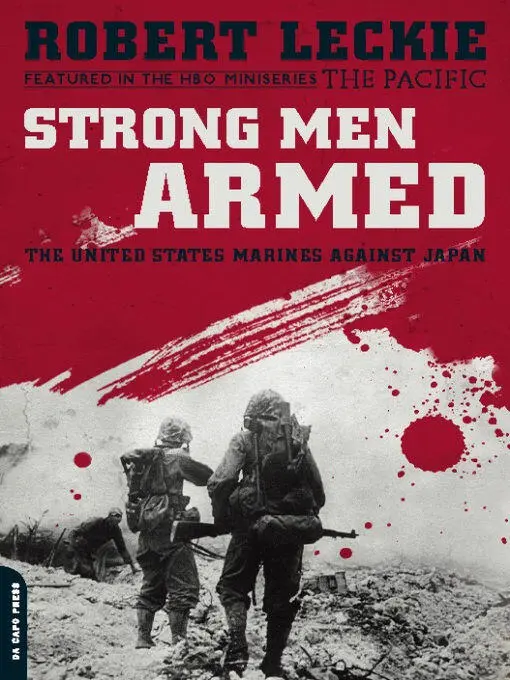
- Название:Strong Men Armed
- Автор:
- Издательство:Da Capo Press
- Жанр:
- Год:2010
- Город:Cambridge
- ISBN:978-0-786-74832-7
- Рейтинг книги:3 / 5. Голосов: 1
-
Избранное:Добавить в избранное
- Отзывы:
-
Ваша оценка:
Strong Men Armed: краткое содержание, описание и аннотация
Предлагаем к чтению аннотацию, описание, краткое содержание или предисловие (зависит от того, что написал сам автор книги «Strong Men Armed»). Если вы не нашли необходимую информацию о книге — напишите в комментариях, мы постараемся отыскать её.
Strong Men Armed — читать онлайн бесплатно полную книгу (весь текст) целиком
Ниже представлен текст книги, разбитый по страницам. Система сохранения места последней прочитанной страницы, позволяет с удобством читать онлайн бесплатно книгу «Strong Men Armed», без необходимости каждый раз заново искать на чём Вы остановились. Поставьте закладку, и сможете в любой момент перейти на страницу, на которой закончили чтение.
Интервал:
Закладка:
The tanks drove into a roaring cauldron of explosions and flashing light. As they were hit and set afire they illuminated other tanks farther back. Sometimes the tanks to the rear stopped. An officer jumped out, waved his saber, made a speech, and climbed back in again. A bugle blared. The tanks came on and the Marine bazookamen tore them apart. Sharp-shooters such as Pfc. Herbert Hodges had seven rockets for his bazooka, enough for him to knock out seven tanks. Private Bob Reed got four with four shots, and then, running out of ammunition, he got a fifth by jumping aboard it and dropping in a grenade.
Some of the enemy tanks got in. Two of them rolled over a pair of 60-millimeter mortar positions. Another came up on Captain Rollen, and a rifleman-rider fired just as Rollen attached a grenade to his carbine. The bullet detonated the grenade-and Rollen fell, pinked with shrapnel, his eardrums shattered.
Captain Thomas came up to take his place, the same Norman Thomas who had held off the Jap banzai on Tarawa. A fourth tank raced up. Its riders shot Thomas dead. They turned to take Sergeant Dean Squires under fire.
But Squires had already blown off the head of the tank’s commander. He followed through by tossing a satchel charge in the open turret, finishing both tank and riders.
A fifth Japanese tank penetrated as far back as Colonel Riseley’s command post. The commander of the Sixth Regiment had been sitting on a tree stump, smoking a cigar while he watched the battle.
The tank rattled closer. Colonel Riseley removed his cigar.
“Son,” he called to his regimental clerk, “get me a bazooka.”
Before the man could obey, a Marine half-track clattered up on the tank and set it aflame with its first shell. Thereafter the half-tracks roved like wolves among the Japanese tanks. Each time they fired, a tank burned—until close to 30 had been knocked out. The others fled, and the last of these was sighted going up a distant hill. Its turret could be seen moving among a cluster of houses. The Marines gave the range to an offshore destroyer.
The destroyer fired 20 salvos and the tank burned for the rest of the day—sending up a cloud of oily smoke to mark the limit of the battleground where General Saito had lost another 700 foot soldiers as well as Colonel Goto and most of the 9th Tank Regiment he commanded.
Tokuzo Matsuya had not been killed. He had survived to fill his diary with another lament: “The remaining tanks in our regiment make a total of 12. Even if there are not tanks, we will fight hand to hand. I have resolved that, if I see the enemy, I will take out my sword and slash, slash, slash at him as long as I last, thus ending my life of twenty-four years.”
It was no boast but a prediction, and by the morning of the third day there were already 3,500 Marine casualties to give it force. June 17 brought more than 500 more casualties in a slow, gouging attack which extended the beachhead north about a thousand yards and up to 2,000 yards east or inland. The inland successes, however, also served to lengthen the Lake Susupe bulge between divisions. The Japanese had hidden in Susupe’s marshes, and the Marines who went in after them with heavy machine guns and mortars sank up to their waists in muck. It would be many days before Lake Susupe was cleared.
On the right or southern front the Fourth Division’s gains were followed by the entry of the 165th Infantry on the Marine right flank. The 165th would attack Aslito Airfield in southern Saipan the following day.
On the extreme edge of the left or northern flank, the Second Marines under Colonel Walter Stuart moved cautiously upcoast in a column of battalions until a point 1,000 yards below Garapan had been reached. They were to sit there until southern Saipan had been cleaned out.
Out on the ocean Kelly Turner was already taking the transports and cargo ships away from Saipan to empty blue seas many, many miles to the south and east. There they joined all the ships and men of the Guam invasion force, circling, circling, circling, to the extreme disgust of the troops, until word arrived of the victory or defeat of Mitscher’s Task Force 58.
And at a point about 500 miles west of the Philippines, the fleets of Admiral Ozawa and Ugaki rendezvoused and refueled, and were now streaking east for Saipan, their scout planes conducting searches many hundreds of miles before and around them, hunting for the American fleet.
Tracking the Japanese for Admiral Spruance was a submarine called Cavalla. She was making her first cruise. She had sighted Ozawa’s carriers astern at dusk. Commander Herman Kossler had quickly turned tail and put 15,000 yards between them and Cavalla. It turned dark, but Kossler could still see the vast silhouette of a monster carrier.
“Christ!” Kossler swore. “It looks like the Empire State Building.”
Then Kossler had been forced to take Cavalla down. She submerged 100 feet and Kossler and his men tried to count the screws of the ships passing overhead in a half-hour-long procession. They counted 15, but Kossler thought that was too low.
Cavalla surfaced and got off her report to Spruance. She went down again for two hours. When she surfaced, shortly before midnight, she had lost contact.
On Saipan in the early morning of June 18 the Japanese had received a message from Premier Hideki Tojo. It said:
Because the fate of the Japanese Empire depends on the result of your operation, you must inspire the spirit of the officers and men and to the very end continue to destroy the enemy gallantly and persistently. Thus alleviate the anxiety of our Emperor.
Back flashed the message of Colonel Takuji Suzuki, the 43rd Division’s chief of staff. It said:
Have received your honorable Imperial words and we are grateful for boundless magnanimity of Imperial favor. By becoming the bulwark of the Pacific with 10,000 deaths we hope to requite the Imperial favor.
At daylight, Lieutenant General Saito began burning his secret documents preparatory to moving his headquarters farther north from the American invaders even then breaking out of their beachhead.
By the night of July 18 the Fourth Marine Division had struck straight across the island to the shores of Magicienne Bay—“Magazine Bay” as it would be forever called—while beneath them the 27th Division’s 165th Infantry had overrun Aslito Airfield.
All was gradually shaping up for the drive to the north planned by Lieutenant General Howlin’ Mad Smith, who had set up headquarters at Charan Kanoa the day before. Smith now had three divisions on Saipan and he hoped to attack to the north on a three-division, cross-island front. He already had seen to the emplacement of his corps artillery—30 155-millimeter “long toms” and howitzers which would fire in support of the assault-but he would not launch the clean-up drive until Mount Tapotchau in the center of the island was seized.

Cavalla was going down again. A night-flying Japanese plane had sighted the American sub and Commander Kossler was submerging. It was three o’clock in the morning of June 19.
At seven o’clock Cavalla was up again-but once more an enemy plane spotted her and drove her down. Something was stirring. Kossler could guess it from the number of enemy planes abroad. At ten o’clock he brought Cavalla up. Again the Japanese planes menaced him.
Cavalla went down. Kossler decided to wait fifteen minutes….
Albacore was cruising at periscope depth and Commander J. W. Blanchard was peering into the glass.
He started. There was a big carrier, a cruiser and the tops of other ships about seven miles away—and that carrier was big! It was Taiho, the carrier Commander Kossler had first sighted and the biggest flattop that Japan was able to float. She was 33,000 tons, brand-new, and she flew the eight-rayed, single-banded flag of Admiral Ozawa. She was launching planes, for Ozawa’s attack on the Americans was already begun.
Читать дальшеИнтервал:
Закладка:
Похожие книги на «Strong Men Armed»
Представляем Вашему вниманию похожие книги на «Strong Men Armed» списком для выбора. Мы отобрали схожую по названию и смыслу литературу в надежде предоставить читателям больше вариантов отыскать новые, интересные, ещё непрочитанные произведения.







Обсуждение, отзывы о книге «Strong Men Armed» и просто собственные мнения читателей. Оставьте ваши комментарии, напишите, что Вы думаете о произведении, его смысле или главных героях. Укажите что конкретно понравилось, а что нет, и почему Вы так считаете.