Robert Leckie - Strong Men Armed
Здесь есть возможность читать онлайн «Robert Leckie - Strong Men Armed» весь текст электронной книги совершенно бесплатно (целиком полную версию без сокращений). В некоторых случаях можно слушать аудио, скачать через торрент в формате fb2 и присутствует краткое содержание. Город: Cambridge, Год выпуска: 2010, ISBN: 2010, Издательство: Da Capo Press, Жанр: nonf_military, на английском языке. Описание произведения, (предисловие) а так же отзывы посетителей доступны на портале библиотеки ЛибКат.
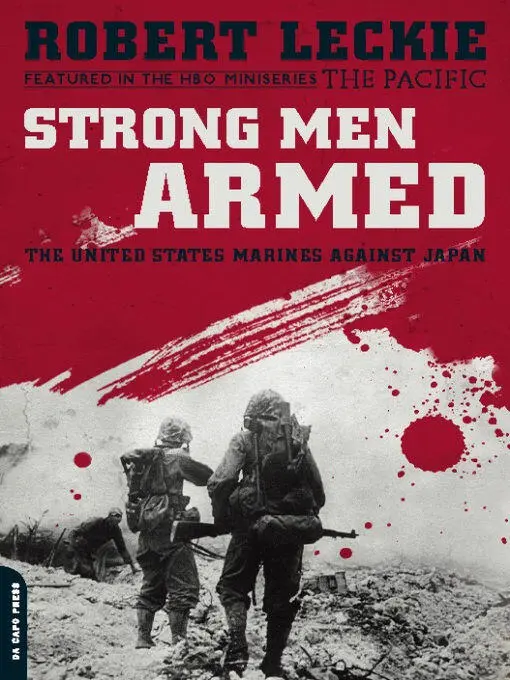
- Название:Strong Men Armed
- Автор:
- Издательство:Da Capo Press
- Жанр:
- Год:2010
- Город:Cambridge
- ISBN:978-0-786-74832-7
- Рейтинг книги:3 / 5. Голосов: 1
-
Избранное:Добавить в избранное
- Отзывы:
-
Ваша оценка:
Strong Men Armed: краткое содержание, описание и аннотация
Предлагаем к чтению аннотацию, описание, краткое содержание или предисловие (зависит от того, что написал сам автор книги «Strong Men Armed»). Если вы не нашли необходимую информацию о книге — напишите в комментариях, мы постараемся отыскать её.
Strong Men Armed — читать онлайн бесплатно полную книгу (весь текст) целиком
Ниже представлен текст книги, разбитый по страницам. Система сохранения места последней прочитанной страницы, позволяет с удобством читать онлайн бесплатно книгу «Strong Men Armed», без необходимости каждый раз заново искать на чём Вы остановились. Поставьте закладку, и сможете в любой момент перейти на страницу, на которой закончили чтение.
Интервал:
Закладка:
While some 700 amtracks carried the assaulting battalions ashore, another force drawn from the Second Division would make a feint at the heavily defended beaches north of Garapan.
Four days before this attacking force dropped anchors off Saipan the planes and guns of the fast carrier fleet began striking the culminating blows of the preliminary bombardment. Three days later, on June 14, the carrier force sent two smaller groups racing north to pin down enemy aerial strength at Iwo Jima and at Chichi Jima and Haha Jima in the Bonins.
That same June 14 Admiral Chuichi Nagumo changed his mind. “The Marianas,” he wrote, “are the first line of defense of our homeland. It is a certainty that the Americans will land in the Marianas Group either this month or the next.”
But a tank officer named Tokuzo Matsuya figured the ships offshore meant something more immediate and he filled his diary with bitter lamentation.
“Where are our planes?” he wrote. “Are they letting us die without making any effort to save us? If it were for the security of the Empire we would not hesitate to lay down our lives, but wouldn’t it be a great loss to the ‘Land of the Gods’ for us all to die on this island? It would be easy for me to die, but for the sake of the future I feel obligated to stay alive.”
And on June 14 the commander of Task Force 58, Vice Admiral Marc Mitscher, got off an exuberant message characteristic of all bombardiers or artillerists captivated by the sound and fury of their cannonading.
“Keep coming, Marines!” he signaled. “They’re going to run away!”
2
Saipan burned fitfully beneath a drifting pall of smoke, and yet, she did not seem menacing. She was, along with Tinian, absolutely ringed round by American warships. They sailed back and forth, firing, and some of them lay in the strait between Saipan and Tinian to hurl broadsides at Saipan’s southern tip. Others in the strait fired along the beaches which would shortly be swarming with American Marines.
Yet, Saipan was silent, almost dreamlike. The western beaches were quiet. The peak of 1,554-foot Mount Tapotchau seemed to float on a sea of smoke in the middle of the island. Behind the landing beaches, in their center, the ruined village of Charan Kanoa smoldered, and the blackened smokestack of a wrecked sugar mill seemed to cleave the air like a marker dividing the front. Far to the left, upcoast, lay the city of Garapan, marked only by an occasional ray of sunshine glinting off roofs of corrugated iron.
Above Garapan the Marines of the diversionary force had boarded their landing boats. They were roaring inshore, naval gunfire breathing heavily overhead. They were drawing off a regiment of General Saito’s force—but no more. The aged defender of Saipan had guessed that the true effort was coming at Charan Kanoa’s beaches, and he had prepared his artillery for it. His guns were emplaced behind Mount Fina Susa, the ridge overlooking Charan Kanoa. They were firing with skill, for they had the water between beaches and reef thoroughly registered, and they had sown it with little colored flags to mark the range.
Counterbattery shells screamed seaward. Tennessee was hit. Shells burst on the decks of the cruiser Indianapolis, the flagship of Admiral Spruance. But the American warships lashed back. Dive-bombers shrieked down on both islands. The shore batteries were silenced, a flight of 161 Navy bombers came down a staircase of clouds to pound Charan Kanoa once more—and the LST’s had run in close to the fringing reef and were disgorging amtracks filled with Marines, discharging also those amphibious tanks or “armored pigs” which would lead the assault in flaming V’s.
Halfway inside the 1,500-yard run to the beach the amtracks began to take hits. Officers and men could almost guess the caliber of the next enemy barrage by the color of the flags they passed.
On the right sector attacked by the Fourth Marine Division, riflemen were vaulting from the amtracks and running in low toward Charan Kanoa. Shells were exploding among them. Some of the combat teams remained aboard their amtracks, fighting from them as they swayed inland. But the amtracks were targets for the enemy artillery, as were the amtanks, and soon the Marines preferred to advance on foot toward Charan Kanoa.

On their right, at the southernmost beaches, the assault of the Twenty-fifth Marines had split up into squad-to-squad battles. Lieutenant Fred Harvey led his platoon up the beach. A Japanese officer rushed him, swinging his saber. Harvey parried with his carbine, jumped back and shot his assailant dead. A Marine fell and Harvey seized the man’s M-1. With other Marines he closed on three Japanese in a shellhole. Harvey’s M-1 jammed. He drove in slashing with the bayonet. A grenade landed. Harvey hit the deck, the explosion picked him up and slammed him down again. He arose helmetless to help finish off the enemy.
So the battle raged, moving steadily inland through the wrecked village, moving over gently rising hills made labyrinthine by hidden caves, spider holes and interconnected dug-outs. The Marines and Japanese fought each other among bleating goats, lowing oxen, mooing cows and scampering, clucking chickens. Soon the Japanese soldiers began to fall back behind Mount Fina Susa, and then their artillery fire increased.
On the left the Second Marine Division passed through a rhythmical, flashing hell of artillery and mortars. Every 25 yards, every fifteen seconds of their ride to the beaches, a shell exploded among the amtracks. On Afetna Point in the center of the landing beaches an antiboat gun began clanging. Shore batteries opened up again. Close-in destroyers roared back at them, silencing them. But there were amtracks smoking and burning, there were bloody Marines writhing on their twisted decks. And the antiboat gun was driving the amtracks farther and farther north, forcing some of the battalions to land on the wrong beaches.
Within a few minutes of the arrival of the Marines on the leftward beaches, every one of the commanders of the four assault battalions had become a casualty. Lieutenant Colonel Raymond Murray of the Second Battalion, Sixth, was so seriously wounded he had to be evacuated. Jim Crowe was also badly hit.
The big flamboyant redhead, now a lieutenant colonel, became separated from his men as his Second Battalion, Eighth landed by mistake on another battalion’s beach. At half-past nine he moved along the shore with his runner, Corporal William Donitaley. They were fired at by enemy snipers.
Crowe slumped to the earth struck by a bullet which pierced his left lung below the heart and smashed a rib as it came out. Donitaley fell thrashing in a bush, his left side punctured near the kidney. He thought he was dying.
“I’m hit pretty bad, sir,” Donitaley gasped. “I guess I’m a goner.”
“Goddam it,” Crowe spluttered. “Don’t talk like that, boy.” The act of speaking had caused hot air to puff from Crowe’s punctured lung, and he felt blood continuing to gush from his side. Jim Crowe also thought he was a goner.
“I guess they got me too, boy,” he choked.
“Goddam it, sir,” said Donitaley. “Don’t talk like that.”
They lay in the bushes, aware of the grim comedy of their exchange, their wounds multiplying under showers of shrapnel thrown down by Japanese artillery treebursts, until they were found nearly an hour later and brought back to an aid station. A corpsman and Doctor Otto Jantan attempted to fix them up, but Japanese shellfire killed the corpsman and wounded the doctor. Crowe was taken out to a transport, where a young surgeon began to cut away his blood-stained clothing.
Читать дальшеИнтервал:
Закладка:
Похожие книги на «Strong Men Armed»
Представляем Вашему вниманию похожие книги на «Strong Men Armed» списком для выбора. Мы отобрали схожую по названию и смыслу литературу в надежде предоставить читателям больше вариантов отыскать новые, интересные, ещё непрочитанные произведения.










Обсуждение, отзывы о книге «Strong Men Armed» и просто собственные мнения читателей. Оставьте ваши комментарии, напишите, что Вы думаете о произведении, его смысле или главных героях. Укажите что конкретно понравилось, а что нет, и почему Вы так считаете.