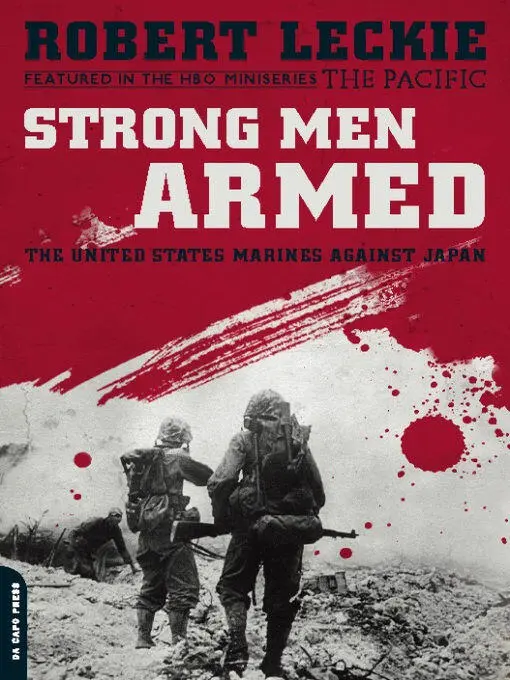
Robert Leckie - Strong Men Armed
Здесь есть возможность читать онлайн «Robert Leckie - Strong Men Armed» весь текст электронной книги совершенно бесплатно (целиком полную версию без сокращений). В некоторых случаях можно слушать аудио, скачать через торрент в формате fb2 и присутствует краткое содержание. Город: Cambridge, Год выпуска: 2010, ISBN: 2010, Издательство: Da Capo Press, Жанр: nonf_military, на английском языке. Описание произведения, (предисловие) а так же отзывы посетителей доступны на портале библиотеки ЛибКат.
- Название:Strong Men Armed
- Автор:
- Издательство:Da Capo Press
- Жанр:
- Год:2010
- Город:Cambridge
- ISBN:978-0-786-74832-7
- Рейтинг книги:3 / 5. Голосов: 1
-
Избранное:Добавить в избранное
- Отзывы:
-
Ваша оценка:
Strong Men Armed: краткое содержание, описание и аннотация
Предлагаем к чтению аннотацию, описание, краткое содержание или предисловие (зависит от того, что написал сам автор книги «Strong Men Armed»). Если вы не нашли необходимую информацию о книге — напишите в комментариях, мы постараемся отыскать её.
Strong Men Armed — читать онлайн бесплатно полную книгу (весь текст) целиком
Ниже представлен текст книги, разбитый по страницам. Система сохранения места последней прочитанной страницы, позволяет с удобством читать онлайн бесплатно книгу «Strong Men Armed», без необходимости каждый раз заново искать на чём Вы остановились. Поставьте закладку, и сможете в любой момент перейти на страницу, на которой закончили чтение.
Интервал:
Закладка:
A Marine officer picked up a telephone and spoke two words:
“Illumination requested.”
It came so swiftly it stunned the Japanese. They had not calculated on the American warships still cruising up and down the west coast. They found themselves outlined from their puttee-taped ankles to the round tops of their mushroom helmets, and they were rapidly cut to pieces in a horizontal hail of bullets, cannister shot, mortar and bazooka shell fragments. They broke and fell back, and then the naval gunfire and Marine artillery burst among them.
The counterattack downroad from Garapan cost General Saito 700 soldiers. It also cost him Garapan, for in the morning General Watson asked the warships and planes to flatten this enemy staging place.
General Saito’s plans for driving a wedge into the gap between the Marine divisions was also doomed. Some 200 Japanese who emerged from the gloom of Lake Susupe and struck for the Charan Kanoa pier collided with the men of Lieutenant Colonel John Cosgrove’s Third Battalion, Twenty-third. They were destroyed. So also was a three-tank attack launched down the Garapan road just before daylight. June 16 dawned with the Marines still holding what they had seized the day before and preparing to expand it. That same day Admiral Spruance hauled back on the line holding the Saipan bait.
Spruance knew that Ozawa had sortied from Tawi Tawi. Throughout the afternoon and night of D-Day he had been receiving submarine reports of the Japanese approach. At half-past four the sub Flying Fish sighted the Japanese carriers debouching from San Bernardino Strait into the Philippine Sea, making dead west for Saipan. An hour later Seahorse spotted Ugaki’s battleships racing north to the rendezvous area.
On the morning of June 16, Spruance conferred with Admiral Turner and General Holland Smith aboard Turner’s flagship Rocky Mount. He ordered Mitscher’s Task Force 58 to intercept the Japanese, postponed the Guam invasion, promised Smith only two more days of unloading operations, launched prolonged air searches for the enemy, and alerted the old battleships to make nocturnal patrols 25 miles west of Saipan to block any Japanese ships which might elude Mitscher.
In the meantime the escort carriers would continue to give the Marines on Saipan aerial cover and Smith would commit the 27th Division that very day. The conquest of the island was to be pushed forward as rapidly as possible.
Satisfied, Spruance prepared to return to his own flagship Indianapolis. Smith stopped him.
“Do you think the Japs will turn and run?”
“No,” Spruance said. “Not now. They’re out after big game. If they’d wanted something easy, they’d have gone after MacArthur’s operation at Biak. But the attack on the Marianas is too great a challenge for the Japanese Navy to ignore.”
That attack was going forward with the Second Battalion, Eighth, and the orphan First Battalion, Twenty-ninth Marines, slugging steadily through the Afetna Point pocket. By noon they had cleared it and secured Charan Kanoa pier.
On the right, the Fourth Division’s artillery fired shell for shell with the Japanese while General Schmidt marshaled his regiments for a noon attack. With 15 batteries of the Fourteenth Marines ashore, it should have been the pushover that artillery duels with the Japanese had always been. But it was not. Four batteries were knocked out, although the ingenuity of the Division Ordnance Company had them back firing before dusk. One howitzer named Belching Beauty took a direct hit which killed or wounded every member of the crew but one. Belching Beauty was repaired and firing an hour later. Two others were blown to bits, and the ordnance man gathered up the pieces and made a new gun from them.
Gradually, the Marine artillery asserted its superiority. One by one, the enemy guns were silenced, the last of their rounds killing Lieutenant Colonel Maynard Schultz while he waited at the Twenty-fourth Regiment’s CP to receive instructions for his First Battalion’s attack.
At half-past twelve the Fourth Division moved out. It slugged ahead slowly. The battalion commanders began calling for tanks. As the Shermans moved up to the front, the Japanese 75’s erupted again.
The platoon of Shermans led by Gunnery Sergeant Bob McCard ran into the concentrated fire of an entire battery of 75’s. Almost instantly, McCard’s tank was cut off from the others and crippled by the converging shells of four enemy guns. McCard battled back with the tank’s 75 and machine guns. But the Japanese 75’s had the range now. The Sherman was done for.
“Take off!” McCard roared at his crew. “Out the escape hatch!”
One by one, the crewmen lowered themselves through the hatch in the tank’s floor, scuttling to safety while McCard hurled grenades from the opened turret. Machine-gun fire raked the tank, wounding McCard. The Japanese charged. McCard seized a machine gun and faced them a second time alone. He shot 16 of them before they killed him.
The other Marine tanks returned. The stand which won McCard the Medal of Honor had also won the time to coordinate the attack. It went forward, slowly, but by dusk the Marines’ lines were firm all along the beachhead. The Fourth Division had a penetration of 2,000 yards across its 4,000-yard front. The Second Division had contented itself with cleaning out the Afetna Point gap, with patrolling, and with consolidating its own left flank facing north toward Garapan. It was well. At dusk, while the 27th Division’s 165th Infantry began to come ashore, Lieutenant General Saito ordered the first night tank attack of the Pacific War.
It would strike the left flank sector held by the Jones boy named Bill.
“He may be only twenty-seven, but he’s the best damn battalion commander in this division-or any other division.”
That was what Colonel Jim Riseley of the Sixth Marines thought of the commander of his First Battalion, Lieutenant Colonel Bill Jones, the Marine Corps’ youngest field commander and one so at home in battle he could tell his men, “I’d rather command a battalion in combat than sleep with Hedy Lamarr.” Jones was the brother of Captain Jim Jones, whose Recon Boys were then assigned the unglorious mission of guarding the Corps CP in the rear, and he delighted in warning his officers that they must stand at all costs, “because if my brother gets hurt, Mother will never forgive me.” This night of June 16-17 they would have to stand against the full brunt of Colonel Hideki Goto’s 9th Tank Regiment.
Up in the blackened rubble that was once the city of Garapan, Colonel Goto unbuttoned the turret of his regiment’s leading tank. He stood erect. He raised his saber and flourished it over his head. The turrets of the following tanks came open. The commanders, among them that Tokuzo Matsuya who had written so fiercely in his diary two days before, stood erect. They flourished their sabers.
Colonel Goto struck the side of his tank a resounding clank. His junior officers spurred their metal-mounts forward with similar saber-slaps. The turrets were closed.
The 9th Tank Regiment swept forward.
“Colonel,” said Captain Claude Rollen, “it sounds like a tank attack coming. Request illumination.”
“Right,” said Lieutenant Colonel Jones, and passed the request for illumination back to Colonel Riseley. Then he notified a medium tank company to stand by and got bazookamen from A Company moving over to Captain Rollen’s sector.
That was at half-past three.
Fifteen minutes later the squeaking, rattling Japanese mediums—the “kitchen sinks” as the Marines called them-burst into Rollen’s sector in two waves.
The first wave carried riflemen or light machine-gunners sprawled on the long trunk of the engine compartment or hanging on to the guide rails like firemen. Crewmen led the tanks forward on foot, although here and there a commander stood erect in an open turret, shouting orders and flashing his saber in the crashing glare of the star-shells. Behind the second wave of tanks the bulk of Colonel Ogawa’s 136th Infantry Regiment came trotting forward.
Читать дальшеИнтервал:
Закладка:
Похожие книги на «Strong Men Armed»
Представляем Вашему вниманию похожие книги на «Strong Men Armed» списком для выбора. Мы отобрали схожую по названию и смыслу литературу в надежде предоставить читателям больше вариантов отыскать новые, интересные, ещё непрочитанные произведения.











Обсуждение, отзывы о книге «Strong Men Armed» и просто собственные мнения читателей. Оставьте ваши комментарии, напишите, что Вы думаете о произведении, его смысле или главных героях. Укажите что конкретно понравилось, а что нет, и почему Вы так считаете.