Robert Leckie - Strong Men Armed
Здесь есть возможность читать онлайн «Robert Leckie - Strong Men Armed» весь текст электронной книги совершенно бесплатно (целиком полную версию без сокращений). В некоторых случаях можно слушать аудио, скачать через торрент в формате fb2 и присутствует краткое содержание. Город: Cambridge, Год выпуска: 2010, ISBN: 2010, Издательство: Da Capo Press, Жанр: nonf_military, на английском языке. Описание произведения, (предисловие) а так же отзывы посетителей доступны на портале библиотеки ЛибКат.
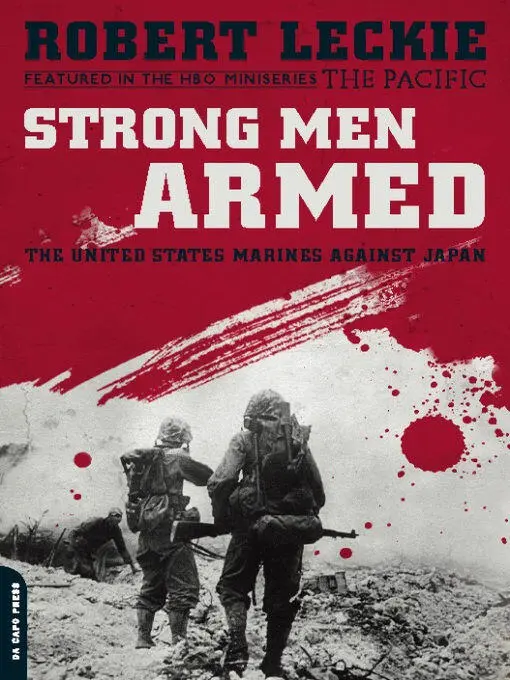
- Название:Strong Men Armed
- Автор:
- Издательство:Da Capo Press
- Жанр:
- Год:2010
- Город:Cambridge
- ISBN:978-0-786-74832-7
- Рейтинг книги:3 / 5. Голосов: 1
-
Избранное:Добавить в избранное
- Отзывы:
-
Ваша оценка:
Strong Men Armed: краткое содержание, описание и аннотация
Предлагаем к чтению аннотацию, описание, краткое содержание или предисловие (зависит от того, что написал сам автор книги «Strong Men Armed»). Если вы не нашли необходимую информацию о книге — напишите в комментариях, мы постараемся отыскать её.
Strong Men Armed — читать онлайн бесплатно полную книгу (весь текст) целиком
Ниже представлен текст книги, разбитый по страницам. Система сохранения места последней прочитанной страницы, позволяет с удобством читать онлайн бесплатно книгу «Strong Men Armed», без необходимости каждый раз заново искать на чём Вы остановились. Поставьте закладку, и сможете в любой момент перейти на страницу, на которой закончили чтение.
Интервал:
Закладка:
By nightfall of July 7 the beaches of Tanapag Harbor were clogged with Japanese dead. Next day the Second Marine Division came out of reserve to mop up the area, and a tank sergeant named Grant Timmerman won a Medal of Honor by smothering a grenade with his life to save his crew. Fighting fluttered on throughout that night, but by morning of July 9 the mop-up was finished and men were beginning to make the count of enemy dead that reached nearly 2,500. Gunnery Sergeant Claude Moore of the First Battalion, Second Marines, was among them.
Sometimes Gunny Moore bent over to count, and once, as he did, there came a shot from a sniper in a cave. Moore went down bawling his dismay. A corpsman rushed up to assuage the gunny’s wounded posterior. He knelt down and gasped.
“Damned if it didn’t go in and out both cheeks!”
A beatific smile chased the grimace of pain from Gunny Moore’s face.
“Four Purple Hearts,” he breathed. “And all with the one bullet!”
Several hours later-at four in the afternoon-the Second, Twenty-fourth and Twenty-fifth Marines drove up to the island’s northernmost extremity at Marpi Point. They reported they could see nothing in front of them but blue sea.
Saipan had fallen, and now the Japanese civilians began to make the final gesture.
8
Marpi Point was a high plateau. It rose 220 sheer feet from the shore above a clutter of cruel coral rocks. Its seaward face was honeycombed with caves. At Marpi Point had gathered half of Saipan’s civilian population, together with the surviving remnant of its military defenders, and here, throughout the afternoon and night of July 9, throughout the following day, there occurred an orgy of self-destruction which sickened those Marines who were powerless to halt it.
Surrender pleas broadcast from sound trucks, the entreaties of the Marines themselves, the pleading of prisoners-both civilian and military-nothing could deter these Japanese civilians in the horrible slaughter of themselves and their families.
Men and women jumped hand in hand from the cliff onto the rocks. Fathers stabbed or strangled their babies to death, hurled their tiny forms over the cliff, and threw themselves after them. Soldiers prodded groups of civilians out of the caves, posed arrogantly before them, and blew themselves apart. Cowed, the civilians also committed suicide.
On the beaches below, one boy of about fifteen paced irresolutely over the rocks. He sat down and let the water play over his feet. A roller gathered out on the sea. He awaited it stoically. It broke over his body, it swept him away. He lay face down in it—and then, suddenly, frantically, unable to restrain the youth of his life, his arms flailed the water.
But it was too late. He lay inert. His trousers filled with water, and he sank.
Not far away, three women sat on a rock combing their long black hair. They stood erect. They joined hands and walked slowly out into the sea.
A father, mother and three children had also walked into the water. But they had come back to the rocks. A Japanese soldier in one of the caves shot the father. The soldier fired again and hit the woman. She dragged herself along the rocks but the sea seized her and floated her out in a spreading stain of blood. The sniper took aim on the children. A Japanese woman ran across the beach and carried them away.
The sniper strode out of his cave, preening himself, and crumpled under the concentrated firing of a hundred Marine weapons.
Sometimes the Marines were able to rescue a child, and then an entire squad of men would rush about for dried milk to placate the squalling infant whose mother had chosen to leap alone. One big Marine squatted in the road brushing flies from the face of a dazed six-year-old girl, while the tears streaked his earth-stained cheeks.
Along the reefs to the west of Marpi Point, knots of Japanese soldiers had gathered to commit suicide. An amtrack full of Marines approached one group, just as six men knelt down and an officer backed off to draw his saber from its scabbard. The Marines called to him to surrender. He swung. He hacked off four heads, and as the Marines approached the reef, he and the two remaining men charged. The Marines cut them down.
Underneath Marpi Point, 100 soldiers emerged from the caves to frolic on the rocks. They bowed ceremoniously to the Marines above. They stripped and ran into the sea. They came out and put on their clothes. Their leader distributed hand grenades. One by one, they blew themselves up.
By July 10, the waters off Marpi Point were incarnadine and so clogged with bodies rolling on the swells that small American ships could not run into shore to rescue civilians from the soldiers who held them. Nor could they have come ashore if the waters had been clear, for the soldiers had begun to snipe at them and the rocket boats and minesweepers were forced to turn their guns on the caves.
It was then that a naked woman in the last stages of childbirth waded into the water to drown herself and her child.
Eight days after this ultimate expression of the horror of Bushido, the very high priest of the cult-Premier Hideki Tojo —was himself fallen. The loss of Saipan, the catastrophe of the Battle of the Philippine Sea, had broken the power of the man who led the Empire into the war. He was forced to resign on July 18, although this disgrace did not shame him into the final gesture made by his misguided followers on Marpi Point. Hideki Tojo chose to live, until the Americans came to Japan and he was convicted as a war criminal and hung.
Saipan had cost a total of 14,111 American casualties- 3,674 soldiers, 10,347 Marines—while destroying all but 1,000 prisoners of the island’s 30,000 defenders. But Saipan also caused changes as important as the fall of Tojo. After Saipan, Japan was within bombing range of air bases which she could not neutralize, as she would do in China; she had no more carrier air power; and the inner works of Empire lay open to attack. The force of the blow struck by the Americans was measured in anguish by Fleet Admiral Osami Nagano, supreme naval advisor to the Emperor. Hearing of Saipan’s fall, Nagano held his head and groaned:
“Hell is on us.”
9
Back in San Diego, California, during this July of 1944, the new Fifth Marine Division had completed training and was preparing to shove off for Camp Tarawa in Hawaii.
On Pavuvu Island in the Russells, staff officers of the First Marine Division were drawing plans for the assault on a little island which was spelled Peleliu and pronounced “Pella-loo.”
In Eniwetok Lagoon the long wait was ending for the men of the Guam invasion force.
And in the narrow waters between Saipan and Tinian, on that very night of July 10, while Marpi Point still shook to the last of the suicide cave explosions, there were a pair of destroyers discharging Captain Jim Jones and his Recon Boys into rubber boats.
Tinian, three and a half miles to the south of Saipan, had to be taken. Its seizure, along with the reconquest of Guam, would consolidate the Marianas. More, Tinian held an excellent airdrome with two 4,700-foot runways and there were three more being built. Though Tinian was but 10½ miles long and a maximum of five miles wide, it had enough level ground to make it the chief B-29 base in the Pacific.
But Tinian had very few landing beaches. The only ones known to be suitable for invasion, opposite Tinian Town on the island’s southwest coast, were also heavily defended. The Marines dared not risk them.
That was why the Recon Boys of Captain Jones-together with sailors of two Underwater Demolition Teams-had come into the strait between Saipan and Tinian. They were looking for unguarded landing beaches on Tinian’s northern nose.
Читать дальшеИнтервал:
Закладка:
Похожие книги на «Strong Men Armed»
Представляем Вашему вниманию похожие книги на «Strong Men Armed» списком для выбора. Мы отобрали схожую по названию и смыслу литературу в надежде предоставить читателям больше вариантов отыскать новые, интересные, ещё непрочитанные произведения.











Обсуждение, отзывы о книге «Strong Men Armed» и просто собственные мнения читателей. Оставьте ваши комментарии, напишите, что Вы думаете о произведении, его смысле или главных героях. Укажите что конкретно понравилось, а что нет, и почему Вы так считаете.