Robert Leckie - Strong Men Armed
Здесь есть возможность читать онлайн «Robert Leckie - Strong Men Armed» весь текст электронной книги совершенно бесплатно (целиком полную версию без сокращений). В некоторых случаях можно слушать аудио, скачать через торрент в формате fb2 и присутствует краткое содержание. Город: Cambridge, Год выпуска: 2010, ISBN: 2010, Издательство: Da Capo Press, Жанр: nonf_military, на английском языке. Описание произведения, (предисловие) а так же отзывы посетителей доступны на портале библиотеки ЛибКат.
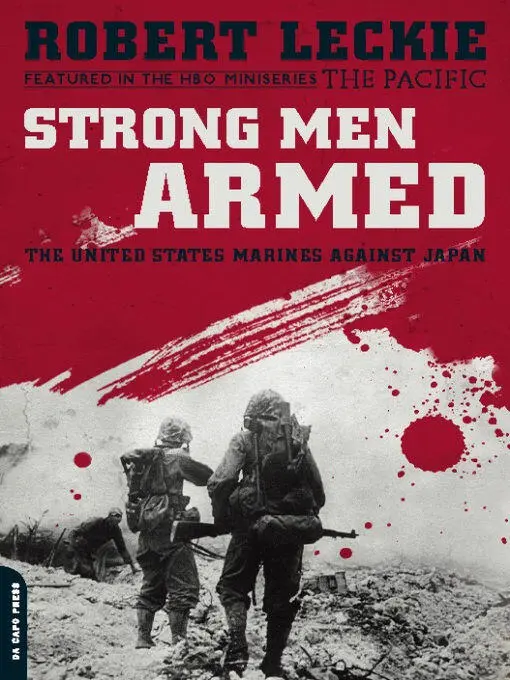
- Название:Strong Men Armed
- Автор:
- Издательство:Da Capo Press
- Жанр:
- Год:2010
- Город:Cambridge
- ISBN:978-0-786-74832-7
- Рейтинг книги:3 / 5. Голосов: 1
-
Избранное:Добавить в избранное
- Отзывы:
-
Ваша оценка:
Strong Men Armed: краткое содержание, описание и аннотация
Предлагаем к чтению аннотацию, описание, краткое содержание или предисловие (зависит от того, что написал сам автор книги «Strong Men Armed»). Если вы не нашли необходимую информацию о книге — напишите в комментариях, мы постараемся отыскать её.
Strong Men Armed — читать онлайн бесплатно полную книгу (весь текст) целиком
Ниже представлен текст книги, разбитый по страницам. Система сохранения места последней прочитанной страницы, позволяет с удобством читать онлайн бесплатно книгу «Strong Men Armed», без необходимости каждый раз заново искать на чём Вы остановились. Поставьте закладку, и сможете в любой момент перейти на страницу, на которой закончили чтение.
Интервал:
Закладка:
And Colonel Ogata was going to strike it. Outnumbered, his communications all but knocked out, his units scattered, his very authority being constantly challenged by the orders of Captain Oya to his south, Colonel Ogata was still going “to destroy the enemy at the beach.”
Even though the Americans were off the beach, he would carry out that plan of “annihilation at the water’s edge” which so many Japanese commanders seemed to conceive concurrent with their own conception. In fact, he had already instructed his units to counterattack at two in the morning.
At exactly that hour on the morning of July 25, about 600 screaming Japanese struck at the left flank held by the Twenty-fourth Marines. They were annihilated.
A half-hour later the first of a series of strong thrusts began against the Twenty-fifth Marines in the center. About 200 Japanese found an opening at the boundary between this regiment and the Twenty-fourth. They poured through. They met muzzle-blasting artillerists and counterattacking riflemen. They were killed to a man.
At half-past three the third and final assault fell on the Twenty-third Marines to the right. It was blown to bits. Five tanks were destroyed. At dawn, astonished Marines saw Japanese bodies flying 15 feet into the air. The wounded were blowing themselves up with magnetic mines—an end at once more powerful and spectacular than the customary hand-grenade suicide.
That dawn was also the end of Colonel Ogata’s defense of Tinian.
Strewn all around the Fourth Division’s perimeter were the bodies of 1,241 Japanese soldiers and sailors. At least another 700 had been wounded. With a single stroke, Ogata had deprived himself of perhaps a quarter of the best troops which had survived the first day’s assault. He could do nothing else but fall steadily south until he and all but 255 of his command were destroyed.
That took seven more days, with the Second Marine Division joining the attack. On July 25, the Second moved in behind the Fourth. It cleaned out the northern end of Tinian, then wheeled to move down the eastern half of the island. Second on the left, Fourth on the right, General Schmidt’s attack rolled south with the impetuosity which had not been possible on Saipan. On July 31, Tinian was declared fallen. On that night, Colonel Ogata himself fell—machine-gunned to death on Marine barbed wire—while leading the last banzai. There was mopping-up to follow, during which Pfc. Robert Wilson sacrificed his life for his friends by falling on an enemy grenade, winning the Medal of Honor. There was also a replication of the suicidal horrors of Marpi Point. But Tinian was the masterpiece of island war. Only 327 men had died and 1,771 had been wounded in securing Saipan’s southern flank and in seizing some of the finest bomber sites in the Central Pacific. It would indeed have been better if none had died and none had suffered, but such perfection is possible only against men of straw.
By all the real and cruel standards of war, Tinian was amphibious assault mastered at last, the problem of how to land on a hostile, fortified island finally solved—and then made perfect by Colonel Ogata’s back-breaking banzai.
12
Marines of the Third Division and First Brigade had been taught everything there was to know about Guam—except that it was the Japanese liquor locker of the Central Pacific.
Guam had whisky by the small pond, it had rivers of saki, it had lakes of beer by the uncountable case. It had, in this sea of intoxicants, the answer to a question which had puzzled Marines since the first banzai was broken at Tulagi on the night of August 7,1942. That was:
Are they drugged or are they drunk?
On Guam the night of July 25 the Japanese to the north were buoyant with booze, while those in the south were rip-roaring drunk.
On the southern or Agat beachhead, the Japanese troops led by Commander Asaichi Tamai had been driven west on Orote Peninsula by the First Marine Brigade. On the morning of July 25 the brigade sealed off the mouth of the peninsula. The Marines dug in, Fourth Regiment on the left, Twenty-second on the right.
Tamai made a desperate effort to evacuate his troops by water. Barges put out into Apra Harbor from Orote’s north coast. But Marine artillery on the mainland and on Cabras Island in the harbor blew them to bits. That happened at five o’clock in the afternoon. A few hours later, with the advent of a black night, while a daylong drizzle changed to a downpour, Tamai’s officers began passing out the whisky.
Six miles to the north, outside the Asan-Adelup beachhead held by the Third Marine Division, the drinking did not begin until midnight.
At Asan-Adelup the attack was not going to be the drunken suicide-rush brewing on Orote. This was to be the well-planned “single stroke” with which Lieutenant General Takashina hoped to “solve the issue of the battle.” Saki would be used to inflame the ardor of the troops, but not until after they had reached their assembly areas on the Fonte Plateau east of the American lines. Six battalions from the 45th Brigade, the 18th Regiment and other units—about 5,000 men—began moving out at about ten o’clock under cover of Japanese artillery and guided by red flares. After they had assembled, patrols went out to probe for weak spots in the American line.
They found gaps. By July 25 the Third Division’s line was about a mile deep and five miles wide, and it was held by only 7,000 riflemen. The alignment had the Third Marines on the left (with the detached Second Battalion, Ninth), the Twenty-first in the center, and the Ninth (less that detached Second Battalion) on the right. Between the Twenty-first and the Ninth was a gap 800 yards wide and held by a mere scouting unit. Many of the rifle companies were understrength. One Japanese patrol found a soft spot in the Marine left-center held by the First Battalion, Twenty-first, and another one of 50 soldiers ran into the Marine scouts in the 800-yard gap and drove them back.
There was now a broad undefended avenue running to the American rear, and in its path, 200 yards inland from the beach, was the Division Hospital.
Already many of the wounded in the hospital were stirring uneasily to hear the sound of Japanese artillery shells exploding around the batteries of the Twelfth Marines a few hundred yards to the left or north.
Not far from the hospital a young artilleryman of the Twelfth Marines felt a terror that is the palsy of the soul.
He had crawled into a cave to take cover from the Japanese shells. He had gone to sleep. He had awakened to find someone sitting on him. He felt for his carbine. Someone was sitting on that. There were perhaps a half-dozen of these intruders. He could hear the clinking of their canteens and smell the sour reek of saki, could hear the soft jabbering of their voices, could feel on the man astride him the hard round shape of a magnetic mine.
A squad of Japanese infiltrators had crept into his cave and were sitting there awaiting the daylight—when they would depart to attack the Marine guns.
It was eleven o’clock at night on Orote Peninsula, and an indescribable clamor had erupted in a mangrove swamp outside the right front of the First Marine Brigade.
“Listen at’em,” a Marine hissed to his foxhole buddy. “Damn if it don’t sound like New Year’s Eve in the zoo!”
The Japanese were screaming, singing, laughing, capering—they were smashing empty bottles against the big mangroves and clanging bayonets against rifle barrels.
Hoarse voices cried, “The Emperor draws much blood tonight!” Others rose in fits of cackling presumed to be terrifying. Some tossed grenades, yelling, “Corpsman! Corpsman!” or “K Company withdraw!” If they had hoped to unnerve the Marines or to goad them into giveaway fire, they had less than success. Their uproar only helped artillery observers call down a restraining fire on the edge of the swamp, while carefully registering all the Japanese avenues of approach with the combined guns of the brigade, the corps, and the 77th Division —as well as with the light and heavy mortars and 37’s of the front-line companies.
Читать дальшеИнтервал:
Закладка:
Похожие книги на «Strong Men Armed»
Представляем Вашему вниманию похожие книги на «Strong Men Armed» списком для выбора. Мы отобрали схожую по названию и смыслу литературу в надежде предоставить читателям больше вариантов отыскать новые, интересные, ещё непрочитанные произведения.











Обсуждение, отзывы о книге «Strong Men Armed» и просто собственные мнения читателей. Оставьте ваши комментарии, напишите, что Вы думаете о произведении, его смысле или главных героях. Укажите что конкретно понравилось, а что нет, и почему Вы так считаете.