Robert Leckie - Strong Men Armed
Здесь есть возможность читать онлайн «Robert Leckie - Strong Men Armed» весь текст электронной книги совершенно бесплатно (целиком полную версию без сокращений). В некоторых случаях можно слушать аудио, скачать через торрент в формате fb2 и присутствует краткое содержание. Город: Cambridge, Год выпуска: 2010, ISBN: 2010, Издательство: Da Capo Press, Жанр: nonf_military, на английском языке. Описание произведения, (предисловие) а так же отзывы посетителей доступны на портале библиотеки ЛибКат.
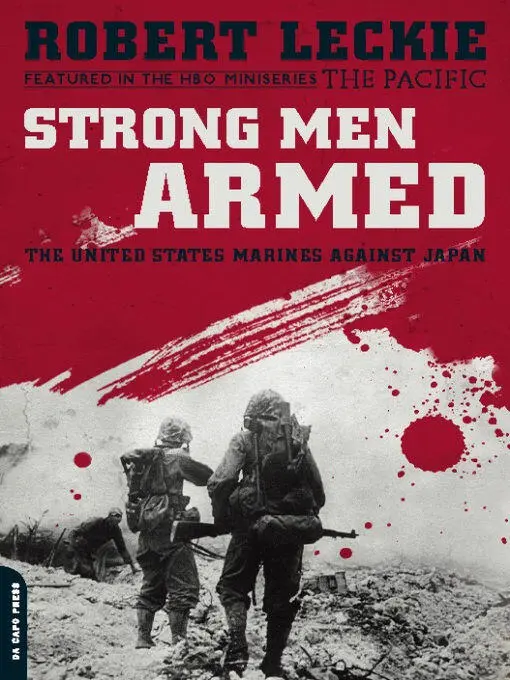
- Название:Strong Men Armed
- Автор:
- Издательство:Da Capo Press
- Жанр:
- Год:2010
- Город:Cambridge
- ISBN:978-0-786-74832-7
- Рейтинг книги:3 / 5. Голосов: 1
-
Избранное:Добавить в избранное
- Отзывы:
-
Ваша оценка:
Strong Men Armed: краткое содержание, описание и аннотация
Предлагаем к чтению аннотацию, описание, краткое содержание или предисловие (зависит от того, что написал сам автор книги «Strong Men Armed»). Если вы не нашли необходимую информацию о книге — напишите в комментариях, мы постараемся отыскать её.
Strong Men Armed — читать онлайн бесплатно полную книгу (весь текст) целиком
Ниже представлен текст книги, разбитый по страницам. Система сохранения места последней прочитанной страницы, позволяет с удобством читать онлайн бесплатно книгу «Strong Men Armed», без необходимости каждый раз заново искать на чём Вы остановились. Поставьте закладку, и сможете в любой момент перейти на страницу, на которой закончили чтение.
Интервал:
Закладка:
The Marines let loose a shower of grenades, charged—and routed the Japanese on the hill.
But to the rear of that hill, toward the sea, Yukioka’s demolition squads were slipping down the ravines toward the Division Hospital. They were tipsy and they were swigging the last of the saki in their canteens. Some were already in the throes of hangover. They moved on, their ranks augmented by the suiciders creeping from the caves in which they had spent the night. One such group came out reeling drunkenly, unaware that they had spent the night sitting on a terrified American who had by now lost his mind. They joined up. They came to a high hill overlooking the American hospital tents. They could see the sea only a few hundred yards west. It was half-past six in the morning, and they started down the hill.
A wounded Marine coming east from the hospital to rejoin his outfit on the front saw the short men in khaki slipping and sliding down the hill. He turned and wide-legged it back to the hospital, bawling:
“The Japs are coming! The Japs are coming!”
Corpsmen and patients grabbed weapons and flung themselves behind cots or cartons of plasma. Some of the walking wounded jumped from their cots and ran for the beach. A cook wounded the night before leaped erect, naked, and hobbled for safety.
The Japanese came with a yell and a shower of grenades. Corpsmen and patients fired back. A doctor absorbed in an operation glanced up as shrapnel whistled through the tent canvas. He sent his corpsmen outside to fight and continued the operation.
Meanwhile, at Division Headquarters, a few hundred yards to the right of the hospital as it faced the front, Colonel George Van Orden began rounding up another pick-up force. Every available man behind the lines—Seabees, MP’s, combat correspondents, truck drivers—was collected and led toward the hospital, where the Japanese were driven back into a jumble of hills.
Then Colonel Van Orden’s force turned to a methodical mopping-up of all the terrain between the sea and the front lines. It was grisly work, relieved only by the fact that the Japanese began to blow themselves up. Here and there a new method of suicide appeared. Enemy soldiers took off their helmets, placed a primed grenade on top of their heads, replaced the helmet—and awaited oblivion with folded arms.
By noon it was all over.
By nightfall it was clear that General Takashina had lost 3,500 soldiers, exclusive of the Orote losses. He had lost 95 per cent of his commissioned officers and go per cent of his weapons had been destroyed. He had so many wounded that their presence was weakening morale. He had no hope of help either by sea or by air, and American power in those elements was battering him ceaselessly. His men had killed only 200 of the enemy, while wounding 645 more, and the Third Marine Division was already prepared to come out fighting on Fonte Plateau. There was nothing for Takashina to do but withdraw. He had staked all on that grand banzai, but in the words of the man who opposed him, Major General Allen Turnage:
“It was a grand victory for us.”
13
Two days after General Takashina’s grand banzai had been shattered, the general was himself dead. He was machine-gunned by Marines breaking out of the Asan-Adelup beachhead. Command passed to elderly Lieutenant General Hideyoshi Obata, the commander of the Marianas defenses who had been caught on Guam when the Americans landed.
On that same July 28, the 77th Division completed patrolling to the south, came up north, took Mount Tenjo, and linked up with the Third Marine Division’s right flank. Also that day, Brigadier General Shepherd’s First Brigade struck out along Orote and drove into the old Marine Barracks. They found a cigar box holding prewar Post Exchange receipts, a star-spangled pillow which a Japanese soldier had made from the blue field of the American flag, and a bronze plaque. The rest was rubble. They drove on, to take the airfield and to herd the last of Commander Tamai’s 3,500 men onto Orote’s eastern tip.
On July 31—the day General MacArthur’s approach to the Philippines reached its terminus on Sansapor Point in western New Guinea, the date of the Allied breakout from the Normandy beachhead in France—the First Brigade came to the end of Orote Peninsula. The Brigade had fought a bitter battle since the landing at Agat, the sweep north, the fighting left-turn onto Orote. Their dead and missing numbered 431, their wounded 1,525. But they had buried 3,372 Japanese and taken only three prisoners. Now a squad had come upon the last living enemy soldier on Orote.
He was a forlorn scrimp of a man, small even for his race, and his tattered blouse and breeches were much too large. But there was an easiness about him that puzzled the Marines who took him captive. Many times Japanese prisoners had become ashamed of having surrendered and asked for a knife to commit hara-kiri . Yet this soldier seemed almost eager to be taken away. A Marine interpreter spoke to him.
“Why did you surrender?”
“My commanding officer told us to fight to the last man.” The Marine’s eyebrows rose.
“Well?”
The Japanese soldier’s eyebrows also rose—in wounded innocence—and he exclaimed:
“I am the last man.”
The same day, Guam’s two-division attack to the northeast began with the Third Marine Division on the left, the 77th Infantry on the right. The Marines were moving against Agana, the city which stood on the island’s western shore at the narrow waist where the Guam peanut twists east and north. There was no opposition in Agana. The city had been ruined by American bombing and naval gunfire called down on General Takashina’s artillery concentrations there. Its Chamorro population had fled into the bush days before the invasion, after American warplanes dropped leaflets advising them to do so.
A squad of Marines moved warily through Agana’s streets, now silent and powdery with dust. They passed what had once been a neat little cemetery, now debauched by naval shelling. Huge 14-inch shell craters pocked it and its crosses and headstones were a jumble of jagged pieces. One of the Marines shook his head.
“Even the dead can’t rest in peace,” he said.

On the right flank, Major General Andrew Bruce’s 77th Infantry Division also moved ahead with no opposition. The only hindrances were the roughness of the terrain, the heat, and nagging swarms of flies and mosquitoes.
Then, at a jungle place called Yona, the soldiers found a concentration camp filled with Chamorros.
There were 2,000 of them, cheering, weeping, laughing, singing. They had been living in lean-tos and thatched huts built in the mud to either side of a sluggish stream. They had had little food, no medical care. They were clothed in rags. They were weak, racked by continual coughing fits—victims of malnutrition, malaria and tuberculosis. Their bodies were sticks of bones and their olive skin was drawn drum-tight. But this thirty-first of July was the day they had awaited for nearly three years. When they saw the American soldiers coming through the trees they hobbled to their feet with glad cries.
They sang “The Marines’ Hymn”—for they remembered the Marines—but the soldiers of the 3rd Battalion, 307th Infantry, didn’t mind that at all. They began to sing a song of their own underground, composed especially for this date and memorized in face of every threat of reprisal.
Early Monday morning
The action came to Guam,
Eighth of December,
Nineteen forty-one.
Oh, Mr. Sam, Sam, my dear Uncle Sam,
I want you please come back to Guam.
Our lives are in danger—
You better come
And kill all the Japanese
Right here on Guam.
Oh, Mr. Sam, Sam, my dear Uncle Sam,
I want you please come back to Guam.
Интервал:
Закладка:
Похожие книги на «Strong Men Armed»
Представляем Вашему вниманию похожие книги на «Strong Men Armed» списком для выбора. Мы отобрали схожую по названию и смыслу литературу в надежде предоставить читателям больше вариантов отыскать новые, интересные, ещё непрочитанные произведения.










Обсуждение, отзывы о книге «Strong Men Armed» и просто собственные мнения читателей. Оставьте ваши комментарии, напишите, что Вы думаете о произведении, его смысле или главных героях. Укажите что конкретно понравилось, а что нет, и почему Вы так считаете.