Robert Leckie - Strong Men Armed
Здесь есть возможность читать онлайн «Robert Leckie - Strong Men Armed» весь текст электронной книги совершенно бесплатно (целиком полную версию без сокращений). В некоторых случаях можно слушать аудио, скачать через торрент в формате fb2 и присутствует краткое содержание. Город: Cambridge, Год выпуска: 2010, ISBN: 2010, Издательство: Da Capo Press, Жанр: nonf_military, на английском языке. Описание произведения, (предисловие) а так же отзывы посетителей доступны на портале библиотеки ЛибКат.
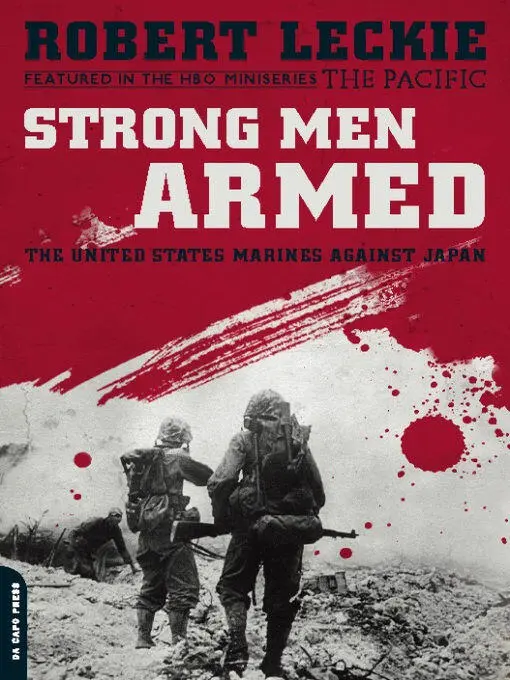
- Название:Strong Men Armed
- Автор:
- Издательство:Da Capo Press
- Жанр:
- Год:2010
- Город:Cambridge
- ISBN:978-0-786-74832-7
- Рейтинг книги:3 / 5. Голосов: 1
-
Избранное:Добавить в избранное
- Отзывы:
-
Ваша оценка:
Strong Men Armed: краткое содержание, описание и аннотация
Предлагаем к чтению аннотацию, описание, краткое содержание или предисловие (зависит от того, что написал сам автор книги «Strong Men Armed»). Если вы не нашли необходимую информацию о книге — напишите в комментариях, мы постараемся отыскать её.
Strong Men Armed — читать онлайн бесплатно полную книгу (весь текст) целиком
Ниже представлен текст книги, разбитый по страницам. Система сохранения места последней прочитанной страницы, позволяет с удобством читать онлайн бесплатно книгу «Strong Men Armed», без необходимости каждый раз заново искать на чём Вы остановились. Поставьте закладку, и сможете в любой момент перейти на страницу, на которой закончили чтение.
Интервал:
Закладка:
“What in hell’s the matter with the artillery? Why’d you cease firing?”
“Aren’t we hitting our own men?”
“Like hell you are!” the officer bellowed. “Those are the Japs screaming. Make ‘em scream some more—plenty more! My men like to hear it.”
So the tension left the lips of Lieutenant Rennie and he smiled as he picked up the telephone and said:
“Belay that last. Fire for effect!”
The shells continued to crash into the coconut grove and when the barrage was lifted, E Company had pulled out of the enemy trap and was able to re-form for the attack which went forward that day and the next until the coconut grove was cleaned out.
The mouth of the East-West Trail had been cleared and the way was now open to pursuit.
7
When Rear Admiral Keiji Shibasaki came out to the Gilbert Islands in August, 1943, to direct the defense of this Central Pacific group about 2,400 miles southwest of Pearl Harbor, he set up headquarters on the islet of Betio. This was the coral speck which the Japanese had renamed Bititu and which the world now knows as Tarawa from the chain of which it is only a part.
For Tarawa is not an island but an atoll, one of those chains of islets created by a great saw-toothed saucer of coral rising from the ocean floor. The broken teeth sticking above water are the islets. Within them, in the hollow of the saucers—enclosed or half-closed by surrounding reef—are lagoons. They are excellent anchorages. Some of the islets are broad enough to support airports. Tarawa Atoll, a triangle with its sides running about 30 miles north-south and its base about 25 miles east-west, formed one of these anchorages. It was accessible through a western channel about six miles above Betio, which was the westernmost islet and the left-hand angle of the triangle. Betio was also just big enough to support an airfield while being too small for enemy maneuver. It became the heart of the defense of Tarawa Atoll, which was itself the key to the Gilberts, and it was fortified by the Japanese as had been no island in history.
Such defenses were the result of the raid on Makin Atoll 105 miles north by Carlson’s Raiders in August, 1942. The Makin incursion had had a rich yield of headlines in America, but it had warned Japan of the necessity of defending the Gilberts and of the futility of attempting it on Makin. In September of 1942 an industrious rear admiral named Tomanari Saichiro began fortifying Betio. He built an airfield on the western half of the parrot-shaped islet, on the bird’s body, and he made each of Betio’s 291 acres bristle with every gun in the Japanese arsenal-all mounted within pillboxes, blockhouses and huge bombproofs of ferro-concrete two stories high. Betio’s beaches were girdled by a sea wall made of coconut logs clamped and stapled together. It was from three to five feet in height and stood about 20 feet inland from the water. An American helmet reared above this sea wall would be as clear and helpless as a fly walking down a windowpane. And if the Americans crouched beneath it, Betio’s mortars would dye the sands with their blood. The mortars had the beaches registered—and they were behind a formidable array of machine guns and light artillery interlocked to sweep the lip of the sea wall, and after that the airfield.
There were 62 heavy machine guns and 44 light machine guns—many of them twin mounts-nine 37-millimeter antitank guns and the 37’s of 14 light tanks dug into the coral sand and camouflaged with palm fronds-to say nothing of the rifles, pistols, grenades and bayonets of the defending troops, to say nothing of the heavier artillery.
Of this there were six 70-millimeter battalion guns, eight more 75-millimeter dual-purpose guns, ten 75-millimeter mountain guns, four five-inch dual purpose guns, six 80-millimeter guns, four coast defense guns 5.5 inches in diameter and four eight-inch coastal guns brought to Betio from Singapore. Most of these guns were mounted to fire antiboat along preselected fields of fire. They were sighted from concrete-and-coral pillboxes. The five- and eight-inch guns could duel the invading ships. The eight-inchers were placed at each end of the island, two to an end, and served from enormous concrete ammunition rooms.
To either end of the airfield, east and west, there were tank traps. The field itself was protected by rifle pits and pillboxes, dug in deeply and covered with coconut logs and coral sand and sometimes also with concrete. These firing holes were also interlocked, often served by networks of trenches.
Only the water defenses needed improvement when, eleven months later, Admiral Shibasaki arrived on Betio to relieve Saichiro. The new commander completed these on the south or ocean side by erecting a wicked offshore maze of horned concrete tetrahedrons. They were wired together, mines were sprinkled among them, and they were so placed as to channel all incoming boats into the point-blank fire of the 70-, 75- and 8o-millimeter guns. This was done by mid-September, 1943. Admiral Shibasaki next set his men to placing the same sort of obstacles between the northern or lagoon beaches and the lagoon reef about 500 to 1,000 yards offshore. When this was done, the admiral would have fulfilled his assignment in the Imperial General Headquarters plan called Yogaki, or Waylaying Attack. Yogaki’s purpose was to teach the Americans the prohibitive costs of invading fortified islands. Under it, Shibasaki was to make Betio impregnable while:
Long-range aircraft flew down from Rabaul and Kavieng to bomb the invaders, and then land on Gilberts-Marshalls fields;
Short-range aircraft flew down from Truk by stages to these same airfields to provide aerial defense;
Admiral Kondo’s powerful Second Fleet arrived to attack American shipping;
And a heavy force of submarines converged from all directions.
This was the plan, but on September 19 the Americans began hacking away at it.
On that night and the succeeding day the new American carriers Lexington and the smaller Princeton and Belleau Wood made their fighting debut at Betio’s expense. Their airplanes shot up the boats needed to carry the tetrahedrons out into the lagoon and they also destroyed much of the cement.
Still, Shibasaki was not dismayed. His gun emplacements had not been harmed. He had had time to make Betio’s ocean side impregnable and Tarawa was now on the neap, that seasonal tide when waters are lowest. Shibasaki doubted very much if the Americans would be able to cross the lagoon reef.
So did the Americans; so did a couple of generals named Smith.
The first was Holland M. Smith and he was a major general in command of the Fifth Amphibious Corps. He was six-one, graying, a man with a dandified white mustache and professorial eyeglasses juxtaposed against a big aggressive nose and a tongue that could be blistering and irreverent whenever Marines were being slighted. The Marines called him Howlin’ Mad. In legend it was because of what he had said to the men he led on a record-breaking hike through the Philippine jungle in 1906; in fact it was because it fitted his first name and middle initial as much as his temperament.
The second Smith was Major General Julian Smith, the commander of the Second Marine Division. He was soft-spoken, gentle-eyed, fatherly. He rarely lost his temper. But if Julian Smith was not angry on October 2, 1943, he was at least concerned.
General Julian Smith had come to Pearl Harbor with his chief of staff, Red Mike Edson of Guadalcanal, and had begun to confer with General Holland Smith on the Second Division’s assignment to capture Betio. He was worried about the reef and the tides. Even though his men would make their assault from the lagoon side, entering by boat from the western channel, there was a reef there, too. And with the attack occurring during the neap tide, Julian Smith could not be certain of much water over that reef. Tarawa was also visited by “dodging tides” which were sometimes irregularly high, sometimes irregularly low, but Julian Smith did not share Rear Admiral Richard Kelly Turner’s confidence that there would be a high-dodger on invasion day. There could be a low one. If there was, Julian Smith’s Marines would never get over the reef in their landing boats. They would have to wade inshore from 500 to 1,000 yards out—into a murderous fire. Julian Smith wanted amtracks. Amtracks could climb the reefs and churn ashore. But he had only 75 operable amtracks, which was not enough to get his first waves ashore. He needed at least 100 more.
Читать дальшеИнтервал:
Закладка:
Похожие книги на «Strong Men Armed»
Представляем Вашему вниманию похожие книги на «Strong Men Armed» списком для выбора. Мы отобрали схожую по названию и смыслу литературу в надежде предоставить читателям больше вариантов отыскать новые, интересные, ещё непрочитанные произведения.









Обсуждение, отзывы о книге «Strong Men Armed» и просто собственные мнения читателей. Оставьте ваши комментарии, напишите, что Вы думаете о произведении, его смысле или главных героях. Укажите что конкретно понравилось, а что нет, и почему Вы так считаете.