Robert Leckie - Strong Men Armed
Здесь есть возможность читать онлайн «Robert Leckie - Strong Men Armed» весь текст электронной книги совершенно бесплатно (целиком полную версию без сокращений). В некоторых случаях можно слушать аудио, скачать через торрент в формате fb2 и присутствует краткое содержание. Город: Cambridge, Год выпуска: 2010, ISBN: 2010, Издательство: Da Capo Press, Жанр: nonf_military, на английском языке. Описание произведения, (предисловие) а так же отзывы посетителей доступны на портале библиотеки ЛибКат.
- Название:Strong Men Armed
- Автор:
- Издательство:Da Capo Press
- Жанр:
- Год:2010
- Город:Cambridge
- ISBN:978-0-786-74832-7
- Рейтинг книги:3 / 5. Голосов: 1
-
Избранное:Добавить в избранное
- Отзывы:
-
Ваша оценка:
Strong Men Armed: краткое содержание, описание и аннотация
Предлагаем к чтению аннотацию, описание, краткое содержание или предисловие (зависит от того, что написал сам автор книги «Strong Men Armed»). Если вы не нашли необходимую информацию о книге — напишите в комментариях, мы постараемся отыскать её.
Strong Men Armed — читать онлайн бесплатно полную книгу (весь текст) целиком
Ниже представлен текст книги, разбитый по страницам. Система сохранения места последней прочитанной страницы, позволяет с удобством читать онлайн бесплатно книгу «Strong Men Armed», без необходимости каждый раз заново искать на чём Вы остановились. Поставьте закладку, и сможете в любой момент перейти на страницу, на которой закончили чтение.
Интервал:
Закладка:
They were openly “beating their gums” over the stench and heat below decks; about the confusion of crossing the International Date Line so often that one week had two Sundays and no Thursday; over being tricked by the “Hawkes Bay Hoax” and not having had the chance to say goodbye in style; about being offered the insult of assaulting an upside-down bird of an island rock while the Third Division was taking Bougainville-which even the Stateside folks had heard of-and the First had sneaked up to New Guinea to try to steal headlines from Dugout Doug; over the tedium of playing endless games of gin rummy, of smoking, of drinking lukewarm coffee that the swabbie messman handed you like he wanted to charge you for it; of washing socks and underwear by tying them to ropes and heaving them over the fantail to be cleansed by the wake from the propeller; of reading paperbacked mysteries, paperbacked westerns, Bibles, histories; and finally of having to be led below daily, platoon by platoon, to dissolve in puddles of their own sweat while the officers rolled down the bulkhead maps and went over their role on Betio-again and again and again.
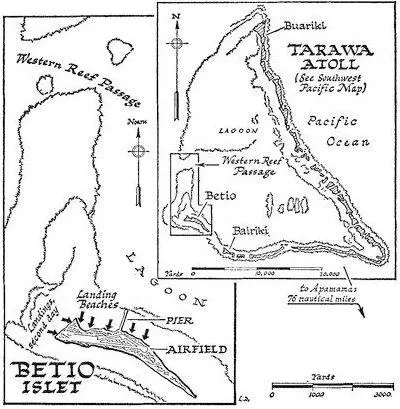
It was the maps which gave the men the impression of Betio as an upside-down bird. They were of course oriented north, and because the parrot’s back was the south coast and the underbelly the north, the bird seemed upside down. The Marines were going to hit this north coast, the underbelly, with three battalions landing in three sectors almost exactly coextensive with the airfield, the bird’s head and body. In roughly the center of this was a long pier stretching out into the lagoon, and this gave the impression of the bird’s legs.
Attacking on the left or east would be the Second Battalion, Eighth Marines-detached to Colonel Shoup’s Second Marines for the assault—led by the red-mustachioed Major Henry (Jim) Crowe, a “mustang” up from the ranks and a commander as energetic as he was enormous. In the center would be the Second Battalion, Second, under Lieutenant Colonel Herbert Amey. On the right or west was the Third Battalion, Second, under Major John Schoettel. Major General Julian Smith would have his three remaining battalions in reserve, for his Sixth Marine Regiment was still detached to Fifth Corps.
The first three waves were to be led into the lagoon by destroyers Ringgold and Dashiell after the little minesweepers Pursuit and Requisite had swept the entrance clear of mines. The amtracks would cross the lagoon reef to bring the assault troops ashore at about half-past eight, then return to the reef to pick up reinforcements which would be brought up to it by landing boats.
Julian Smith and his commanders still doubted that there would be enough water on the reef for the landing boats to cross it. Their only consolation was that they had had the forethought to provide themselves with enough amtracks to take in the first three waves. They took no comfort from the message sent them by the Tarawa force’s sea commander, Rear Admiral Harry Hill. It said:
“It is not our intention to wreck the island. We do not intend to destroy it. Gentlemen, we will obliterate it.”
8
The invasion fleet stood off Tarawa Atoll on the morning of November 20. Seventeen dark shapes slid into position about a mile off the western entrance to the lagoon, a few miles above the islet of Betio. They were the transports.
Below the lagoon entrance were the fire-support ships, battleships Maryland, Colorado and Tennessee with their cruisers and destroyers. Japan would regret not having attacked old Maryland and Tennessee in the open sea-where they would have been lost forever—instead of in the shallow waters of Pearl Harbor. They had been salvaged, modernized and sent out to join bombardment forces.
It was about half-past three in the morning. A half-moon flitted in and out of fleecy clouds. It was cool. Marines going down cargo nets into waiting landing boats could feel the perspiration drying on their foreheads.
They came from stifling galleys in which they had dined on steak and eggs, french fried potatoes and hot coffee, a meal as sure to induce perspiration as it provoked dismay from the transport surgeons who would soon be sewing up some of these men.
“Steak and eggs!” a surgeon aboard Zeilin exclaimed. “Jesus, that will make a nice lot of guts to have to sew up-full of steak!”
The men were boated now, moving slowly away from the big ships, coming to make the difficult transfer to the amtracks. They made it without accident. The attack lines were forming a quarter-mile off the lagoon entrance. Little Pursuit and Requisite were darting into the channel to sweep it clear of mines -and at 4:41 A.M. a red star-shell swished into sight high above Betio and a half-hour later the Japanese shore batteries opened up.
The American battleships fired back.
Aboard Maryland the great long lengths of steel fingered the sky. One of them leaped. Flame spouted from it. A streaking blob of red sailed toward Betio. Marines in their tiny churning boats could watch its progress. They saw no explosion on Betio. The shell was short. Again the great gob of orange flame and the speck of streaking red, and again no explosion. But then dawn seemed to burst like a rocket from western Betio. A great sheet of flame sprang 500 feet into the air, and the explosion which succeeded it sent shock waves rolling out over the water.
Old Maryland had hurled one of her 16-inch armor piercers into the ammunition room of the eight-inchers mounted on Betio’s western tip. It was perhaps the greatest single bombardment feat of the war, for that shell of more than half a ton had killed men by the hundreds and had detonated hundreds of tons of enemy shells, and utterly wrecked the eight-inchers’ blockhouse. And then Tennessee and Colorado began to thunder. All the battleships were firing in salvos, drifting in and out of their own gunsmoke as they paraded the Betio shoreline. Heavy cruisers belched flame and smoke from eight-inch muzzles. The lights roared away with six-inchers. Destroyers ran in close to send five-inch bullets arching ashore with almost the rapidity of automatic weapons.
Betio was aglow. She was a mass of fires. Great dust clouds swirled above her. Smoke coiled up and fused with them. Fires towered high and lit them with a fluttering pink glare. It seemed that Admiral Hill had been right, that Betio would not greet another dawn. The islet was being torn apart. She was no longer visible beneath that pall, now frowning, now glowing.
Then at forty-two minutes past five the American warships ceased firing. The American carrier planes were coming in, and it would be well to let the smoke clear so that the Dauntlesses and Avengers and the superb new Hellcat fighters could see their targets.
But the air strike did not arrive, and in the interval those “pulverized” Japanese began firing back.
They shot at the transports with five-inchers and those eight-inchers still operative. They drove the transports off, and plowing after them in flight went the amtracks and landing boats loaded with Marines. For half an hour the fleeing transports duck-walked among exploding shells, and then, because the air strike had still not arrived, the American warships resumed fire.
For ten minutes the air was filled with their bellowing, and then with the islet again glowing, the carrier planes came in. Hardly a bursting enemy antiaircraft shell or bullet rose to chastise these strafing, swooping planes, and it seemed that Betio was surely zemmetsu. Again she was swathed in smoke.
Читать дальшеИнтервал:
Закладка:
Похожие книги на «Strong Men Armed»
Представляем Вашему вниманию похожие книги на «Strong Men Armed» списком для выбора. Мы отобрали схожую по названию и смыслу литературу в надежде предоставить читателям больше вариантов отыскать новые, интересные, ещё непрочитанные произведения.









Обсуждение, отзывы о книге «Strong Men Armed» и просто собственные мнения читателей. Оставьте ваши комментарии, напишите, что Вы думаете о произведении, его смысле или главных героях. Укажите что конкретно понравилось, а что нет, и почему Вы так считаете.