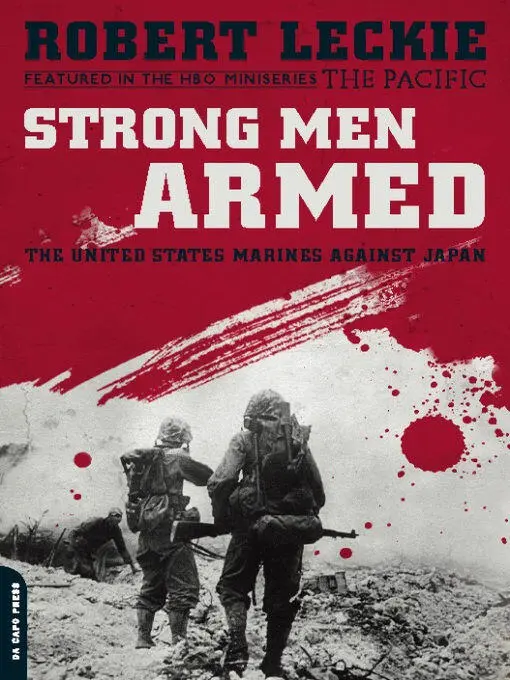
Robert Leckie - Strong Men Armed
Здесь есть возможность читать онлайн «Robert Leckie - Strong Men Armed» весь текст электронной книги совершенно бесплатно (целиком полную версию без сокращений). В некоторых случаях можно слушать аудио, скачать через торрент в формате fb2 и присутствует краткое содержание. Город: Cambridge, Год выпуска: 2010, ISBN: 2010, Издательство: Da Capo Press, Жанр: nonf_military, на английском языке. Описание произведения, (предисловие) а так же отзывы посетителей доступны на портале библиотеки ЛибКат.
- Название:Strong Men Armed
- Автор:
- Издательство:Da Capo Press
- Жанр:
- Год:2010
- Город:Cambridge
- ISBN:978-0-786-74832-7
- Рейтинг книги:3 / 5. Голосов: 1
-
Избранное:Добавить в избранное
- Отзывы:
-
Ваша оценка:
Strong Men Armed: краткое содержание, описание и аннотация
Предлагаем к чтению аннотацию, описание, краткое содержание или предисловие (зависит от того, что написал сам автор книги «Strong Men Armed»). Если вы не нашли необходимую информацию о книге — напишите в комментариях, мы постараемся отыскать её.
Strong Men Armed — читать онлайн бесплатно полную книгу (весь текст) целиком
Ниже представлен текст книги, разбитый по страницам. Система сохранения места последней прочитанной страницы, позволяет с удобством читать онлайн бесплатно книгу «Strong Men Armed», без необходимости каждый раз заново искать на чём Вы остановились. Поставьте закладку, и сможете в любой момент перейти на страницу, на которой закончили чтение.
Интервал:
Закладка:
But as Pursuit and Requisite entered the lagoon through the reef passage, shore batteries on the landing beaches lashed out at them. The minesweepers called for Ringgold and Dashiell. The two graceful destroyers swept into the lagoon, firing as they came, with amtracks full of Marines churning after them.
A shell struck Ringgold to starboard, passing through the engine room. But it didn’t explode. Another. Again a dud. Through the smoke and fire ashore Ringgold’s gunnery officer had spotted the flashes of her tormentor. Her five-inchers swung around and gushed flame. There was a great explosion ashore. The enemy gun’s ammunition dump had been hit.
It was getting close to nine o’clock and the amtrack motors were rising to full throttle. The swaying clumsy craft were going into Betio. They were taking harmless air bursts overhead, taking long-range machine-gun fire with bullets rattling off their sides. The wind was blowing Betio’s smoke into their faces, blowing the water flat and thin over the reef-but the amtracks were bumping over it and boring in. Now the Marines were ducking low beneath the gunwales, for a volcano of flame and sound had begun to erupt around them and there were amtracks blowing up, amtracks beginning to burn, amtracks spinning around, slowing and sinking—for if they cannot move they sink—and there were amtracks grinding ashore and rising from the surf with water streaming from their sides, with helmeted figures in mottled green leaping from them and sprinting over the narrow beaches toward the treacherous sanctuary of the sea wall; and falling, falling, falling as they ran.
The Scout-Sniper Platoon went into Betio five minutes before the first wave. It was led by a lieutenant named William Deane Hawkins, but hardly any of the platoon’s 40 men could remember Hawk’s first name. He was just Hawk, lean and swift like a hawk, a man as convinced of victory as he was sure of his own death in battle. Hawkins had joined the Marines with this remark to his closest friend: “I’ll see you some day, Mac-but not on this earth.” He had come up from the ranks, actually risen, unlike that legion who “come up through the ranks” by marking time as an enlisted man while powerful friends push their commission through channels.
Hawkins and the Scout-Snipers went in to seize the pier extending about 500 yards into the lagoon. It split the landing beaches, and from it those numerous Japanese latrines now filled with riflemen and machine-gunners could rake the Marine amtracks passing to either side.
Hawkins had his men in two landing boats, one commanded by himself, the other by Gunnery Sergeant Jared Hooper. In a third boat were the flame-throwing engineers of Lieutenant Alan Leslie.
They came in and hit the reef. They were held up there just as enemy mortars began to drop among them and drums of gasoline stacked on the pier began to burn. Sniper and machine-gun fire raked the boats. Airplanes were called down on the enemy guns while Hawkins and his men awaited transfer to amtracks. They got them and rode in to assault the pier. They fought with flame-throwers, with grenades, with bayonets. They fought yard by yard, killing and being killed-while the pier still burned-and swept ashore to attack enemy pillboxes.
Like Hector in his chariot, Lieutenant Hawkins stood erect in his amtrack while it butted through barbed wire, climbed the sea wall and clanked among the enemy spitting fire and grenades.
In another amtrack called The Old Lady was a stocky corporal named John Joseph Spillane, a youngster who had a big-league throwing arm and the fielding ability which had brought Yankee and Cardinal scouts around to talk to his father. The Old Lady and Corporal Spillane went into Betio in the first wave, a load of riflemen crouching below her gunwales, a thick coat of hand-fashioned steel armor around her unlovely hull. Then she came under the sea wall and the Japanese began lobbing grenades into her.
The first came in hissing and smoking and Corporal Spillane dove for it. He trapped it and pegged it in a single, swift, practiced motion. Another. Spillane picked it off in mid-air and hurled it back. There were screams. There were no more machine-gun bullets rattling against The Old Lady’s sides. Two more smoking grenades end-over-ended into the amtrack. Spillane nailed both and flipped them on the sea wall. The assault troops watched him in fascination. And then the sixth one came in and Spillane again fielded and threw.
But this one exploded.
Johnny Spillane was hammered to his knees. His helmet was dented. There was shrapnel in his right side, his neck, his right hip, and there was crimson spouting from the pulp that had once been his right hand.
But the assault troops had vaulted onto the beach and were scrambling for the sea wall. Though Johnny Spillane’s baseball career was over, he had bought these riflemen precious time, and he was satisfied to know it as he called, “Let’s get outta here,” to his driver and the squat gray amphibian backed out into the water to take him out to the transport where the doctor would amputate his right hand at the wrist.
Pfc. Donald Libby also came in on the first wave. He came in crouching in fear, grimacing in pain. Machine-gun fire had been sweeping his amtrack since it had lumbered up on the reef, and there were bullets in both of Libby’s thighs. Then a mortar shell landed in the amtrack, killing all but two men, hurling Libby into the water.
He came to the surface with seven shrapnel fragments lodged in his flesh. He was bleeding heavily, but he hoped the salt water would staunch the flow. He dog-paddled toward his wrecked amtrack. It was canted on its side in the water. Libby grabbed the amtrack’s wheel and hung onto it. A life preserver floated by. He seized it and squirmed into it, clenching his teeth against the pain of his movement. He floated behind the amtrack, hardly more than his nose above the surface. At night, if he still had strength, he would try to swim out to the ships.
Lieutenant Commander Robert MacPherson buzzed back and forth over Betio and the lagoon in his Kingfisher observation plane. He was acting as the eyes of Major General Julian Smith aboard Maryland. Howlin’ Mad Smith was up at Makin with Vice Admiral Raymond Spruance, the over-all commander.
MacPherson peered below him. The muzzles of Ringgold’s and Dashiell’s guns were spitting flame and smoke and the little amtracks were bobbing shoreward. Some of them stopped and began to burn. Tiny dots of men leaped on the beach to go clambering over the sea wall and vanish beneath the pall of smoke still obscuring Betio.
The Marines seemed to be attacking in little groups—three or four of them, rarely more than half a dozen—moving behind their NCO’s. Here and there a loner struck at the enemy.
Staff Sergeant Bill Bordelon was such a loner. He was one of four Marines to survive the gunning of their amtrack from about 500 yards out. He reached the beach, running low. Behind him were the remainder of his men, dead and dying or drowning. Bordelon had to get the pillboxes that filled the air around these men with whining invisible death.
He prepared his demolition charges.
He sprang erect and went in on the pillboxes, running at them from their flanks because the Japanese used very small gun ports which reduced their field of fire. Twice Bordelon threw and sprinted for cover and each time a pillbox collapsed with a roar. Bordelon primed more charges and ran against a third.
Machine-gun bullets hit him, but he stayed on his feet. He saw the white blocks of explosive sail into the gun port and ducked. The third position was knocked out. Then he seized a rifle to cover a group of Marines crawling over the sea wall.
Читать дальшеИнтервал:
Закладка:
Похожие книги на «Strong Men Armed»
Представляем Вашему вниманию похожие книги на «Strong Men Armed» списком для выбора. Мы отобрали схожую по названию и смыслу литературу в надежде предоставить читателям больше вариантов отыскать новые, интересные, ещё непрочитанные произведения.











Обсуждение, отзывы о книге «Strong Men Armed» и просто собственные мнения читателей. Оставьте ваши комментарии, напишите, что Вы думаете о произведении, его смысле или главных героях. Укажите что конкретно понравилось, а что нет, и почему Вы так считаете.