Robert Leckie - Strong Men Armed
Здесь есть возможность читать онлайн «Robert Leckie - Strong Men Armed» весь текст электронной книги совершенно бесплатно (целиком полную версию без сокращений). В некоторых случаях можно слушать аудио, скачать через торрент в формате fb2 и присутствует краткое содержание. Город: Cambridge, Год выпуска: 2010, ISBN: 2010, Издательство: Da Capo Press, Жанр: nonf_military, на английском языке. Описание произведения, (предисловие) а так же отзывы посетителей доступны на портале библиотеки ЛибКат.
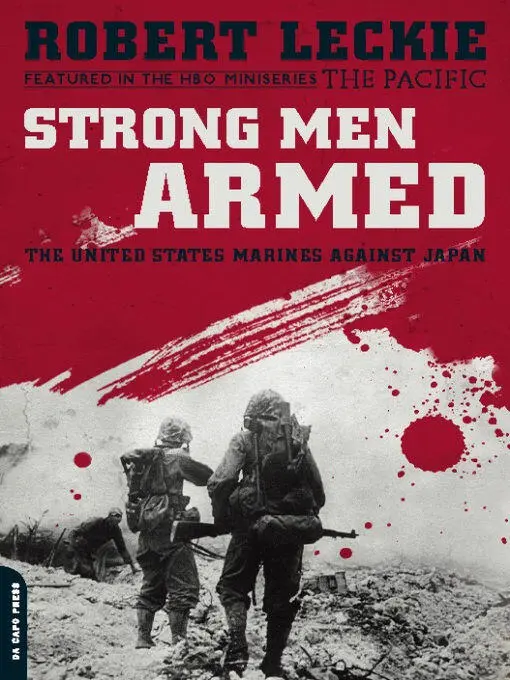
- Название:Strong Men Armed
- Автор:
- Издательство:Da Capo Press
- Жанр:
- Год:2010
- Город:Cambridge
- ISBN:978-0-786-74832-7
- Рейтинг книги:3 / 5. Голосов: 1
-
Избранное:Добавить в избранное
- Отзывы:
-
Ваша оценка:
Strong Men Armed: краткое содержание, описание и аннотация
Предлагаем к чтению аннотацию, описание, краткое содержание или предисловие (зависит от того, что написал сам автор книги «Strong Men Armed»). Если вы не нашли необходимую информацию о книге — напишите в комментариях, мы постараемся отыскать её.
Strong Men Armed — читать онлайн бесплатно полную книгу (весь текст) целиком
Ниже представлен текст книги, разбитый по страницам. Система сохранения места последней прочитанной страницы, позволяет с удобством читать онлайн бесплатно книгу «Strong Men Armed», без необходимости каждый раз заново искать на чём Вы остановились. Поставьте закладку, и сможете в любой момент перейти на страницу, на которой закончили чтение.
Интервал:
Закладка:
“All right,” said Howlin’ Mad Smith. “I’ll get’em for you.”
So Julian Smith and Red Mike Edson flew back to Wellington, but when Howlin’ Mad Smith spoke to Kelly Turner, Kelly Turner said, “No.”
The admiral who commanded the Fifth Amphibious Force said he would not have the amtracks aboard his ships. There was going to be a high-dodging tide off Betio on November 20 and amtracks would not be needed. Howlin’ Mad said:
“Kelly, it’s like this: I’ve got to have those amtracks. We’ll take a helluva licking without them. No amtracks—no operation.”
It was not customary to hand Kelly Turner ultimatums, but this one had the virtue of suggesting Smith’s determination. It was finally arranged that of 100 amtracks then in California 50 would be rushed to Samoa where the Second could pick them up after they departed Wellington.
Meanwhile, what about Makin?
Makin would be taken by another general named Smith-the Army’s Major General Ralph Smith, who led the 27th Infantry Division. Intelligence estimated Makin’s garrison at a little better than 500 men, though there were actually 900. To take Makin, Ralph Smith was going to use but one of his three regiments, the 165th Infantry.
A third, much smaller operation was planned. This was the seizure of Apamama, a beautiful and historic atoll about .85 miles south of Tarawa. Apamama would not be attacked until November 26, but it would be scouted on November 21 by the Fifth Corps Reconnaissance Company of Captain Jim Jones. These Marines were to sail by submarine from Tarawa the night of November 20, going ashore by rubber boat in early morning to learn the extent of Apamama’s defenses. Intelligence believed the atoll to be defended in company strength or more, though actually it was much less.
Intelligence was more accurate in its estimate of 4,500 men on Betio. They had used a unique yardstick to measure it. An aerial photograph had shown numerous latrines built out over the lagoon. Intelligence officers carefully marked the number of holes, and then, knowing that Japanese doctrine was also inflexible in such matters as the ratio of holes to occupants, they made an estimate not very far from the exact figure of 4,836 Imperial Japanese Marines and construction troops.
In assault against them would be only two-thirds of the Second Marine Division’s strength, the Second and Eighth Marines with attached troops. The Sixth Marines would be in Corps reserve, on call for either operation. But all of the Second Division’s 18,600 Marines were together when they began boarding ship in Wellington in late October under the delusion that they were merely going to run up Hawkes Bay on maneuvers.
Julian Smith had not forgotten how the First Division sailed from Wellington fifteen months ago with newspapers talking of an attack on Tulagi, and he took his own Second out of New Zealand under an elaborate smokescreen. Orders for the “Hawkes Bay Maneuvers” were drawn up. The Royal New Zealand Air Force was solemnly briefed on coverage for these practice landings. Men were told they would be back in camp within a week, and of course they told their girls. The final touch was to arrange with New Zealand firms for the movement of equipment from Hawkes Bay back to the Wellington base.
It was not until the Second sailed from Wellington in late October that the governor general of New Zealand was told the Marines were leaving his country for good. They were going to Efate in the New Hebrides.
It was at Efate that the Second Division made its practice landings, using those 50 new amtracks picked up in Samoa. It was in Efate that a bull-chested, bull-necked, profane colonel named David Shoup was placed in charge of that Second Regiment which was going to lead the way in to Betio. The Second’s commanding officer, Colonel William Marshall, became ill in Efate, and Major General Julian Smith named his operations officer, Shoup, to take his place. And it was at Efate, during a meeting attended by Britishers who had lived in the Gilberts, that someone spoke of the difficulty of crossing Betio’s lagoon reef on the neap tide.
“Neap tide!” exclaimed Major Frank Holland. “My God, when I told you there would be five feet of water on the reef, I never dreamed anyone would try to land at neap tide. There won’t be three feet of water on the reef!”
The Americans were shocked, and a meeting of captains and pilots who had sailed the Gilberts was called. In spite of what Holland had said, it was concluded that there would probably be enough water to float both landing boats and LCM’s over the reef.
Which was not true.
But by then all the plans had been made. It was argued that to wait until after November 22, when the spring tides would appear, would also be to risk a coincident west wind which whips up a steep short sea off Betio. Also, the flood of the spring tide would cover Betio’s beaches right up to the barricades and there might not be any place to land. Again, each day’s delay would mean the arrival of the flood an hour later, and because invasions normally must come at the flood, that meant one hour less daylight in which to seize the beachhead.
Admiral Turner still was willing to gamble on the presence of a high-dodging tide on November 20, and the great invasion fleet of three battleships, five cruisers, nine destroyers and 17 troop and cargo ships had already begun to assemble. Naval bombardment officers were already predicting what they were going to do to Betio.
“We are going to bombard at 6,000 yards,” said one battleship captain. “We’ve got so much armor we’re not afraid of anything the Japs can throw back at us.”
“We’re going in at 4,000 yards,” said a cruiser skipper. “We figure our armor can take anything they’ve got.”
And Major General Julian Smith arose to say, “Gentlemen, remember one thing. When the Marines land and meet the enemy at bayonet point, the only armor a Marine will have is his khaki shirt!”
Then the fleet upped anchor and sailed for Betio.
At Betio more misfortune had befallen the Yogaki Plan.
On November 1 the American Marines had landed at Bougainville and troops intended for Shibasaki had been sucked off to the Solomons.
On November 5 the American carriers had made their disastrous strike at Rabaul and had knocked out the cruiser screen of Vice Admiral Kondo’s Second Fleet.
On November 11 the American carrier planes came again, destroying many planes on the ground at Rabaul, shooting down something like go of them in ensuing dogfights. Many of these were the short-rangers from Truk which had been staged into Rabaul in preparation for strikes at the Marines on Bougainville. Now Shibasaki would not get his aerial cover. More, he had also been informed that the submarine force was badly depleted and he could expect the help of only a few undersea boats in the Gilberts.
By November 13, when the American fleet left Efate, aerial strikes at the Gilberts and especially Betio had risen in fury. American planes were constantly overhead from that date until November 10. On the eighteenth alone, carrier planes dropped 115 tons of bombs. Next day it was 69 tons and three American cruisers and two destroyers hurled 250 tons of projectiles into Betio the same day.
Clearly the Americans believed that they could knock out Betio. Shibasaki did not. He was confident as he moved among the 300 headquarters troops who shared his vast two-story bombproof at roughly the island’s center. He knew, and the Americans as yet did not, that only the direct hits of the biggest bombs could destroy most of his positions. His own bombproof he thought impregnable. As Keiji Shibasaki frequently assured his troops:
“A million men cannot take Tarawa in a hundred years.”
The men actually coming to take it, in less numbers and time, were in the best of fighting shape, for they were already bitching.
Читать дальшеИнтервал:
Закладка:
Похожие книги на «Strong Men Armed»
Представляем Вашему вниманию похожие книги на «Strong Men Armed» списком для выбора. Мы отобрали схожую по названию и смыслу литературу в надежде предоставить читателям больше вариантов отыскать новые, интересные, ещё непрочитанные произведения.












Обсуждение, отзывы о книге «Strong Men Armed» и просто собственные мнения читателей. Оставьте ваши комментарии, напишите, что Вы думаете о произведении, его смысле или главных героях. Укажите что конкретно понравилось, а что нет, и почему Вы так считаете.