Robert Leckie - Strong Men Armed
Здесь есть возможность читать онлайн «Robert Leckie - Strong Men Armed» весь текст электронной книги совершенно бесплатно (целиком полную версию без сокращений). В некоторых случаях можно слушать аудио, скачать через торрент в формате fb2 и присутствует краткое содержание. Город: Cambridge, Год выпуска: 2010, ISBN: 2010, Издательство: Da Capo Press, Жанр: nonf_military, на английском языке. Описание произведения, (предисловие) а так же отзывы посетителей доступны на портале библиотеки ЛибКат.
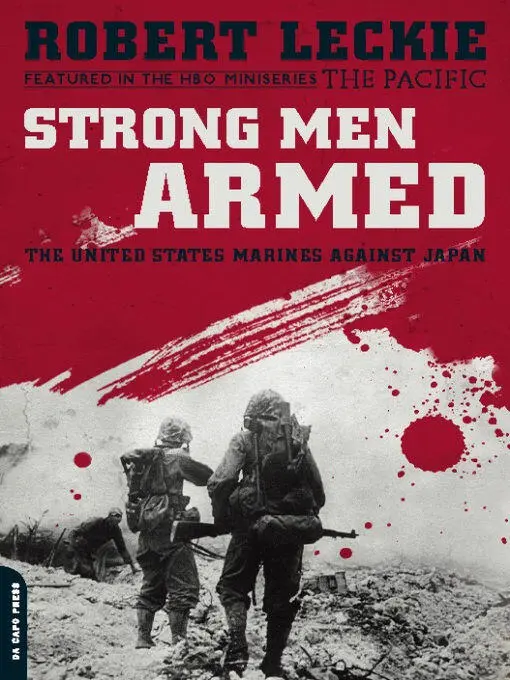
- Название:Strong Men Armed
- Автор:
- Издательство:Da Capo Press
- Жанр:
- Год:2010
- Город:Cambridge
- ISBN:978-0-786-74832-7
- Рейтинг книги:3 / 5. Голосов: 1
-
Избранное:Добавить в избранное
- Отзывы:
-
Ваша оценка:
Strong Men Armed: краткое содержание, описание и аннотация
Предлагаем к чтению аннотацию, описание, краткое содержание или предисловие (зависит от того, что написал сам автор книги «Strong Men Armed»). Если вы не нашли необходимую информацию о книге — напишите в комментариях, мы постараемся отыскать её.
Strong Men Armed — читать онлайн бесплатно полную книгу (весь текст) целиком
Ниже представлен текст книги, разбитый по страницам. Система сохранения места последней прочитанной страницы, позволяет с удобством читать онлайн бесплатно книгу «Strong Men Armed», без необходимости каждый раз заново искать на чём Вы остановились. Поставьте закладку, и сможете в любой момент перейти на страницу, на которой закончили чтение.
Интервал:
Закладка:
On the morning of November 9 the Twelfth Marines opened up with howitzers. When the barrage lifted, the Marine riflemen attacked—and were struck by Japanese who had waited out the artillery in foxholes.
Again it was grenade for grenade, shot for shot. Tanks were useless. The trail was too narrow and the swamp on either side too deep. The Marines had to attack straight ahead-blindly.
A platoon led by Lieutenant John Sabini was pinned down by an unseen machine gun. Sabini jumped up, shouting, “When they open up on me, fire back!” The Japanese did open up and Sabini was hit. He fell. He jumped up again, still shouting, and was hit again. By then his Marines had spotted the hidden gun and had charged it and destroyed it. The attack slogged forward, 40 or 50 yards an hour.
Downtrail the Japanese came stealthily at the Raiders’ roadblock, searching out its defenses. When they had located two foxhole outposts each manned by a pair of Marines with a BAR and rifle, they opened up with heavy machine-gun fire. They filled the air with grenades. The Marines in one of the holes were killed. There was a lull.
In the other hole Pfc. Henry Gurke said to Pfc. Donald Probst, “Look, you’ve got the BAR and you’re more important.”
“So?” Probst whispered, his eyes fastened on the green tangle to his front.
“They’re using a lot of grenades,” Gurke explained. “One of ’em might land in the hole.”
Probst nodded in anticipation, and Gurke concluded: “So if one should land in here I’ll take it.”
It was not the time to argue. The enemy was rushing in again and Probst’s automatic rifle was chattering and spreading death among them. Then came the somersaulting grenades and the thud as one of them plopped between them. It lay there, a dirty hissing container packed with death and Gurke threw Probst aside and dropped upon it.
Pfc. Probst never knew whether or not he heard the muffled explosion for his finger was squeezing the trigger of the BAR his friend had found “important” enough to die for, and the charging enemy was falling back. They returned, again and again, sweeping in on other fronts, but the roadblock still held. The attack up the Piva Trail went forward until, on the morning of November 10, with a brief sharp artillery shoot and the support of 12 low-flying Avengers, the Second Battalion, Ninth, moved out to find that the enemy was gone.
Colonel Kawano had left 550 of his soldiers along the Mission-Piva Trail in fighting that began November 5 and ended November 11, and there were only 19 Marines killed and 32 wounded.
And there was also a posthumous Medal of Honor for Pfc. Henry Gurke.
Life on Puruata was like living on a bull’s-eye. This tiny islet 700 yards long and 400 wide was now the warehouse of the Bougainville campaign. The mainland beaches were too narrow and there was no dry coastal plain on which to place food and ammunition dumps. LST’s running up to Bougainville had to come to Puruata to unload.
So did the Japanese bombers from Rabaul. It was such an easy trip they could make it regularly. Torokina was only 230 miles from Rabaul, in comparison to the 640 miles which had separated Rabaul and Guadalcanal a year ago.
Japanese bombers plastered Puruata endlessly and made a sleepless hell of the lives of the Marine pioneers and depot companies who were stationed there. By day the bombers were not so bad, for there was always Marine air to intercept them and drive them off.
But at night…
At night little Puruata lay like a moonstone embedded in the dark ocean. Moonlight bathed her coconuts and washed the water breaking on her seaward reef to silver. Moonlight marked her clearly for the enemy bombers, and men who had worked all day ran to man antiaircraft guns or to form stretcher parties to make the inevitable search for the dead and wounded once the bombers had flown away.
Their ears were filled with the wailing and crashing of the bombs and the whamming of the antiaircraft guns, and when the fuel dump was set afire or the ammunition depot blew up they rolled the gas drums out of the inferno or darted among the exploding shells to lug ammunition cases to safety.
Even so Puruata never lost its sense of humor, that self-mockery which could make men laugh even while the air around them was whizzing with disintegrating steel-as they did the night Puruata had its third straight raid and a little Marine ran for his foxhole shouting:
“Hang onto your false teeth, girls-they may be dropping sandwiches.”
Colonel Kawano had decided to withdraw. He was going to move off the Piva Trail which ran north-south over Bougainville’s towering mountains and retreat east over the East-West Trail. He was going to await the arrival of reinforcements.
To gain time to make his withdrawal, Kawano arranged a delaying action at a position he had fortified beforehand. It was in a coconut grove just below the junction where the Piva Trail going north met the East-West going east. It was about five miles outside General Turnage’s perimeter. Something less than a company was assigned to hold it. It was a sturdy defense line, well underground, for the men of the 23rd Regiment respected the Marine artillery.
But on the morning of November 13, when Lieutenant Colonel Eustace Smoak’s Second Battalion, Twenty-first, attacked through the coconut grove, they came on without their artillery. They were immediately pinned down. E Company led by Captain Sidney Altman was unable to move. Word was sent back to Smoak. He rushed up reinforcing companies and called for the artillery.
Lieutenant Bob Rennie went up the trail to join Major Glenn Fissel, the battalion’s executive officer. He set up his telephone behind a mangrove tree about fifty yards away from the source of all that banging and chattering. He gave his position to the artillery operations officer and said, “Put a round about five hundred yards in front of me.”
It went whistling over, but its crash was muffled by the jungle.
“Bring it down two hundred yards,” Rennie said.
The whistle was louder, the crash of the shell distinct and reverberating, but it seemed to the left of the battle.
“Another hundred down and you’d better bring it right one hundred yards.”
The shell’s passage was a scream now, its crash echoing. Rennie glanced at Major Fissel.
“That deflection seem all right, Major?”
Fissel nodded and Rennie spoke again into the telephone.
“Down one hundred. Deflection correct.”
There was hardly an instant separating the scream and the wham. Rennie glanced again at Fissel. The shells were landing only a hundred yards from the Marine front. It could be dangerous to lower the range, but Fissel nodded, and Rennie’s voice was tinged with apprehension as he said:
“Down fifty. Deflection correct.”
Now the scream of the shell seemed to begin sooner and stay around longer. The crash shook water from the foliage.
“How was that?” Rennie asked.
Fissel ignored him and shouted uptrail, “Pass the word for someone up there to come back and tell us how those shells are going.”
A Marine came back. His face was gaunt and streaked with slime. He shouted, for his ears were still full of the clamor of battle.
“If you come back another twenty-five yards you’ll be right on top of those lousy Japs: ‘
Lieutenant Rennie’s face blanched. His lips tightened. Twenty-five yards! It was too risky. But he gave the order.
“Down twenty-five.”
And now the screams were those of wounded and dying men, hoarse and trailing in their agony and making no words but only the atavistic sounds of stricken animals.
“Cease fire!” Rennie shouted frantically into the telephone.
“Cease fire!”
He knew it, he should never have brought it in that close, and he cursed that Marine for misleading him into bringing death down on his own men. Then another Marine appeared, an officer, and he was angry.
Читать дальшеИнтервал:
Закладка:
Похожие книги на «Strong Men Armed»
Представляем Вашему вниманию похожие книги на «Strong Men Armed» списком для выбора. Мы отобрали схожую по названию и смыслу литературу в надежде предоставить читателям больше вариантов отыскать новые, интересные, ещё непрочитанные произведения.









Обсуждение, отзывы о книге «Strong Men Armed» и просто собственные мнения читателей. Оставьте ваши комментарии, напишите, что Вы думаете о произведении, его смысле или главных героях. Укажите что конкретно понравилось, а что нет, и почему Вы так считаете.