Robert Leckie - Strong Men Armed
Здесь есть возможность читать онлайн «Robert Leckie - Strong Men Armed» весь текст электронной книги совершенно бесплатно (целиком полную версию без сокращений). В некоторых случаях можно слушать аудио, скачать через торрент в формате fb2 и присутствует краткое содержание. Город: Cambridge, Год выпуска: 2010, ISBN: 2010, Издательство: Da Capo Press, Жанр: nonf_military, на английском языке. Описание произведения, (предисловие) а так же отзывы посетителей доступны на портале библиотеки ЛибКат.
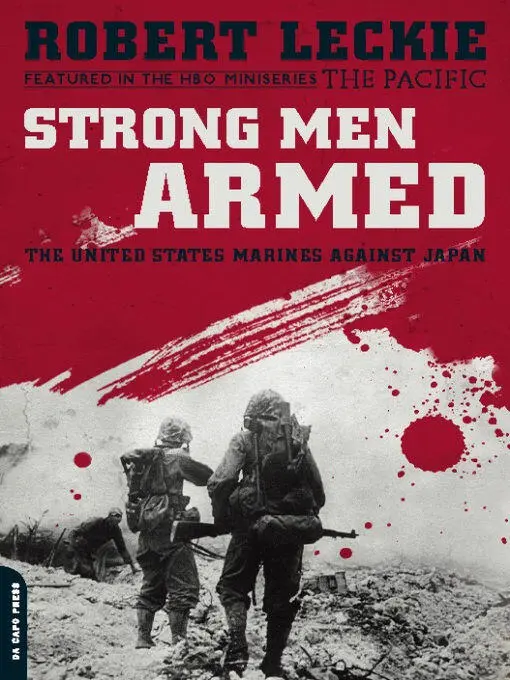
- Название:Strong Men Armed
- Автор:
- Издательство:Da Capo Press
- Жанр:
- Год:2010
- Город:Cambridge
- ISBN:978-0-786-74832-7
- Рейтинг книги:3 / 5. Голосов: 1
-
Избранное:Добавить в избранное
- Отзывы:
-
Ваша оценка:
Strong Men Armed: краткое содержание, описание и аннотация
Предлагаем к чтению аннотацию, описание, краткое содержание или предисловие (зависит от того, что написал сам автор книги «Strong Men Armed»). Если вы не нашли необходимую информацию о книге — напишите в комментариях, мы постараемся отыскать её.
Strong Men Armed — читать онлайн бесплатно полную книгу (весь текст) целиком
Ниже представлен текст книги, разбитый по страницам. Система сохранения места последней прочитанной страницы, позволяет с удобством читать онлайн бесплатно книгу «Strong Men Armed», без необходимости каждый раз заново искать на чём Вы остановились. Поставьте закладку, и сможете в любой момент перейти на страницу, на которой закончили чтение.
Интервал:
Закладка:
The 70 Japanese fighters already airborne to oppose them could not knock down more than 10 of them, and the damage to Kondo’s cruisers was enormous. Not one ship was sunk, but few were left in fighting trim. Takao was torn apart at the waterline, Mogami was sent staggering back to Japan for repairs, Atago took three near-misses and a bomb fell down one of Maya’s stacks and exploded in her engine room. Meanwhile the lights Agano and Noshiro were also hit and destroyer Fujinami was holed by a dud torpedo and Wakatsuki ripped open by near-misses.
Then, as the Navy planes flew back to their mother ships, 24 Army Liberators and 67 Lightnings came winging over from New Guinea and the Woodlarks to pound the city itself and tear up the docks.
Yet, with the cruiser force out of action, and the naval phase of the counterattack now almost impossible, a portion of Hyakutate’s soldiers was still going to be sent down The Slot on the first run of the Tokyo Express in nearly a year.
Why?
Because the Rabaul planes sent out to hunt Princeton and Saratoga and their escorting warships thought they had found their quarry between Cape Torokina and the Treasuries. What they had actually found was one damaged LCT under the care of an LCI-gunboat and a PT-boat. The Japanese planes struck. The three little American ships not only beat them off but also shot a few of them down. Next day the world heard this from Radio Tokyo:
“One large carrier blown up and sunk, one medium carrier set ablaze and later sunk, and two heavy cruisers and one cruiser and destroyer sunk.”
It was the biggest lie of the Pacific War, the ultimate result of the Japanese custom of making reports wearing rose-colored glasses. Because of it the Tokyo Express sped down to Bougainville the night of November 6. Four destroyers took 475 soldiers down to Koromokina Swamp, the place which would give its name to the brief, bitter battle in which they died.
The men of the Third Battalion, Ninth Marines, rose from their watery sleeping places at dawn of November 7 and saw 21 Japanese barges plodding toward beaches just west of Koromokina Swamp. The boats beached and Japanese soldiers jumped ashore and ran into the jungle. Some of them struck up the Laruma River still farther west of these Marines on the left or western flank. The Japanese planned to get upriver and then turn right or east to work down against the American perimeter.
The main body struck at the Marine left held by the Third Battalion, Ninth. They were stopped. They withdrew into the swamp, and at twenty minutes after eight the Marines attacked.
They too were stopped, for the Japanese had occupied those foxholes and entrenchments abandoned only a few days before when Turnage shortened his lines. They had had more than an hour to improve them, and the Japanese had no equals at digging in.
Now it was stalemate, and during it, a Laruma River patrol led by Lieutenant Orville Freeman opened battle with those Japanese who had marched upriver. Outnumbered, Freeman withdrew. He retreated to the perimeter, setting up frequent rear-guards to ambush the pursuing Japs. It would take him thirty hours to get back to his lines, during which one Marine would be killed and Freeman himself would be wounded. But they would make it.
In the meantime, on that morning of November 7, Major General Turnage called for his reserve.
The men of the First Battalion, Third Marines, had gone into reserve to rest after doing most of the fighting during the Cape Torokina landings. They had been pleased. But now, like the Raiders of Guadalcanal, they were learning that it is often safer to be on the lines than to be behind them where the general can put you to use.
At a quarter past one these men passed through the bogged-down Third Battalion, Ninth. They attacked into a tangle of fern and creeper and giant trees with a mire for underfooting and five yards for visibility. Men shot at movement and when concealed Japanese machine guns spat at them they hurled grenades at the sound.
Sergeant Herbert Thomas threw a grenade in this way, but it was caught by ropelike lianas overhead and dropped back among Thomas and his men. The sergeant threw himself on it and was killed. The men he had saved moved on.
Then a Marine tank came churning through the muck. It swayed as it burst through the undergrowth like a great blind amphibian, the sharp branches of the undergrowth clawing harmlessly at its metal hide, its cannon jerking and spouting flame. Captain Gordon Warner ran alongside the tank. He carried a helmet full of hand grenades, hurling them at Japanese machine-gun nests to spot them for the tank-gunner.
“Fix bayonets!” he roared in the Japanese he had learned years ago. “Charge!”
Betrayed by their own virtues—ardor and obedience—the Japanese leaped erect and charged, coming in a swarm to be obliterated by Marine rifle fire or the hosing of the tank’s machine gun.
Six enemy guns were knocked out by Warner and the tank, until the Japanese were gradually thrust from the swamp and a solid Marine firing line had been built up. Captain Warner lost a leg as a result of wounds received in his attack, but he had put the battle on the way to being won. Artillery observers were soon up front calling for the fire which held the line until morning.
Then five batteries of field guns began firing. Machine guns swept the swamp, mortars lobbed in shells, antitank guns blasted away with cannister shot—and the screams of the enemy were audible to the Marines. When the guns fell silent the men of the First Battalion, Twenty-first Marines, moved through the First Battalion, Third, into the swamp and found it as still and silent as a morgue.
Koromokina contained the bodies of 377 Japanese soldiers who had died to kill 17 United States Marines.
It was November 9 and Technical Sergeant Frank Devine was desperate for a story. He was a Marine combat correspondent, one of that corps of professional newsmen who had given up their jobs to march with the Marines and write about them. They were assigned one to a regiment and given the mission of reporting the battle at the cannon’s mouth. Their stories went by mail to Marine Headquarters in Washington and were passed on to the press from there.
On that morning of November 9 Devine was soaking wet and he did not have a story in sight.
True, there had been the Battle of the Koromokina Swamp, but that hadn’t happened in his sector. True, Major General Roy Geiger had relieved Lieutenant General Vandegrift as commander of the First Marine Amphibious Corps on Bougainville and the Treasuries, but that was a story for the civilian war correspondents (it was a big one, however, for Vandegrift of Guadalcanal was going home to his fourth star and command of the Marine Corps). True again, the first elements of the Army’s 37th Division had begun to arrive, but that was the Army combat reporters’ beat—and who wanted to write about dogfaces anyway?
Sergeant Devine looked sourly at the sodden sheet of paper in the little typewriter cradled on his knees. He noticed that the machine had already begun to rust and wondered how many days before it would become useless. He wondered what it would be like to wear dry socks and sleep on dry ground. He listened to the rain. He stared and tried to think of something that the folks at home might find interesting, and then he wrote:
“Bougainville, Nov. 1, 2, 3, 4, 5, 6, 7, 8, 9—It rained today.”
The fighting on Bougainville had shifted to the Marines’ right or eastern flank.
Since November 5, the men of the 23rd Infantry Regiment commanded by Colonel Kawano had been striking hard at the Raiders blocking the Mission Trail. The trailblock held. More, the Marines came out of it to push farther toward a fork about 2,000 yards outside the new perimeter where the Mission Trail joined the Piva Trail, becoming thereafter the Piva Trail. This force, commanded by Colonel Edward Craig, had left the Raiders holding the trailblock behind them and by November 8 had pushed up to a point just below the Mission-Piva confluence. The next morning they would attack past it.
Читать дальшеИнтервал:
Закладка:
Похожие книги на «Strong Men Armed»
Представляем Вашему вниманию похожие книги на «Strong Men Armed» списком для выбора. Мы отобрали схожую по названию и смыслу литературу в надежде предоставить читателям больше вариантов отыскать новые, интересные, ещё непрочитанные произведения.










Обсуждение, отзывы о книге «Strong Men Armed» и просто собственные мнения читателей. Оставьте ваши комментарии, напишите, что Вы думаете о произведении, его смысле или главных героях. Укажите что конкретно понравилось, а что нет, и почему Вы так считаете.