Robert Leckie - Strong Men Armed
Здесь есть возможность читать онлайн «Robert Leckie - Strong Men Armed» весь текст электронной книги совершенно бесплатно (целиком полную версию без сокращений). В некоторых случаях можно слушать аудио, скачать через торрент в формате fb2 и присутствует краткое содержание. Город: Cambridge, Год выпуска: 2010, ISBN: 2010, Издательство: Da Capo Press, Жанр: nonf_military, на английском языке. Описание произведения, (предисловие) а так же отзывы посетителей доступны на портале библиотеки ЛибКат.
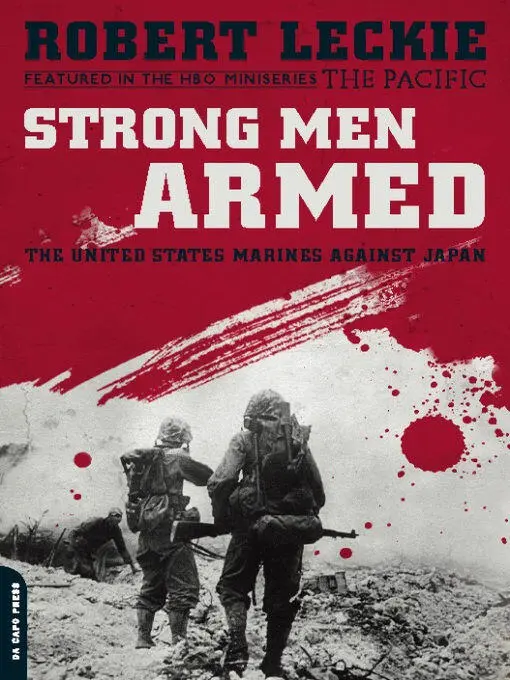
- Название:Strong Men Armed
- Автор:
- Издательство:Da Capo Press
- Жанр:
- Год:2010
- Город:Cambridge
- ISBN:978-0-786-74832-7
- Рейтинг книги:3 / 5. Голосов: 1
-
Избранное:Добавить в избранное
- Отзывы:
-
Ваша оценка:
Strong Men Armed: краткое содержание, описание и аннотация
Предлагаем к чтению аннотацию, описание, краткое содержание или предисловие (зависит от того, что написал сам автор книги «Strong Men Armed»). Если вы не нашли необходимую информацию о книге — напишите в комментариях, мы постараемся отыскать её.
Strong Men Armed — читать онлайн бесплатно полную книгу (весь текст) целиком
Ниже представлен текст книги, разбитый по страницам. Система сохранения места последней прочитанной страницы, позволяет с удобством читать онлайн бесплатно книгу «Strong Men Armed», без необходимости каждый раз заново искать на чём Вы остановились. Поставьте закладку, и сможете в любой момент перейти на страницу, на которой закончили чтение.
Интервал:
Закладка:
“So am I,” the Marine yelled, and killed him with his knife.
Otherwise, the lines were quiet. There was only the steady drumming of the rain. Back in Division headquarters it seemed strange that the enemy did not strike.
Then at a half-hour or so after two in the morning there was a flashing and a thundering to seaward and a sudden buzzing of CP telephones and the word was passed:
“Condition Black. You may expect shelling from enemy ships followed by counterinvasion.”
In Rabaul on November 1 a counterinvasion had been ordered for the Cape Torokina area and then canceled.
Rear Admiral Sentaro Omori had been told to take 1,000 soldiers aboard five destroyer-transports to the American beachhead on Bougainville. Omori assembled his fleet—six big destroyers, the heavy cruisers Myoko and Haguro, the lights Sendai and Agano —and took them down to St. George Channel between New Britain and New Ireland. They waited there for the destroyer-transports, which did not show up until half-past ten that night. Already chafing at the delay, disturbed at having been sighted by an American submarine, Omori was further upset to hear that the transports could not make more than 26 knots. Then an American plane dropped a bomb close aboard Sendai at eleven o’clock, and Omori asked Rabaul for permission to send back the transports so that he might speed down to Empress Augusta Bay unencumbered and attack the American transports. Permission was granted. Bending on 32 knots, Omori took his warships south.
Waiting below to meet him, knowing he was coming, was Rear Admiral A. Stanton (Tip) Merrill, commanding Task Force 39.
Admiral Merrill had already set minesweepers to work sealing off Torokina with a field of mines. He too had sent his transports away and had taken station about 19 miles off the Cape at the mouth of Empress Augusta Bay—determined “to prevent the entry therein of a single enemy ship.”
Merrill had more ships but not as much firepower as the enemy. He had eight destroyers, including the four “Little Beavers” of Captain Arleigh ( Thirty-One-Knot ) Burke, and the light cruisers Montpelier, Cleveland, Columbia, and Denver. At about half-past two in the morning of November 2 the pips of the approaching Japanese warships were clearly visible on American radar screens.
“Believe this is what we want,” Montpelier’s combat information center reported, and ten minutes later the battle was joined.
It quickly broke up into three fights, one between the cruisers and two separate destroyer battles. Almost immediately the savage concerted shellfire of Merrill’s cruisers struck Sendai. It was radar-controlled firing at its best. Sendai began to burn brightly, exploding as she burned. Destroyers Samidare and Shiratsuyu swung violently around to escape the fire that was sinking Sendai and collided with one another with a screech of rending steel. They limped home to Rabaul.
Zigzagging violently, making smoke, the American cruiser commanders shifted fire to the Japanese columns centered around Myoko and Haguro. Again their aim was unerring. The third salvos walked right into them. Destroyer Hatsukaze tried to dodge. She swerved between the two big cruisers and shuddered as Myoko plowed into her, shearing off two of her tubes, mangling her starboard bow, leaving her to be torn apart and sunk by the American destroyers.
But now Omori’s heavies were opening up with eight-inch star-shells and patrol planes were dropping white and colored flares. The American cruisers, unscratched for half an hour, began to receive hits. Eight-inch salvos straddled them. Denver received three eight-inch hits forward and began to take in water, but she stayed afloat while the battle became a thing of terrible beauty.
Clouds drifting overhead had become suffused with the light of flare and gunflash. They illuminated the battle as though it were being fought upon a theatrically lighted black pond, and all that flashed and glittered and shone seemed to be magnified by the encircling darkness. There was that quality of slow majesty attendant upon night surface action when great ships move at great speed over great bodies of water. Salvos striking the sea threw up great geysers; they seemed not to leap but to gather themselves upward, to rise in slow-pluming fountains, to catch the red light of burning ships, the green-gold of flame-streaming guns, the jagged orange glinting off swirling black water, to catch it, to make it dazzling with its own phosphorescence—and then to burst apart in a million vanishing sparkles.
It would have been an unreal world, a ghostly one, fantastical, but for the pungent smell of smoke, the constant thundering of the guns and the real crashing of the shells and crying of the stricken.
As the battle continued, Admiral Omori came to believe that he had destroyed three American cruisers. He thought that near-misses straddling them and raising geysers in the air had been torpedo hits. When the American cruisers vanished beneath their own smoke, he believed they had sunk—and he sailed home.
Like Mikawa at Savo, Omori had not gotten in on the American transports. Unlike him he had not sunk an American ship.
It was dawn of November 2 but the Marines inland on Bougainville saw only the murky light of the swamp as they hurried to expand their beachhead. The Twenty-first Marines held in division reserve by Major General Turnage were to be brought in from Guadalcanal, followed by the Army’s 37th Infantry Division, representing the corps reserve. In the meantime the Marine combat battalions pushed deeper into the rain forest and expanded the perimeter wide enough to contain the airfield which the Seabees were building. The new line’s left rested on the Koromokina Swamp in the west and its right at a point about 2,000 yards east of Cape Torokina. Its over-all width was about 5,500 yards, it was about 2,000 yards at its deepest and something more than 1,000 yards at the norm. Outside it was the rain forest to the north and behind it the waters of Empress Augusta Bay. The Laruma River lay 10,000 yards to the west of it on the left and the crooked Piva River about the same distance east on the right.
Major General Turnage still had the Raiders holding the Mission Trail roadblock-but now only about 400 yards outside the perimeter. Puruata was becoming a supply dump, and little Torokina Island midway between Puruata and the Cape had also been occupied. Turnage also reshuffled his units to place the fresh ones in position to receive the counterthrust he still believed to be impending—either from sea or jungle. In this movement, the left flank had been shortened and the Koromokina Swamp positions held by two battalions had been abandoned. And this would help the enemy in the counterinvasion that was to come.
Lieutenant General Hyakutate had not given up on the idea of counterinvasion by sea. After Admiral Omori sent back the transports the night of November 1, Hyakutate collected 3,000 men from the 17th Division’s 53rd and 54th Regiments. They were to go south escorted by another powerful cruiser force which was to sweep the waters clear of Americans and bombard the Marine beachhead while the soldiers went ashore.
The cruisers came down from Truk— Takao , Maya, Atago, Suzuya, Mogami, Chikuma, Chokai— the old pros, the big and veteran sluggers of Admiral Kondo’s 2nd Fleet. With them came light cruiser Noshiro, four destroyers and a sizable fleet train. They came into Rabaul on November 5 to refuel. They considered themselves safe. There were 150 planes on Rabaul’s fields. American bases were too far off. There were no American carriers at sea.
But Princeton and Saratoga had already raced up to Bougainville under cover of darkness. At nine in the morning of November 5 they began to fly off their planes—97 fighters and bombers-and three hours later a torrent of American aircraft thundered up St. George Channel, roared straight through the flak of the flatfooted enemy ships without breaking formation, and then broke off into small groups to begin their work.
Читать дальшеИнтервал:
Закладка:
Похожие книги на «Strong Men Armed»
Представляем Вашему вниманию похожие книги на «Strong Men Armed» списком для выбора. Мы отобрали схожую по названию и смыслу литературу в надежде предоставить читателям больше вариантов отыскать новые, интересные, ещё непрочитанные произведения.








Обсуждение, отзывы о книге «Strong Men Armed» и просто собственные мнения читателей. Оставьте ваши комментарии, напишите, что Вы думаете о произведении, его смысле или главных героях. Укажите что конкретно понравилось, а что нет, и почему Вы так считаете.