Robert Leckie - Strong Men Armed
Здесь есть возможность читать онлайн «Robert Leckie - Strong Men Armed» весь текст электронной книги совершенно бесплатно (целиком полную версию без сокращений). В некоторых случаях можно слушать аудио, скачать через торрент в формате fb2 и присутствует краткое содержание. Город: Cambridge, Год выпуска: 2010, ISBN: 2010, Издательство: Da Capo Press, Жанр: nonf_military, на английском языке. Описание произведения, (предисловие) а так же отзывы посетителей доступны на портале библиотеки ЛибКат.
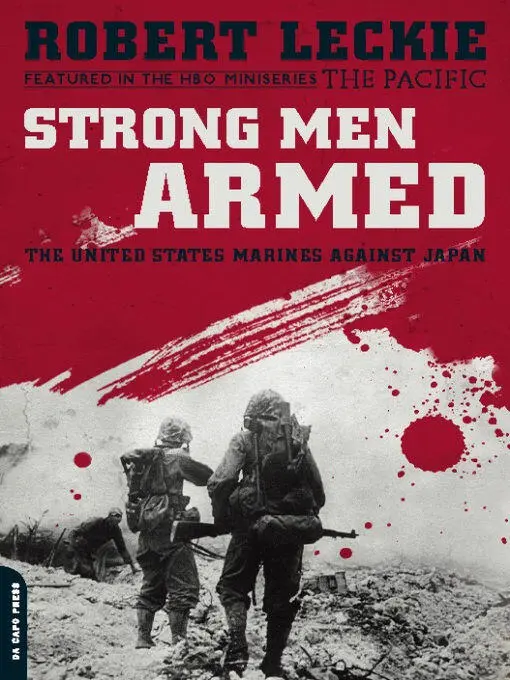
- Название:Strong Men Armed
- Автор:
- Издательство:Da Capo Press
- Жанр:
- Год:2010
- Город:Cambridge
- ISBN:978-0-786-74832-7
- Рейтинг книги:3 / 5. Голосов: 1
-
Избранное:Добавить в избранное
- Отзывы:
-
Ваша оценка:
Strong Men Armed: краткое содержание, описание и аннотация
Предлагаем к чтению аннотацию, описание, краткое содержание или предисловие (зависит от того, что написал сам автор книги «Strong Men Armed»). Если вы не нашли необходимую информацию о книге — напишите в комментариях, мы постараемся отыскать её.
Strong Men Armed — читать онлайн бесплатно полную книгу (весь текст) целиком
Ниже представлен текст книги, разбитый по страницам. Система сохранения места последней прочитанной страницы, позволяет с удобством читать онлайн бесплатно книгу «Strong Men Armed», без необходимости каждый раз заново искать на чём Вы остановились. Поставьте закладку, и сможете в любой момент перейти на страницу, на которой закончили чтение.
Интервал:
Закладка:
Krulak’s men made more smoke for General Vandegrift before they were withdrawn by LCI at midnight of November 3. By that time they had accomplished their mission. General Hyakutate had already begun to move Bougainville troops south to Choiseul by barge. On November 1 he sent 60 bombers and escorting fighters against the “force of 20,000 men” which Radio Tokyo said was then ashore on Choiseul.
The Japanese aircraft were bombing the bait even as the Third Marine Division commanded by Major General Allen Turnage hit the narrow beaches of Cape Torokina.
6
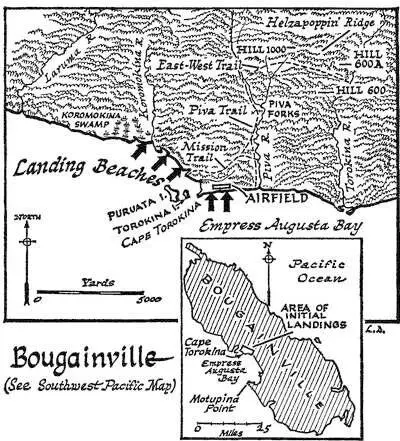
November 1, 1943, was clear and bright, a tropic day when the air is soft and aromatic, when the sea is all silvery and glittering in the light of the rising sun. At a quarter after six Marines crowding the rails of their transports could see the sun standing clearly above the bleak blue line of the Bougainville mountains, a thread of smoke from the crater of Mount Bagana trailing across its face. The Marines also saw the shell-smoke rising from Cape Torokina and from the island of Puruata, 1,000 yards offshore and about the same distance to the left or west of the Cape. American cruisers and destroyers had begun a bombardment. In another hour the landing boats churned shoreward and the naval gunfire lifted.
At that point, 270 soldiers of the 2nd Company, 1st Battalion, 23rd Japanese Infantry, began fighting to hold the landing beaches west of the Cape. Snipers on Puruata poured rifle fire into the boats rounding the island, and from 18 big pillboxes on the right or east flank came the bullets of automatic weapons and the shells of a 75-millimeter field piece.
The Japanese gun whanged from within a concealed emplacement of coconut logs and sandbags. Before it fired 50 shells it had sunk four landing boats and damaged 10 others carrying the men of Major Leonard (Spike) Mason’s First Battalion, Third.
Sergeant Robert Owens, among the first men to land safely, spotted the emplacement from which the gun poured its terrible fire. He crawled toward it. He posted four men to pin down the two rifle bunkers which covered the approach to the gun. Then he jumped to his feet and charged. He was hit repeatedly on his way in, but he kept on. He dove straight through the gun port. He killed the gunner and drove the other crewmen out the rear entrance, where they were cut down by his companions. Then Owens sank to the ground, dying. His charge had won the Medal of Honor and also had destroyed the most formidable obstacle on the Torokina beaches.
With the gun knocked out, Major Spike Mason could continue his reorganization of the assault on the pillboxes. One by one they fell, while Mason’s Marines and the Second Raider Battalion of Lieutenant Colonel Joseph McCaffery darted low through enemy small-arms fire, running in close to the hulking pillboxes to hurl the grenades that flushed the enemy into the open. At one pillbox Platoon Sergeant Bill Wilson began firing at 15 enemy soldiers dashing from an exposed trench for the security of a pillbox. He was joined by another Marine. They killed them all and advanced on another bunker. As a terrified Japanese burst from its entry Wilson leaped on his shoulders and finished him with a knife thrust.
It was that kind of fighting—savage, close, primitive. For the first time the Marines were meeting an organized beach defense, and they were taking casualties. McCaffery fell, mortally stricken. Mason was wounded. He refused evacuation, for he feared a counterattack and had no wish to be the living commander of a lost battalion. He turned command over to his executive. “Get the hell in there and fight!” he swore, and the assault swept on until the smoke and yells and roar of battle had faded by noon and most of the 270 Japanese who had fought so hard to hold the Cape were dead.
On the west or left flank it was not the Japanese but the sea that was the enemy. The Ninth Marines came in unopposed, but their beaches were too steep for the landing boats to ground along the full length of their keel. They were upended. They were swamped or they filled at the stern and slid off the beach to sink in deep water. Sixty-four landing boats and 22 LCM’s were broached before the troops came ashore.
But by noon, more than half the Third Marine Division had been landed and destroyers were heading south for Guadalcanal to escort the second echelon north. Over at Puruata the Third Raider Battalion was mopping up the Japanese snipers. And the 30 Japanese fighters and bombers which had been gulled down Choiseul way had at last found the true target and were roaring in to strike it.
The red-balled planes arrived at forty minutes past noon, making for the troops ashore and the transports out in Empress Augusta Bay. Dropping down from the clouds to take on eight of them came five Marine Corsairs led by Lieutenant Colonel Herbert Williamson. Among them was Butcher Bob Hanson, the youthful, India-born lieutenant who was to have one of the most brilliant—and meteoric—careers of all American fliers.
While his comrades knocked down two of the enemy aircraft, Hanson made three quick high side passes at a trio of low-flying Kates and shot down all of them. But the bullets of a Kate rear-gunner shot down Hanson. He crashed safely, got out, inflated his rubber boat until he sighted the destroyer Sigourney in the Bay. He paddled toward it, hopefully singing “You’d Be So Nice to Come Home To,” and Sigourney obligingly came about and picked him up.
Except for slight damage to destroyer Wadsworth, where two sailors were killed and five wounded, the Japanese attackers caused little damage. They lost 22 planes while shooting down four Americans, and they had not killed a single Marine.
It had not been thought possible that the swamps and steaming jungle of Guadalcanal could be anywhere exceeded. These men had trained on Guadalcanal and had learned how to live in the rain forest. After Guadalcanal they thought of themselves as jungle-fighters, but they had not been on Guadalcanal during the rainy season.
Before dusk the rain began to fall. Marines sloshing inland discovered that the difference between Guadalcanal and Bougainville was that Bougainville was all jungle. There were no lovely white beaches, only a streak of sand separating sea from forest. There were no pleasant groves of coconuts, for dark and wild Bougainville had never attracted planters.
In the rains falling that dusk of November 1, wiremen found that it was taking them an hour to move a hundred yards. It was hard to move supplies, except by hand or amtrack. Anything wheeled was useless. Because of this it was not until nightfall that Major General Turnage had established his beachhead perimeter.
This was an area about 5,000 yards in width on an east-west axis, and 1,000 yards at its deepest. Protecting it against the Japanese 23rd Regiment then assembling inland was a roadblock which a battalion of Raiders had set up along the Mission Trail. The trail ran into the jungle from roughly the center of the perimeter, slanting right or east. The Raider roadblock was placed across it at a point about 2,000 yards outside the perimeter. This was to stop, or at least check, the night’s inevitable Japanese counterattack.
But it never came.
Marines sitting up to their waists in water heard nothing but the blundering of an occasional wild pig, or, more infrequently, the thrashing of one of those Japanese soldiers who had infiltrated with no notion of what he would do once he had pierced the line. One of these fell into a water-filled hole occupied by a Marine rifleman.
“I’m too young to die,” he cried in impeccable English.
Читать дальшеИнтервал:
Закладка:
Похожие книги на «Strong Men Armed»
Представляем Вашему вниманию похожие книги на «Strong Men Armed» списком для выбора. Мы отобрали схожую по названию и смыслу литературу в надежде предоставить читателям больше вариантов отыскать новые, интересные, ещё непрочитанные произведения.









Обсуждение, отзывы о книге «Strong Men Armed» и просто собственные мнения читателей. Оставьте ваши комментарии, напишите, что Вы думаете о произведении, его смысле или главных героях. Укажите что конкретно понравилось, а что нет, и почему Вы так считаете.