Robert Leckie - Strong Men Armed
Здесь есть возможность читать онлайн «Robert Leckie - Strong Men Armed» весь текст электронной книги совершенно бесплатно (целиком полную версию без сокращений). В некоторых случаях можно слушать аудио, скачать через торрент в формате fb2 и присутствует краткое содержание. Город: Cambridge, Год выпуска: 2010, ISBN: 2010, Издательство: Da Capo Press, Жанр: nonf_military, на английском языке. Описание произведения, (предисловие) а так же отзывы посетителей доступны на портале библиотеки ЛибКат.
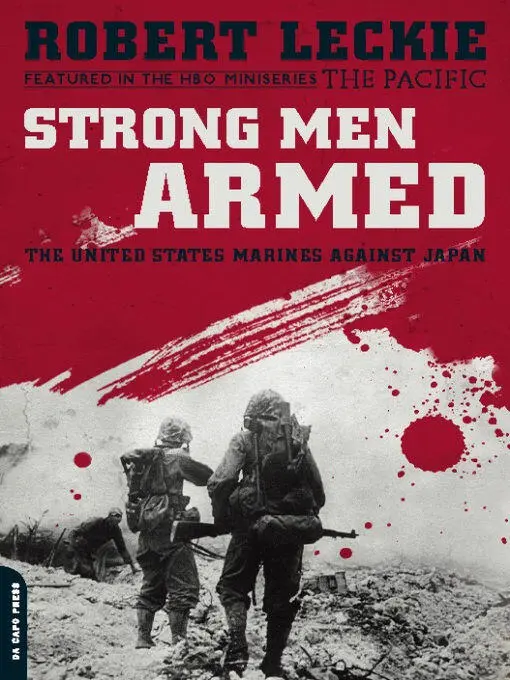
- Название:Strong Men Armed
- Автор:
- Издательство:Da Capo Press
- Жанр:
- Год:2010
- Город:Cambridge
- ISBN:978-0-786-74832-7
- Рейтинг книги:3 / 5. Голосов: 1
-
Избранное:Добавить в избранное
- Отзывы:
-
Ваша оценка:
Strong Men Armed: краткое содержание, описание и аннотация
Предлагаем к чтению аннотацию, описание, краткое содержание или предисловие (зависит от того, что написал сам автор книги «Strong Men Armed»). Если вы не нашли необходимую информацию о книге — напишите в комментариях, мы постараемся отыскать её.
Strong Men Armed — читать онлайн бесплатно полную книгу (весь текст) целиком
Ниже представлен текст книги, разбитый по страницам. Система сохранения места последней прочитанной страницы, позволяет с удобством читать онлайн бесплатно книгу «Strong Men Armed», без необходимости каждый раз заново искать на чём Вы остановились. Поставьте закладку, и сможете в любой момент перейти на страницу, на которой закончили чтение.
Интервал:
Закладка:
Up high again, Segal saw a Zero riding the tail of a smoking Wildcat. He chased the Zero all the way up to the next island, Kolombangara, where a single sharp burst blew it up. He had two planes to his credit on his first flight, and within another two weeks he was an ace.
On July 11, with Segal again flying wing for Swett, eight of the Fighting Falcons took off for a patrol over Rendova. Six turned back because of engine trouble. Swett and Segal were alone. They heard from the fighter director that there was “a big bogey” coming down The Slot: 30 Bettys with a cover of 20 Zeros flying at 18,000 feet. Swett and Segal nosed over from 26,000 feet and went slashing among them. They broke up the formation. Swett missed on his first pass, but Manny Segal shot down the Zero that went for Swett’s tail. Three more eased in behind Segal, and Swett obliged by shooting one of them down. Then the two Marine fliers became separated. They were no longer able to protect one another, but Segal shot down two more planes, and Swett sent a bomber plunging into the ocean with such impact that water swept skyward in a plume so high it doused his Corsair.
And then Segal and Swett were shot down.
Swett’s Corsair smacked the water in a dead-stick glide. It remained surfaced for some time, giving Swett protection from the pair of Zeros which strafed him. He was finally rescued by Captain Donald Kennedy’s smoothly-functioning organization at Segi Point.
Murderous Manny Segal also survived. His face smashed and bloodied from the impact of his watery crash, Segal paddled about The Slot for twenty-three hours until an American destroyer spotted him and threw him a line. He was hauled aboard. The sailors rushed forward to help him, and Segal waved them weakly away.
“Don’t worry, boys,” he gasped—“things are bad all over.”
On July 28, soldiers of the Fourteenth Corps, spearheaded by Marine flame-throwers mounted on tanks, struck at the Munda Airfield’s labyrinthine defense. They pushed through a gaunt no man’s land where not a tree had been left intact. By August 5 they had taken the airfield. Ten days later the strip was in use and Lieutenant Ken Walsh was fireballing a Corsair down the strip. He roared up to Vella Lavella, shot down a fighter and then launched a lone attack on a formation of nine Vals. He shot down two of them and came in to Munda with two cannon holes in his right wing, his hydraulic line cut, his horizontal stabilizer punctured and his right tire blown. But he made a perfect landing and was actually cheered by the ground crews.
Fifteen days later Walsh was again demonstrating his superb flying skill. He flew to Kahili, developed engine trouble and returned to get another Corsair. He took off again and tore north to take on 50 Japanese fighters by himself. He shot down four. Walsh was awarded the Medal of Honor for both these actions, and before he left combat he had shot down 21 planes.
During that same period of fighting in the Central Solomons, Lieutenant Jensen destroyed 24 parked enemy planes in one of the Pacific’s freak feats of combat.
During a storm which burst suddenly over Kahili on August 28, Jensen found himself separated from his comrades. He flew down through the storm. To his great surprise he emerged from it upside down and directly over the enemy airfield. Jensen twisted his Corsair right side up while roaring to one end of the airport. He banked around and came skimming over the runway with all guns hammering, turning eight parked Zekes, four Vals and 12 Bettys into flaming heaps before the stunned Japanese had a chance to raise a hand against him.
Such was the heat of the aerial warfare, matching the bitter savagery of the Central Solomons ground fighting, during that August when the armed forces of both nations seemed to be marking time.
But August also marked the end of that seeming lull, for in Quebec the Quadrant Conference between President Roosevelt and Prime Minister Churchill had already marked out the specific routes for the march on Japan. General MacArthur would still strike through the Bismarcks to the Philippines, and the Marines would fight twice more in the South Pacific. But Quadrant was also shifting emphasis to the Central Pacific, to the chain of island fortresses that ran like steel-sheathed stepping stones to the very heart of Japan.
In that same month of August a Japanese rear admiral named Keiji Shibasaki came out from Japan to the Central Pacific to direct the defense of the Gilbert and Marshall groups which were the foremost of these islands, the outer glacis of Fortress Nippon. Shibasaki was particularly anxious to fortify an island shaped like an upside-down parrot. The Gilbert Islanders called it Betio, the Japanese renamed it Bititu and the world would know it as Tarawa.
4
Major Gregory Boyington was called “Pappy” because he was already a venerable thirty-one years of age when he burst upon the South Pacific with all the ungentle force of his brash, boisterous, belligerent character. His men called themselves “Black Sheep” because they were a collection of replacements, rejects and loners turned over to Boyington as much to squelch his demands for a squadron as in hopes that he would put one together.
He did put together a squadron, a unique one, and he did it in hardly a month of training on Espiritu Santo in the New Hebrides. For the captain had found the men, and the men their captain. It was as though mavericks had actually gathered to elect a leader, and then, having asked themselves who among them could shoot fastest, drink most, care less, fly highest and make more enemies in high places, had chosen Boyington.
Boyington was a veteran long before World War Two broke. He had left the Marines to join Claire Chennault’s Flying Tigers in China and Burma. He had shot down six Japanese planes there. After Pearl Harbor he returned home and requested reinstatement in the Marines. But Boyington was considered to be in disgrace for “having left the Corps in a time of national emergency.” After three months of rebuff he at last sent off a desperation telegram to the under secretary of the Navy and was returned to duty.
He left off parking cars in a Seattle garage and came out to Guadalcanal. With prompt perverseness he broke his ankle playing a sort of nocturnal leapfrog. It seemed that much that had been said about Boyington’s off-duty habits might be true, and it was after this episode that Boyington was given his last chance to deliver.
By September he had trained his Black Sheep to fly the big Corsairs and had brought them to a base in the Russells.
By September 16 they roared aloft on their first mission.
They were assigned to cover a formation of bombers headed for Ballale Airfield off the southern tip of Bougainville. The clouds over Bougainville were thick. Boyington and his 19 comrades didn’t anticipate interception from that direction while the Dauntlesses and Avengers dove and slashed at tiny Ballale, raising puffs of dirt and smoke. The Black Sheep started down. They flew right into a formation of 40 Zeros coming up.
One of them tore past Boyington’s right wing and wobbled his wings as though to say “Join up.” The American pilot pressed his gun button and found he had been so absorbed in the bombing display he had forgotten to turn on his electric gunsight or his gun switches. He had not even charged his guns. But Boyington quickly corrected the oversight and “joined up” with the Japanese, firing into the unsuspecting Zero’s tail and sending it spiraling down in flames.
Streaking down to the water where the bombers were reforming for the homeward flight, Boyington flashed by another Zero. He aimed a burst at the cockpit and the plane gushed flame and smoke and vanished, some of its parts striking Boyington’s plane.
Читать дальшеИнтервал:
Закладка:
Похожие книги на «Strong Men Armed»
Представляем Вашему вниманию похожие книги на «Strong Men Armed» списком для выбора. Мы отобрали схожую по названию и смыслу литературу в надежде предоставить читателям больше вариантов отыскать новые, интересные, ещё непрочитанные произведения.








Обсуждение, отзывы о книге «Strong Men Armed» и просто собственные мнения читателей. Оставьте ваши комментарии, напишите, что Вы думаете о произведении, его смысле или главных героях. Укажите что конкретно понравилось, а что нет, и почему Вы так считаете.