Robert Leckie - Strong Men Armed
Здесь есть возможность читать онлайн «Robert Leckie - Strong Men Armed» весь текст электронной книги совершенно бесплатно (целиком полную версию без сокращений). В некоторых случаях можно слушать аудио, скачать через торрент в формате fb2 и присутствует краткое содержание. Город: Cambridge, Год выпуска: 2010, ISBN: 2010, Издательство: Da Capo Press, Жанр: nonf_military, на английском языке. Описание произведения, (предисловие) а так же отзывы посетителей доступны на портале библиотеки ЛибКат.
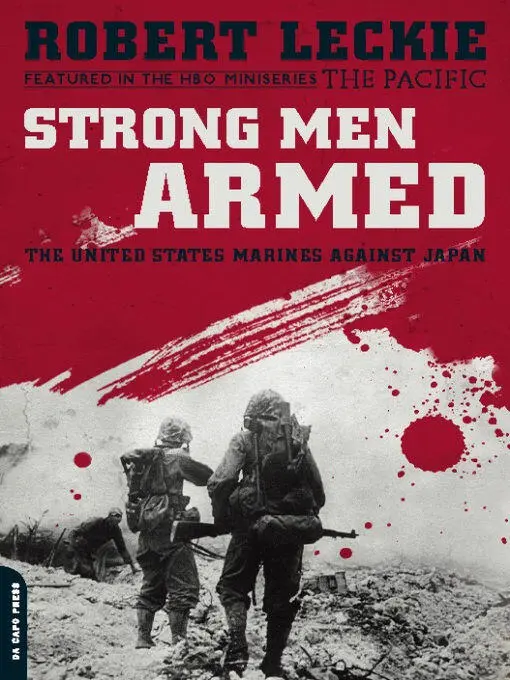
- Название:Strong Men Armed
- Автор:
- Издательство:Da Capo Press
- Жанр:
- Год:2010
- Город:Cambridge
- ISBN:978-0-786-74832-7
- Рейтинг книги:3 / 5. Голосов: 1
-
Избранное:Добавить в избранное
- Отзывы:
-
Ваша оценка:
Strong Men Armed: краткое содержание, описание и аннотация
Предлагаем к чтению аннотацию, описание, краткое содержание или предисловие (зависит от того, что написал сам автор книги «Strong Men Armed»). Если вы не нашли необходимую информацию о книге — напишите в комментариях, мы постараемся отыскать её.
Strong Men Armed — читать онлайн бесплатно полную книгу (весь текст) целиком
Ниже представлен текст книги, разбитый по страницам. Система сохранения места последней прочитанной страницы, позволяет с удобством читать онлайн бесплатно книгу «Strong Men Armed», без необходимости каждый раз заново искать на чём Вы остановились. Поставьте закладку, и сможете в любой момент перейти на страницу, на которой закончили чтение.
Интервал:
Закладка:
Shoup never got the message, and the First Battalion, Eighth, stayed in their boats.
Someone had come for Pfc. Libby.
The wounded Marine had felt the tide going out and had pushed himself away from his wrecked amtrack. He hoped to float out to the ships on the tide.
Just then someone waded toward him. He wore a Marine’s helmet and had a rifle slung across his back. He carried a bayonet in his hand. He came directly toward Pfc. Libby and he called out:
“What state are you from?”
“Maine,” Libby gasped. “Where you fr—?”
Pfc. Libby came to his feet in the water, for the bayonet this man was lifting was hooked at the hilt.
The Japanese lunged. Libby threw up his left hand. The bayonet pierced his palm. Libby grabbed the blade with his right hand and wrenched it away. The Japanese fumbled for his rifle. Libby swung. He hit the Japanese behind the ear with the hilt. The Jap moaned and sank into the water. Libby hit him on the forehead as he fell. Then he seized his head and held him under.
Pfc. Libby let go and began paddling weakly toward the reef. Hours later an amtrack found him floating in his life preserver 1,000 yards offshore. His body was wrinkled like a prune and blood still flowed from his torn hands. But he was alive.
Colorado was on the left and China Gal was on the right, between them were perhaps 3,500 United States Marines, and the sun was setting behind the tuft of the Betio parrot’s head.
Some 5,000 assault troops had come ashore, and of these about 1,500 were already dead or wounded. And now, between that pair of tanks, there were two separate and precarious holds on Betio. The left or eastern foothold, in which Colonel Shoup’s command post was located, began at about midway of the north coast and ran west for about 600 yards. It was 250 yards deep at its farthest penetration, roughly halfway across the airfield. Holding this, from left to right facing south or inland, were Major Crowe’s Second Battalion, Eighth; the riddled Third Battalion, Eighth; and the First and Second Battalions, Second. The right or western hold was a tiny enclave 200 yards deep and perhaps 100 yards wide which Major Ryan’s reorganized Third Battalion, Second had hacked out on the extreme western tip—the bird’s beak.
Between Ryan’s toehold and Shoup’s foothold was a gap fully 600 yards wide stuffed with Japanese men and guns.
Out in the lagoon, still in boats, were the recently alerted First Battalion, Eighth, and those waves of the Third Battalion, Eighth, which had been unable to get ashore.
Standing west of Tarawa in ships was that Sixth Marine Regiment just returned to Major General Julian Smith. There was no artillery ashore, but Lieutenant Colonel Rixey was preparing to bring in some batteries under cover of darkness.
These were the lines of the Second Marine Division as the dust began to settle and night fell on Betio.
But there were no lines as such; there were groups of Marines who had dug in here or fortified an abandoned pillbox there. There were gaps everywhere. Flanks were dangling. The inland advance of some units could be measured in hundreds of yards, others in scores of feet. Some troops were still trapped beneath the sea wall. In some places the Japanese would need to go only 30 feet to drive the Americans into the sea.
It was a situation made for counterattack, and even the most rear-ranked private among all those embattled Marines knew that just as the Japanese always defended at the water’s edge, he always counterattacked at night.
Rear Admiral Keiji Shibasaki had planned to counterattack. He had always believed that his defenses would stop the Americans at the water’s edge, and that a strong nocturnal counterblow would finish them off.
But the terrible bombardment which had failed to slaughter Shibasaki’s men had knocked out his communications. His men were scattered over the island in strong points and there was now no way of assembling them for the counterattack.
He could attempt to communicate with them by runner, but it was likely the runners would be picked off. Worse, Admiral Shibasaki had not even provided himself with message blanks. There were, of course, dozens of bicycles at his disposal, but bike-riding messengers would only provide these uncouth Marines with jokes as well as targets.
Admiral Shibasaki stayed within his huge bombproof command post. Though his men lobbed mortars into the Marines on the beaches or swam out to the wrecked American boats or the capsized Saida Maru to harass them with sniper fire, they did not counterattack. They had killed many Americans that day. Next day they would kill more. Admiral Shibasaki was not cast down by the loss of his communications. Obviously it was the Americans, not the Japanese, who were in a tight spot.
All through the night, cries of “Corpsman!” “Corpsman!” were raised above and below the sea wall. Men wounded during the day, men who fought on while wounded, were dying from loss of blood. And there was a shortage of blood plasma, of bandages.
“Doc” Rogalski had patched up the dozen or so men left of the 40 whom Lieutenant Toivo Ivary had led against the central sector. Ivary’s right leg had been shattered by a grenade and he had been shot in the arm. Sergeant Jim Bayer had been shot in the head. Rogalski had fixed up the lieutenant’s leg with splints and sulfa and bandaged the sergeant’s head. And then, during the morning-long fight to knock out a pillbox looming over the sea wall, he used up the rest of his supplies.
In the afternoon as more wounded were brought back to the beach, Rogalski was forced to take medical kits from the bodies of fallen fellow corpsmen. He waded into the lagoon to strip dead Marines of the little first-aid pouches attached to their cartridge belts and even tore their skivvy shirts off them and ripped them up for bandages.
At last Rogalski could find no more bodies in the black waters of the lagoon. The tide had floated them out.
Faint cries of “Corpsman!” were still being raised along the beach as Rogalski sat, helpless, under the sea wall. Suddenly four amtracks came out of the darkness and crawled up under the sea wall. Rogalski rose expectantly, but then slumped. Marines jumping out of two of them had begun to unload artillery shells or were wrestling howitzer parts over the side. It was then that Rogalski saw the stretcher-bearers and corpsmen jumping out of the other two and he ran to join them, helping them put Ivary and Bayer and the other wounded into the amtracks for the trip to the reef and waiting landing boats.
The amtracks roared away even as wading artillerymen emerged from the water carrying the parts of their dismantled guns on their backs.
Beyond the reef, Lieutenant Ivary lay in the landing boat that was taking him to a transport. He turned to Sergeant Bayer.
“I’ve been wondering for a long time, Sarge—how come they call your home town Dime Box?”
“Dime Box is a pretty little town in Texas, sir,” Bayer replied.
“An’ you know, lying back there under the sea wall I wondered if I’d ever see it again. But it’s on the San Antonio Pike, between Giddings and Caldwell. A long time ago it was only a plantation. One of the plantation’s mammies would leave a dime in the mailbox every day for the mailman to get her a box of snuff. That’s how they come to call my town Dime Box.”
Lieutenant Ivary nodded. He could hear voices high above him. He felt the boat being lifted up in the air. He was very weak but he was feeling better already.
“Thanks, Sarge,” the lieutenant murmured. “I always wondered.”
And as the booms swung the landing boat onto the deck of the transport, ten short-snouted pieces of artillery were made ready hub to hub under the sea wall.
Читать дальшеИнтервал:
Закладка:
Похожие книги на «Strong Men Armed»
Представляем Вашему вниманию похожие книги на «Strong Men Armed» списком для выбора. Мы отобрали схожую по названию и смыслу литературу в надежде предоставить читателям больше вариантов отыскать новые, интересные, ещё непрочитанные произведения.












Обсуждение, отзывы о книге «Strong Men Armed» и просто собственные мнения читателей. Оставьте ваши комментарии, напишите, что Вы думаете о произведении, его смысле или главных героях. Укажите что конкретно понравилось, а что нет, и почему Вы так считаете.