Robert Leckie - Strong Men Armed
Здесь есть возможность читать онлайн «Robert Leckie - Strong Men Armed» весь текст электронной книги совершенно бесплатно (целиком полную версию без сокращений). В некоторых случаях можно слушать аудио, скачать через торрент в формате fb2 и присутствует краткое содержание. Город: Cambridge, Год выпуска: 2010, ISBN: 2010, Издательство: Da Capo Press, Жанр: nonf_military, на английском языке. Описание произведения, (предисловие) а так же отзывы посетителей доступны на портале библиотеки ЛибКат.
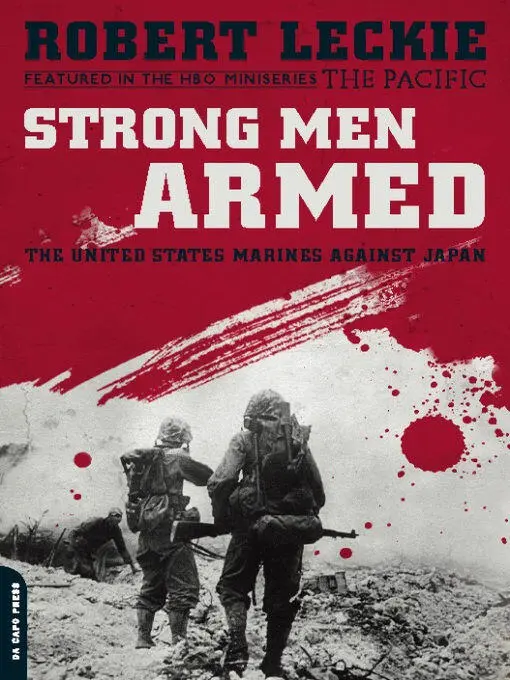
- Название:Strong Men Armed
- Автор:
- Издательство:Da Capo Press
- Жанр:
- Год:2010
- Город:Cambridge
- ISBN:978-0-786-74832-7
- Рейтинг книги:3 / 5. Голосов: 1
-
Избранное:Добавить в избранное
- Отзывы:
-
Ваша оценка:
Strong Men Armed: краткое содержание, описание и аннотация
Предлагаем к чтению аннотацию, описание, краткое содержание или предисловие (зависит от того, что написал сам автор книги «Strong Men Armed»). Если вы не нашли необходимую информацию о книге — напишите в комментариях, мы постараемся отыскать её.
Strong Men Armed — читать онлайн бесплатно полную книгу (весь текст) целиком
Ниже представлен текст книги, разбитый по страницам. Система сохранения места последней прочитанной страницы, позволяет с удобством читать онлайн бесплатно книгу «Strong Men Armed», без необходимости каждый раз заново искать на чём Вы остановились. Поставьте закладку, и сможете в любой момент перейти на страницу, на которой закончили чтение.
Интервал:
Закладка:
Over on the right flank, the western toehold, Major Ryan was calling for naval fire to knock out the Japanese positions. Lieutenant Thomas Greene, a naval gunfire spotter, signaled a destroyer and pinpointed Ryan’s targets. The destroyer ran in and let go. Another destroyer followed. The men whom Shoup had already called “fighting fools” fanned out behind China Gal and another tank to begin their attack. The tanks stopped and one of the tank commanders called out:
“Send us an intelligent Marine to spot the pillboxes for us.”
“Hell’s fire!” a sergeant snorted. “I ain’t very smart, but I’ll go.”
He went, walking between the tanks, guiding them from pillbox to pillbox, and the western beaches began to fall.
To the east, Dave Shoup heard the report of Ryan’s progress with relief. At a few minutes before four o’clock he turned to Major Culhane and said:
“I think we’re winning. But the bastards still have a lot of bullets left.”
Then Colonel Shoup put his estimate into the language of official reports, concluding with that terse summary which would become historic:
“Casualties many; percentage dead unknown; combat efficiency: We are winning.”
Colonel Shoup’s Marines could have told him an hour earlier that the issue was no longer in doubt.
The Japanese had begun to kill themselves.
They had been told that the Americans tortured their captives. More, surrender meant the disgrace of a man’s family. So they had begun blowing themselves up, shooting themselves or disemboweling themselves—choosing suicide as the means of immortalizing their spirits among Japan’s warrior dead at Yasakuni Shrine. Men found with bayonets thrust up into their vitals lay beside loaded rifles. Grenade suicides with missing hand-and-head or hand-and-chest, or those others who lay down in their bunkers to place rifle muzzles in their mouths while pushing the trigger with their big toe, were often found in places where the attack was only beginning. They had not waited to take a few Marines with them.
Aboard Maryland General Julian Smith had given Colonel Maurice Holmes of the Sixth Marines his orders for a pair of landings. One was to be made on the newly cleared western beaches of Betio. The other would be on Bairiki, a little islet just east of Betio. Japanese had been reported attempting to reach Bairiki from Betio’s tail. Smith also wanted to place artillery on the islet to batter Betio.
Shortly before five o’clock carrier planes began striking Bairiki, diving at the lone pillbox mounting two machine guns and held by 15 Japanese. Fifty-caliber bullets passed through the gun ports and entered a gasoline can the Japanese had unwisely brought inside with them.
Flames leaped from the position, and the Second Battalion, Sixth, commanded by big Lieutenant Colonel Raymond Murray, occupied Bairiki without incident.
A few hours later the other landing took place. The First Battalion, Sixth, led by youthful Major William Jones, rode rubber boats in to Betio’s western tip. They were embarrassed at the tearful welcome given them by Major Ryan’s ragged remnant. They moved through them and dug in.
Up in the central sector Brigadier General Edson had come ashore. Julian Smith had sent Red Mike in to relieve the near-exhausted Shoup. Edson took command at six o’clock and David Shoup resumed control of what remained of his Second Marine Regiment. He had not slept for forty hours and his leg wound was paining him, but he had hung onto those two desperate holds and kept his scattered units fighting.
On the left flank Major Jim Crowe called for naval gunfire against Admiral Shibasaki’s bombproof. His men were going to have to go up against it next morning, and he wanted them to go the easy way.
At dusk a destroyer ran in so close to Betio that it seemed it would scrape the bottom of the lagoon. Flame spouted from the muzzles of its five-inchers…. Four, five, six rounds—and then the answering crash and flame as the shells struck Admiral Shibasaki’s command post. The graceful, slender ship was almost obscured in smoke. Chips of cement flew from the bombproof’s five-foot walls, geysers of sand leaped from its roof overgrown with palm trees. Some eighty rounds flashed around it like monster fireflies.
The destroyer stopped firing. Major Crowe shrugged.
“They never hit it squarely,” he said, his outer gruffness masking an inner disquiet. “Just almost.”
Within the bombproof Rear Admiral Keichi Shibasaki contemplated the shattered bits of the Yogaki Plan. He had gotten almost no help, nothing but a submarine or two which had harassed the enemy the night before the invasion. Last night a single plane had flown up from the Marshalls. Tonight he could expect no more. Obviously the Americans had neutralized the Marshalls.
And Tarawa, he knew, was falling.
Having felt the lash of the American destroyer’s five-inchers, Shibasaki could guess that it would be his bombproof’s turn tomorrow. He composed his last message for Tokyo.
“Our weapons have been destroyed,” it said, “and from now on everyone is attempting a final charge…. May Japan exist for ten thousand years!”
10
Apamama was truly called the Atoll of the Moon.
She was the loveliest of all the Gilberts, a brilliant pale green lagoon caught in a circlet of sun-bathed islets which were themselves clasped by the gleaming white of the beaches—and surrounding it all was the soft blue of the sea. To Apamama in 1889 came Robert Louis Stevenson as the guest of the philosopher-king Tem Binoka; to Apamama three years later came the British Government; and to Apamama in another half-century came two companies of Japanese under a midget of a monocle-screwing colonel.
The colonel departed in 1943 with the airfield done and with some 1,000 handsome, good-natured, lazy Apamamese introduced to the horrors of work. There were only an excitable captain and two dozen Imperials left when, in the early morning blackness of November 21, the 68 Marines of Captain Jim Jones came to Apamama to scout out the atoll’s defenses for the November 26 invasion.
They came down from Tarawa the night of November 20, making the 85-mile run southeast aboard the big submarine Nautilus. Shortly after midnight Nautilus heaved out of the sea and the Marines came up on deck to inflate and launch rubber boats from her stern.
They were struck by rain squalls. Only three of the boats’ outboard motors started. One conked out and there were but two left to tow the remaining boats, all bobbing and wallowing now in a wild cross-sea of wind and wave while the current pulled them toward the barrier reef. Two boats were carried off into the darkness. Aboard the others, Marines paddled frantically to avoid being cast up on the boiling reef.
An hour later the wind abated. The two missing boats rejoined the column. Now the only enemy was the current, and three hours later Captain Jones’s men were paddling within the comparatively calm waters of the lee shore.
Jones began sending out patrols to scout the islets of Apamama. One of these scouting parties included Lieutenant George Hard, a short, bald Australian who had lived in the Gilberts before the war and knew the people of Apamama. Minutes after the patrol set out, Lieutenant Hard saw and recognized two Apamamese wading to the Marines’ islet from another one to the right. Hard and the Marines hid in the bushes, for the Australian had no notion of how the Gilbertese had reacted to Japan’s Greater East Asia Co-Prosperity Sphere. When the two men were almost on them, Hard jumped up and called a greeting in Gilbertese.
“Why, my word!” one of them replied in unruffled English. “It’s Mr. Hard! But were you wise to come and visit us now, Mr. Hard? The Sapanese are still here.”
Читать дальшеИнтервал:
Закладка:
Похожие книги на «Strong Men Armed»
Представляем Вашему вниманию похожие книги на «Strong Men Armed» списком для выбора. Мы отобрали схожую по названию и смыслу литературу в надежде предоставить читателям больше вариантов отыскать новые, интересные, ещё непрочитанные произведения.










Обсуждение, отзывы о книге «Strong Men Armed» и просто собственные мнения читателей. Оставьте ваши комментарии, напишите, что Вы думаете о произведении, его смысле или главных героях. Укажите что конкретно понравилось, а что нет, и почему Вы так считаете.