Robert Leckie - Strong Men Armed
Здесь есть возможность читать онлайн «Robert Leckie - Strong Men Armed» весь текст электронной книги совершенно бесплатно (целиком полную версию без сокращений). В некоторых случаях можно слушать аудио, скачать через торрент в формате fb2 и присутствует краткое содержание. Город: Cambridge, Год выпуска: 2010, ISBN: 2010, Издательство: Da Capo Press, Жанр: nonf_military, на английском языке. Описание произведения, (предисловие) а так же отзывы посетителей доступны на портале библиотеки ЛибКат.
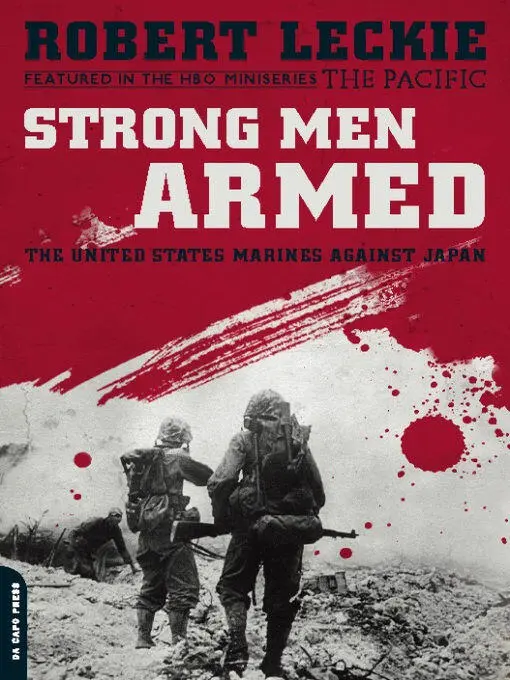
- Название:Strong Men Armed
- Автор:
- Издательство:Da Capo Press
- Жанр:
- Год:2010
- Город:Cambridge
- ISBN:978-0-786-74832-7
- Рейтинг книги:3 / 5. Голосов: 1
-
Избранное:Добавить в избранное
- Отзывы:
-
Ваша оценка:
Strong Men Armed: краткое содержание, описание и аннотация
Предлагаем к чтению аннотацию, описание, краткое содержание или предисловие (зависит от того, что написал сам автор книги «Strong Men Armed»). Если вы не нашли необходимую информацию о книге — напишите в комментариях, мы постараемся отыскать её.
Strong Men Armed — читать онлайн бесплатно полную книгу (весь текст) целиком
Ниже представлен текст книги, разбитый по страницам. Система сохранения места последней прочитанной страницы, позволяет с удобством читать онлайн бесплатно книгу «Strong Men Armed», без необходимости каждый раз заново искать на чём Вы остановились. Поставьте закладку, и сможете в любой момент перейти на страницу, на которой закончили чтение.
Интервал:
Закладка:
Hard grinned. So did the Marines when they learned that the Gilbertese pronounce a J as an S. It was a pleasure to imagine the irritation of those numerous Sapanese who spoke English.
Mr. Hard’s old friend explained that there were only 25 of these Sapanese now, but that they were well entrenched around a radio station on another islet. They had both heavy and light machine guns, mortars and much ammunition, and their pillboxes on both ocean and lagoon beaches would not be easy to rush.
After Captain Jones heard the news he decided to attack. That night he and his “Recon Boys” spotted the winking of blinker lights at sea. An enemy submarine had come to evacuate the atoll’s garrison. But the Japanese couldn’t get away. Jones’s men had destroyed the motor-powered whaleboat that was to have been their getaway craft, and in the morning the Recon Boys would be out to destroy the Japs as well.
Up north at Tarawa Navy Lieutenant Herman Brukardt and his corpsmen worked through the darkness in a “pillbox hospital.” The position had been cleaned out by the Marines and Brukardt had set up an operating room inside. Brukardt was a wisp of a man, black-bearded and seemingly tireless. He had been working throughout the day sewing up the badly wounded. Now, at night, in the light of flashlights held by his corpsmen, Robert Costello and James Whitehead, he worked on.
There was a rifle shot. Brukardt looked up. A wounded Marine pointed grimly into a corner of the pillbox. A Japanese lay there, crumpled in death. He had sneaked into the pillbox while everyone had been absorbed in the operation. Brukardt bent his head again. There was another shot. This time Brukardt didn’t bother to look up.
Machine-gun bullets smacked against the pillbox’s walls. There were rifle shots. The “walking wounded” outside were beating off a party of infiltrators.
“Next!” Brukardt said softly. One of the corpsmen leaned out the door and cried, “Next!” and a wounded man hobbled quickly across the moonlit clearing while the Japanese rifles made their sharp flat cracking.
“We’re out of anaesthetics,” one of the corpsmen whispered. Brukardt shrugged. There were things he had to cut and things he had to sew, and they had to be done, with or without the pain.
He worked on. There were sometimes moans, occasionally an uncontrollable sob, but mostly there was silence while the flashlight beams played on his hands and the bullets smacked against the outer walls.
Of 100 men brought to the pillbox hospital only four died.
11
The third day of battle on Betio was businesslike and it was brutal. It had not the horror and transcending courage of the first day, when Marines fought to rescue their stricken comrades, to knock out the guns that struck them. Nor had it the desperation of the second, when men fought to avoid defeat. It had only the cold, wary precision of the clean-up. Men fought to exterminate an enemy gone to ground. They killed not to save or preserve but to destroy. Such unexalted work requires professionals.
The Marines were coldly efficient the morning of November 22 as one battalion attacked east along Betio’s spine or southern shore and another struck west into The Pocket.
The Pocket was that 600-yard gap which still separated the original Shoup beachhead from the one which Major Ryan had expanded on the west. At seven o’clock in the morning the First Battalion, Eighth, moved out of the Shoup beachhead to reduce it. The men attacked behind three light tanks, but a suicide-soldier got under one of the tanks with a magnetic mine and blew himself and the vehicle apart. The 37-millimeter guns of the light tanks were unable to do more than chip the pillboxes. By noon the attack had done no more than contain the Japanese strong points, and the half-tracks which had come up to relieve the tanks were driven back by machine-gun fire.
Meanwhile, the First Battalion, Sixth, which had landed on the western beaches the night before, moved rapidly east. Major Bill Jones (whose brother Jim had led the Recon Boys ashore at Apamama) drove his men forward. They were as eager as men can be when attacking a maze of forts concealing a stubborn, skillful enemy. They also had three Shermans and the bulldozers of the engineers to accelerate their attack.
The tanks moved against a front about a hundred yards wide. Fifty yards behind them came the riflemen, spread out and watchful for the appearance of suicide-troopers with their magnetic mines. If a blockhouse or pillbox resisted the Sherman’s shells, the tanks waddled on, leaving the position to the riflemen and flame-throwers. If individual assault would not storm the position, it could at least neutralize it while a bulldozer slipped in—its driver crouching behind raised sheltering blade—to seal it off with walls of sand.
At eleven o’clock in the morning the Marines of Jones’s battalion had reached the battalions of the Second Regiment, which had fought to the southern shore midway on the bird’s back the day before. Jones’s men had killed 250 Japanese while taking very light casualties themselves. They moved out along the spine again. By nightfall they had reached the end of the airfield on the southern shore and were dug in looking east toward Betio’s tail.
Just to their left and rear, Jim Crowe’s men were moving toward them across the ruins of Admiral Shibasaki’s bombproof.
The approaches to the bombproof as it faced north toward Crowe’s Marines were guarded on the right by a steel pillbox and on the left by a big emplacement made of reinforced coconut logs. At half-past nine in the morning Crowe’s mortars began falling on the coconut-log structure.
It blew up with a thundering detonation of flame and somersaulting logs. The puny 81-millimeter mortars had scored a direct hit on what had been an ammunition warehouse as well as bunker.
Then jaunty, battered Colorado rolled to the steel pillbox’s right. It fired twice, three times, and Shibasaki’s bombproof lay open to attack.
Crowe’s men moved out, matching shot for shot with the bombproof’s defenders but gradually coming in closer. Assault engineers crawled forward led by a tall cheerful lieutenant named Alexander Bonnyman. They gained the sides of the bombproof and forced their way to the top.
The Japanese counterattacked. They came in a fury, for the bombproof was the heart of their defenses. As they charged up the slopes of sand piled atop the building, they ran into Lieutenant Bonnyman. Though they should have overwhelmed him, they didn’t. He raked them with carbine fire. They hesitated and Bonnyman charged. “Follow me!” he shouted, and the engineers closed in after him. Bonnyman went down and his Marines went over him and beat the enemy back down the hill. Bonnyman died of his many wounds, but the top of the bombproof had been captured, and as the Japanese began to pour out of its eastern and southern exits they were cut down by riflemen and the scything cannister shot of the 37-millimeter cannon. There were still about 200 left inside, among them Admiral Shibasaki.
Bulldozers heaped sand against the exits and sealed off the gun ports. Marines poured gasoline down the air vents and dropped in hand grenades.
There were muffled explosions and then screams. Jim Crowe’s men moved toward Betio’s tail to nail down the left flank of the Marines of Major Jones.
Behind them, on the western beaches, the Third Battalion, Sixth Marines, had landed on Betio under Lieutenant Colonel Kenneth McLeod. Also to their rear, at a rough cemetery in about the center of the Shoup beachhead, parties of their fellow Marines were burying the dead.
Bulldozers scooped out long, long trenches three feet deep. Bodies were laid out in rows, without blankets, without ponchos, and the chaplains moved among them somberly, their lips moving with final prayers or the words of last rites. Bodies that had been identified were quickly placed in the trenches. When a trench was full, the bulldozers roared and butted against the piles of sand. It was soggy wet sand, for it was impossible to dig more than four feet on Betio without striking water. The dead were covered over, the trench was rollered smooth—and a new one was dug. Many bodies were impossible to identify. One was brought in, headless, one-armed, a few shreds of flesh dangling from the neck like a slaughtered chicken. Robert Sherrod the war correspondent turned away.
Читать дальшеИнтервал:
Закладка:
Похожие книги на «Strong Men Armed»
Представляем Вашему вниманию похожие книги на «Strong Men Armed» списком для выбора. Мы отобрали схожую по названию и смыслу литературу в надежде предоставить читателям больше вариантов отыскать новые, интересные, ещё непрочитанные произведения.







Обсуждение, отзывы о книге «Strong Men Armed» и просто собственные мнения читателей. Оставьте ваши комментарии, напишите, что Вы думаете о произведении, его смысле или главных героях. Укажите что конкретно понравилось, а что нет, и почему Вы так считаете.