Robert Leckie - Strong Men Armed
Здесь есть возможность читать онлайн «Robert Leckie - Strong Men Armed» весь текст электронной книги совершенно бесплатно (целиком полную версию без сокращений). В некоторых случаях можно слушать аудио, скачать через торрент в формате fb2 и присутствует краткое содержание. Город: Cambridge, Год выпуска: 2010, ISBN: 2010, Издательство: Da Capo Press, Жанр: nonf_military, на английском языке. Описание произведения, (предисловие) а так же отзывы посетителей доступны на портале библиотеки ЛибКат.
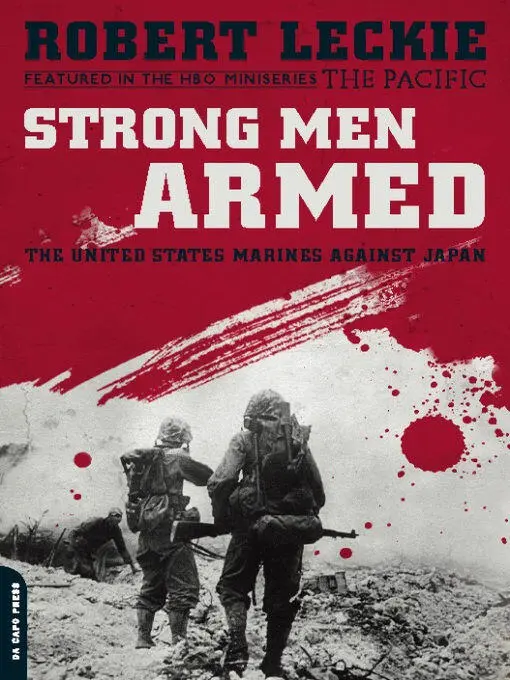
- Название:Strong Men Armed
- Автор:
- Издательство:Da Capo Press
- Жанр:
- Год:2010
- Город:Cambridge
- ISBN:978-0-786-74832-7
- Рейтинг книги:3 / 5. Голосов: 1
-
Избранное:Добавить в избранное
- Отзывы:
-
Ваша оценка:
Strong Men Armed: краткое содержание, описание и аннотация
Предлагаем к чтению аннотацию, описание, краткое содержание или предисловие (зависит от того, что написал сам автор книги «Strong Men Armed»). Если вы не нашли необходимую информацию о книге — напишите в комментариях, мы постараемся отыскать её.
Strong Men Armed — читать онлайн бесплатно полную книгу (весь текст) целиком
Ниже представлен текст книги, разбитый по страницам. Система сохранения места последней прочитанной страницы, позволяет с удобством читать онлайн бесплатно книгу «Strong Men Armed», без необходимости каждый раз заново искать на чём Вы остановились. Поставьте закладку, и сможете в любой момент перейти на страницу, на которой закончили чтение.
Интервал:
Закладка:
They would be firing at dawn.
9
The men of the First Battalion, Eighth, had spent the night in boats. They had not come ashore during darkness as Major General Julian Smith had intended, because his message to Colonel Shoup had not been received. On the morning of November 21 Colonel Shoup had called for them to help expand the beachhead in the central sector.
There were by then only 18 amtracks left and the First Battalion, Eighth, came up to the reef in landing boats. At a quarter after six the ramps of the landing boats banged down, and the Marines began wading in.
From blockhouses on the beach and from the wrecked hulk of Saida Maru came a terrible steady drumming of machine-gun fire, and the morning of the second day was worse than the first.
Out on the reef Marines were rescuing wounded comrades and dragging them back to the landing boats. Pfc. James Collins carried one stricken man back. He turned and seized another, a corpsman who had been shot in the shoulder. He lifted him. There was an explosion, and half the wounded man’s head was blown off. Collins dropped the lifeless body and waded to the beach in tears. Only three of the 24 men who had been in his boat reached the shore. Only 90 of 199 men in the first wave ever got in.
But the wade-in continued, while Marines of the First and Second Battalions, Second, attacked furiously against the blockhouses that were delivering that awful fire. The pack howitzers lined up hub to hub on the beach were leaping and baying in an attempt to silence the enemy machine guns. The artillerymen were using shells with delayed fuses intended to explode once they had penetrated the concrete, but they were firing to a narrow front and thy could not get them all.
Carrier planes swooped down to strafe and bomb the blockhouses, but the enemy fired on. Dive-bombers pounded the Saida Maru, but it still crackled with fire. Marine mortars ashore pounded Saida Maru, but the bullets only slackened, they did not stop. It would eventually take a force of dynamite-throwing engineers covered by riflemen to clean out the ship infestation.
Sometimes the Marines sought to veer away from the enemy’s field of fire. One platoon slipped off to the right toward the sector held by Major Ryan. They waded into a cove, and they were shot down to a man.
It continued for five full hours, and when Major Lawrence Hays at last got his battalion ashore and reorganized, he found he had lost 108 men killed and 235 wounded. But 600 Marines had survived the wade-in. They were now available for the desperate battle raging everywhere along the western half of Betio. As Colonel Shoup radioed Julian Smith at half-past eleven in the morning:
“The situation ashore doesn’t look good.”
Earlier that morning, just as the dreadful wade-in began, Shoup had ordered Lieutenant Hawkins to take his scout-sniper platoon against a Japanese position holding five machine guns. It barred the way to the central sector attack with which Shoup hoped to cut Betio in two.
The Hawk gathered his men. He had often said, “I think my thirty-four-man platoon can lick any two-hundred-man company in the world.” Now he was going on a company-size mission to prove it. His men moved methodically from gun to gun, laying down covering fire while Hawkins crawled up to the pillbox gun ports to fire point-blank inside or toss in grenades. The guns fell, but not before Hawkins had been shot in the chest. He had already lost blood from shrapnel wounds the day before, but he still resisted the corpsman’s suggestions that he accept evacuation.
“I came here to kill Japs, not to be evacuated,” Hawkins said. He and his men knocked out three more enemy positions and then Hawkins was caught in a burst of mortar fire and when they carried him to the rear he was already dying.
But he and his men had opened the way for the cross-island attack, an assault which Colonel Shoup held as important as Major Ryan’s drive to clear Betio’s western beaches for the safe arrival of the reinforcing Sixth Marines.
Still in charge of the battle so long as Julian Smith remained aboard Maryland, Colonel Shoup crouched in his command post and listened to telephoned reports, his hand shaking slightly. His CP was still in front of the occupied Japanese pillbox and it seemed to be crowned by a perpetual cloud of dust rising from the attack south across the airfield. Out of the dust just before noon limped the dirtiest Marine Shoup had seen so far. A quarter-inch of grime coated his beardless face while a lock of limp blond hair hung from beneath his helmet. The youth’s name was Adrian Strange and he entered the colonel’s CP bawling, “Somebody gimme a pack of cigarettes. There’s a machine-gun crew out there in a shellhole and there ain’t one of ‘em’s got a butt.”
Someone threw him a pack of Camels. Imperturbable, impressed by neither the brass crouching below him nor the bullets buzzing above, Pfc. Strange took one of the cigarettes and lighted it.
“I just got another sniper,” he said, grinning. “That’s six today, an’ me a cripple.” He blew smoke. “Busted my ankle steppin’ in a shellhole yesterday.” The bullets began buzzing as though coming in swarms, and Pfc. Strange sneered, “Shoot me down, you son of a bitch!”—before turning to limp back to the airfield.
Not all the Marines on Betio that day were like Pfc. Strange. A few minutes after he had limped off a tearful young major ran into Shoup’s CP crying:
“Colonel, my men can’t advance. They’re being held up by a machine gun.”
Dave Shoup spat in disgust.
“God a’mighty! One machine gun!”
The major turned in confusion and went back to his men, and he had hardly disappeared before there was a sharp crrrack! in the CP and Corporal Leonce Olivier yelped in pain. A Jap in the pillbox had poked a rifle out an air vent and shot him in the leg. Someone dropped a grenade down the vent, but no one took comfort from the muffled explosion. The pillbox had walls three feet thick and was probably compartmented inside.
The confused young major came back.
“Colonel, there are a thousand goddam Marines out there on the beach and not one will follow me across the airstrip.”
Shoup spat again.
“You’ve got to say, ‘Who’ll follow me?’ And if only ten follow you, that’s the best you can do—but it’s better than nothing.”
The major departed—for good this time—and the attack across the airfield to Betio’s southern coast gained momentum. It reached its objective before dusk, after the Marines occupied abandoned enemy positions and beat off two fierce counterattacks.
Betio was sliced in two and the Marines had possession of most of the airfield, the base which would one day be known as Hawkins Field.
On the left flank, the Marines under Jim Crowe were making slow progress. They were trying to beat down the network of pillboxes and blockhouses surrounding Admiral Shibasaki’s bombproof in their sector. It was slow because the men had to go in against an enemy concealed from view. The diving, strafing planes could not knock out these positions. Even Lieutenant Largey’s 32-ton Colorado was not heavy enough to crush most of them. Largey saw one of his own men fall from his own fire and went back to report in grief to Crowe.
“I just killed a Marine,” he said. “Fragments from my 75 splintered against a tree and richocheted off. God damn, I hated for that to happen.”
“Too bad,” Crowe muttered. “But it sometimes happens. Fortunes of war.” He glanced upward at the American planes. “They do it too. One .50-caliber slug just hit one of my men. Went through his shoulder, on down through his lung and liver. He lived four minutes.” He shrugged. “Well, anyway, if a Jap ever sticks his head out of his pillbox the planes may kill him.”
Читать дальшеИнтервал:
Закладка:
Похожие книги на «Strong Men Armed»
Представляем Вашему вниманию похожие книги на «Strong Men Armed» списком для выбора. Мы отобрали схожую по названию и смыслу литературу в надежде предоставить читателям больше вариантов отыскать новые, интересные, ещё непрочитанные произведения.











Обсуждение, отзывы о книге «Strong Men Armed» и просто собственные мнения читателей. Оставьте ваши комментарии, напишите, что Вы думаете о произведении, его смысле или главных героях. Укажите что конкретно понравилось, а что нет, и почему Вы так считаете.