John Nichol - Tornado Down
Здесь есть возможность читать онлайн «John Nichol - Tornado Down» весь текст электронной книги совершенно бесплатно (целиком полную версию без сокращений). В некоторых случаях можно слушать аудио, скачать через торрент в формате fb2 и присутствует краткое содержание. Город: London, Год выпуска: 2008, ISBN: 2008, Издательство: Penguin Adult, Жанр: nonf_military, Биографии и Мемуары, на английском языке. Описание произведения, (предисловие) а так же отзывы посетителей доступны на портале библиотеки ЛибКат.
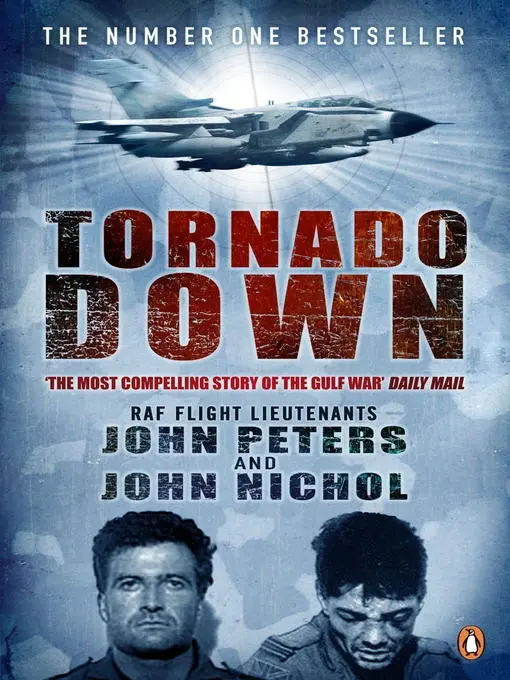
- Название:Tornado Down
- Автор:
- Издательство:Penguin Adult
- Жанр:
- Год:2008
- Город:London
- ISBN:978-0-14-193771-7
- Рейтинг книги:5 / 5. Голосов: 1
-
Избранное:Добавить в избранное
- Отзывы:
-
Ваша оценка:
Tornado Down: краткое содержание, описание и аннотация
Предлагаем к чтению аннотацию, описание, краткое содержание или предисловие (зависит от того, что написал сам автор книги «Tornado Down»). Если вы не нашли необходимую информацию о книге — напишите в комментариях, мы постараемся отыскать её.
In
, John Peters and John Nichol tell the incredible story of their part in the war against Saddam Hussien’s regime. It is a brave and shocking and totally honest story: a story about war and its effects on the hearts and minds of men.
Tornado Down — читать онлайн бесплатно полную книгу (весь текст) целиком
Ниже представлен текст книги, разбитый по страницам. Система сохранения места последней прочитанной страницы, позволяет с удобством читать онлайн бесплатно книгу «Tornado Down», без необходимости каждый раз заново искать на чём Вы остановились. Поставьте закладку, и сможете в любой момент перейти на страницу, на которой закончили чтение.
Интервал:
Закладка:
I thought, ‘Eight to one, the usual odds, this is where they have at me again.’
Their leader, a Warrant Officer, said, ‘Are you an officer?’
‘Yes.’
He turned, his companions following him out like so many goslings. In a little while, the Warrant Officer came back, still with his flock in tow. There is safety in numbers! He was carrying a piece of foam for me to lie on, another to act as a pillow, a couple of blankets, a jug of water, a cup and a metal plate.
‘OK,’ he said, ‘stand up.’ He then searched me. I realised that up until then I had never been thoroughly searched – only looted. When he was satisfied that I was not carrying anything I should not be, he removed the handcuffs, told me to lie down on the foam, threw a blanket over me, and went out. This treatment came as a complete surprise. Next day, the light filtering through the barred window revealed a nine-foot square concrete space, completely bare. They took my clothes off me in the course of the morning, replacing them with a new yellow canvas suit, which looked as though it had just been specially run up on the sewing machine, the jacket and trousers roughly stitched, the initials ‘PW’ stamped attractively in large black letters on the back and chest. With the suit came a pair of black laceless plimsolls. The laces presumably had been removed to prevent us from hanging ourselves. Still, it was the first sign that the Iraqis might have actually heard of prisoners’ rights. The way things were improving, the Red Cross would be visiting soon; I’d get a parcel from home.
This was easily the best period of my time in captivity. The Iraqi Army guards, in complete contrast to our Ba’ath Party interrogators, were treating us with decency and even humanity. Somebody up there had at least heard of the Geneva Convention. One superb luxury was that, when the guards weren’t around, we could communicate by shouting along the corridor. As the conversations echoed, morale soared.
John Peters: Jeff Tice next door told me about his electrocution torture. Like the rest of us, he had been repeatedly beaten to begin with, but had refused to give in. So they had started using electricity on him. I could hardly hear what he was saying, because his ruptured eardrum made him think he was talking much more loudly than he actually was. He nicknamed the electrical instrument the interrogators had used on him a ‘Talkman’, because they had wrapped it around his ears, or attached it to them in some way, a bit like a Walkman personal stereo. This little witticism was fairly spirited of him, considering.
After every meal, the Iraqis would come round and retrieve the metal spoons that always arrived with the food. The cells were small solid concrete boxes; did they imagine we were going to dig our way out with the spoons? I asked Jeff what he thought the reason was.
‘Well,’ he drawled, ‘I don’t know about that. But I’m building a glider in my cell…’
As we were chatting, the Iraqis came rushing into my cell; I could hear them bundling into his. A beating looked on the cards. Instead, they took him away, and swapped him for Simon Burgess, another Tornado pilot from 17 (F) Squadron, who had just been shot down. One of his bombs had gone off after release, when it mistook the bomb just underneath it for the ground and fused itself by mistake. The resulting explosion brought down the aircraft: another one downed. I wondered if any of our friends were dead.
When the guards had gone again, Simon Burgess said, ‘Who is it?’
‘John Peters.’
‘John, hello mate. Let me tell you something: you’ve been on television. I saw you a couple of days ago! Everyone knows you’re alive. The world has completely reacted against it. You’re bloody lucky, because they can’t kill you now!’
So Helen knew I had been captured, and my parents. This was amazing! They had seen me on television! It was strangely comforting. I felt in touch with them. All I had to do now was stay alive, and maybe, one day…
The other person I could hear after the Iraqis had shuffled us around was Cliff Acree. He told me that his neck had been badly beaten. He was quiet-spoken and reserved. He sounded like a true gentleman.
My cell window was barred and filled with foam and old newspapers to block out the light. But there was a small hole in the covering. It acted like a lens, throwing an inverted image of the palm trees outside onto the opposite wall. I lay there sometimes, watching the trees swaying upside-down in the sunlight, a topsy-turvy image of freedom. The light-switch was hanging off the wall, its wires exposed. The walls themselves were crumbling, ancient plaster, covered in scratch marks, as though a large animal had been caged up in there at some time. There were nails sticking out of them, whose purpose I could only guess at. Winning the morale war was still my overriding concern.
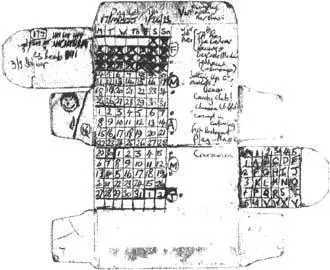
An army doctor finally came in and gave me some drops for my damaged eye. I kept the box. One morning, as I was hobbling along to the toilet hole, I noticed an ancient biro pen sitting in the dust on a window-ledge. Checking that the guard was looking the other way, I grabbed it and slipped it into my pocket. Up until then I had been carving the date every day on the wall with a nail. It seemed very important not to lose track of time. If time didn’t matter, I thought, because one day was the same, exactly the same, as the next, then perhaps life itself would become meaningless. So a pen and paper was a real find. I drew out a crude calendar or ‘diary’ on the inside of the flattened-out box. Marking down the days I had been in captivity already, I set out tiny rows of boxes to represent the days to come, as many as would reasonably fit on the card. Every box had an X drawn through it, from corner to corner. Every day, according to how my morale was doing, I blocked in a segment of the appropriate X. On good days, I filled in the top segment; on medium days, I filled in the two side segments; and on bad days, I filled in the bottom section. It was a way of standing back from myself, of monitoring my state of mind. Most days, perhaps because I had that little challenge to my feelings, the empty square, in front of me, I filled in the top bit.
There was an old Iraqi newspaper on the windowsill, which I carefully tore into strips, as an alternative to using my hand when I was allowed to the toilet. You were meant to wipe your backside with your hand, always the left one, and then wash your fingers clean afterwards. The right hand is reserved for eating. Washing was out of the question, though, because our air forces had bombed all the water mains. A pretty good way of catching hepatitis, or something like it, I thought.
We christened this prison the ‘Baghdad Bungalows’.
John Nichol: Near me was an Italian Tornado pilot, Gian Marco Bellini. Somebody had given him a very bad time, because he had no idea where he was, no idea what was happening to him, no recollection of his capture, nothing. He would not eat; he would not drink. They brought doctors in to see him. He would have yelling fits in his cell. No doubt his problem was severe concussion from his head being hit repeatedly with large chunks of wood – if my own experience was anything to go by.
I glimpsed JP in the courtyard on the second day. Seeing him made me feel we might yet make it, somehow. On the other side of me was Mohammed Mubarak, a Kuwaiti Skyhawk pilot. The Iraqis would have Radio Baghdad on at night, and Mohammed was a godsend, because he could translate for us and relay what was going on. One night he told us, ‘The Iraqis claim they have shot down 200 Allied aircraft, they say that they have successfully invaded Saudi Arabia.’
Читать дальшеИнтервал:
Закладка:
Похожие книги на «Tornado Down»
Представляем Вашему вниманию похожие книги на «Tornado Down» списком для выбора. Мы отобрали схожую по названию и смыслу литературу в надежде предоставить читателям больше вариантов отыскать новые, интересные, ещё непрочитанные произведения.





Обсуждение, отзывы о книге «Tornado Down» и просто собственные мнения читателей. Оставьте ваши комментарии, напишите, что Вы думаете о произведении, его смысле или главных героях. Укажите что конкретно понравилось, а что нет, и почему Вы так считаете.