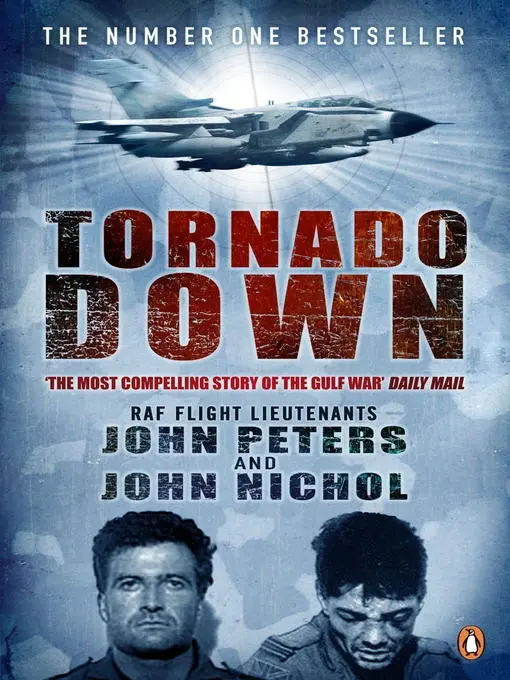
John Nichol - Tornado Down
Здесь есть возможность читать онлайн «John Nichol - Tornado Down» весь текст электронной книги совершенно бесплатно (целиком полную версию без сокращений). В некоторых случаях можно слушать аудио, скачать через торрент в формате fb2 и присутствует краткое содержание. Город: London, Год выпуска: 2008, ISBN: 2008, Издательство: Penguin Adult, Жанр: nonf_military, Биографии и Мемуары, на английском языке. Описание произведения, (предисловие) а так же отзывы посетителей доступны на портале библиотеки ЛибКат.
- Название:Tornado Down
- Автор:
- Издательство:Penguin Adult
- Жанр:
- Год:2008
- Город:London
- ISBN:978-0-14-193771-7
- Рейтинг книги:5 / 5. Голосов: 1
-
Избранное:Добавить в избранное
- Отзывы:
-
Ваша оценка:
Tornado Down: краткое содержание, описание и аннотация
Предлагаем к чтению аннотацию, описание, краткое содержание или предисловие (зависит от того, что написал сам автор книги «Tornado Down»). Если вы не нашли необходимую информацию о книге — напишите в комментариях, мы постараемся отыскать её.
In
, John Peters and John Nichol tell the incredible story of their part in the war against Saddam Hussien’s regime. It is a brave and shocking and totally honest story: a story about war and its effects on the hearts and minds of men.
Tornado Down — читать онлайн бесплатно полную книгу (весь текст) целиком
Ниже представлен текст книги, разбитый по страницам. Система сохранения места последней прочитанной страницы, позволяет с удобством читать онлайн бесплатно книгу «Tornado Down», без необходимости каждый раз заново искать на чём Вы остановились. Поставьте закладку, и сможете в любой момент перейти на страницу, на которой закончили чтение.
Интервал:
Закладка:
Further inside Iraq, we hit a major north-south highway, teeming with military vehicles, a vast convoy of men and weaponry, a sharp-toothed crocodile, crawling as far as the eye could see. It was our first real sighting of the enemy. It was shocking, a silencer: this was suddenly all real. Down there were several thousand men dedicated to the terminally simple idea of killing us before we could kill them. Our formation leader transmitted: ‘OK, quiet boys – let’s get to work.’ But the few bits of banter that had been exchanged over the secure radios had already dried up.
Obsessively, now, relentlessly, we went through our war checks. We were like a certain kind of married couple, continually nagging and upbraiding one another, making sure, keeping ourselves on our toes. To save myself from the more obvious errors, I had made up my own mnemonic, ‘Will the Brits get Aids?’ or WILLGBHIV:
Weapons: check the main and reversionary weapons package selection switches;
IFF: switch on until we reached the FLOT, or Forward Line of Own Troops, so our own side did not shoot us down, switch off now, going into enemy territory;
Laser: ‘illuminate’ targets – give the weapons computer a millimetre-accurate target range;
Lights: all off to minimise detection;
Guns (and Missiles): select both 27-mm Mauser cannons to high-rate, set both AIM-9L Sidewinders to Slave, ready for immediate action; also included under G, we made the Master Arm and Safety (MASS) and the Late Arm switches, so that now I only had to flick the red ‘Pickle’ button on the sticktop for the weapons to release;
Boz-107 chaff and flare decoy dispenser to manual, Skyshadow ECM pod up and jamming;
Height sensor: make sure we have the radio-altimeter on, now we are down at low level;
Eyes: I always tend to tank with my visor up at night, to reduce unwanted reflections, but you want it down going into combat;
Volume: adjust Radar Homing Warning Receiver (RHWR) volume so we have a nice loud warning of incoming SAMs. Adjust Sidewinder volume so you get a good growl from the missile.
We did these checks ad nauseam . We were also monitoring and updating our heading, speed, height, attitude, track to target, Time On Target, time to weapons release, scanning visually all round, all the time, for enemy fighters… Checking again.
The Tornado was bouncing hard now in the low-air turbulence as the desert floor warmed up. Out here on our own, with the sun fully up, it was reassuring to know our formation was part of a much larger formation, somewhere near, that we had massive backup in this attempt to knock out one of Saddam’s airfields. The opposition’s fighters should be showing up about now, if they were going to show up. From time to time, one of the friendly fighters flying the Combat Air Patrol (CAP) for our attack locked us up on its search radar. It was reassuring to know the F-15 was out there, looking – for someone else.
The F-18 radar suppressors had gone in first, the big HARMs strapped under their wings. The HARM offers an enemy a simple choice. He can switch his missile and gun radars on when a raid arrives, in an effort to detect, track and shoot down the incoming aircraft. In this case the HARM locks onto the emitting radar source, flies down its radar beam and kills the radar and everybody near it. Or he can play it safe and leave his radar emitters off – in which case his airfield will be unprotected, his air defence denuded. Switching the radar on in very short bursts is about the only compromise available, and even that is not safe: if he switches off too late, the HARM’s computer may have enough stored information about the emitter’s source to score a direct hit on it anyway. Not much of a choice.
Along with the F-18s went an EA-6B Prowler, bristling with electronic jammers. Its task was to jam enemy search radars and tracking radars. AWACS was up there too, Big Brother, the magic eye in the sky, the all-seeing god of air war, telling us where the enemy was, at what height, and what he was doing. Every so often, an operator onboard the AWACS would send out ‘Picture Clear’ over the radio, a lovely message to hear, sweet as music, meaning there was no enemy air threat. Deeply reassuring.
Our attack profile was ‘loft’ – throwing eight 1,000-pound bombs apiece onto the airfield’s taxiways. With three aircraft, that added up to about eleven tonnes of high-explosive.
The idea of a loft attack is to go in as fast and as low as you can, pull up sharply at a pre-determined distance from the target, and allow the onboard computer to calculate the exact moment at which to release the bombs, ‘lofting’ them onto the designated aiming point.
In this type of attack, each 1,000-pound high-explosive bomb is released when the forward speed of the aircraft and the tremendous catapulting effect of its sharp upward pull will invest the bomb with maximum energy. As it reaches the top of its graceful ballistic arc, each bomb begins falling to earth, acquiring further kinetic energy from the gravitational pull on its mass. By the time it hits the ground its terminal velocity is enormous, as the bomb drills several feet into the target before sending an explosive pressure-wave rippling upwards and out, buckling tarmac and concrete into long jagged chunks.
The loft attack profile is designed to save the attacking aircraft from overflying the target area, to keep it as far away from the target’s point defences as possible, minimising the time an enemy has to react and to shoot it down. Provided, that is, that the enemy defences are not layered out for miles and miles beyond the perimeter of the target airfield. In training, lofting worked very well. This time, it’s for real.
Coming up now to the Initial Point (IP), a preselected ground feature marking the start of the target run proper: nine miles to pull-up, or one minute exactly. No more. Flat out, at fifty feet, the desert looks close enough to touch, fizzling past like a speeded up film. In the front seat, I am happy with all my parameters for the attack. I had made the MASS and the Late Arm switch, arming the weapons, and the sticktop is ‘live’. Position and TOT are both good. The onboard computer is constantly computing the aircraft’s speed, its height and the exact distance in feet to the target. I can see the brilliant hair-thin vertical of the bomb-fall line, which shows me where the bombs will strike, if for any reason we have to release them unexpectedly. I can also see the target bars, which will bracket the target for me, either side of the bomb-fall line. The ‘time to pull’ clock, also in the HUD, also a bright electronic symbol, is running down anti-clockwise, a bit like a gameshow clock. We are flying at good speed. Seven miles – forty-eight seconds – to pull-up. Looking good.
Behind me John is well into his own attack routine. He has set the computer to its attack profile: Fix/ Attack, Radalt (radio-altimeter) selected. He has his head in the radar, looking for the first ‘offset’, which is coincidentally the IP.
Offsets are topographical features used to update the computer’s navigational calculations, fixing the target exactly in space and time relative to the aircraft. There are usually three of them. On a target run John locates each offset in turn on radar, steers his illuminated marker over it on the screen in front of him, and thumbs the button to enter the data. Each offset refines the computer’s attack calculations, progressively eliminating any margins of navigational error. Three successfully marked offsets will result in the bombs being planted to within a very few metres of the intended spot. The only problem is that in the desert there are very few features.
John flips on the radar again. He can see something on the display now that should be the IP: it has a couple of masts around it, that is what we are looking for, but it is very difficult to mark exactly. No matter, he knows we are close to where we should be, that the kit is good enough to find the second offset.
Читать дальшеИнтервал:
Закладка:
Похожие книги на «Tornado Down»
Представляем Вашему вниманию похожие книги на «Tornado Down» списком для выбора. Мы отобрали схожую по названию и смыслу литературу в надежде предоставить читателям больше вариантов отыскать новые, интересные, ещё непрочитанные произведения.






Обсуждение, отзывы о книге «Tornado Down» и просто собственные мнения читателей. Оставьте ваши комментарии, напишите, что Вы думаете о произведении, его смысле или главных героях. Укажите что конкретно понравилось, а что нет, и почему Вы так считаете.