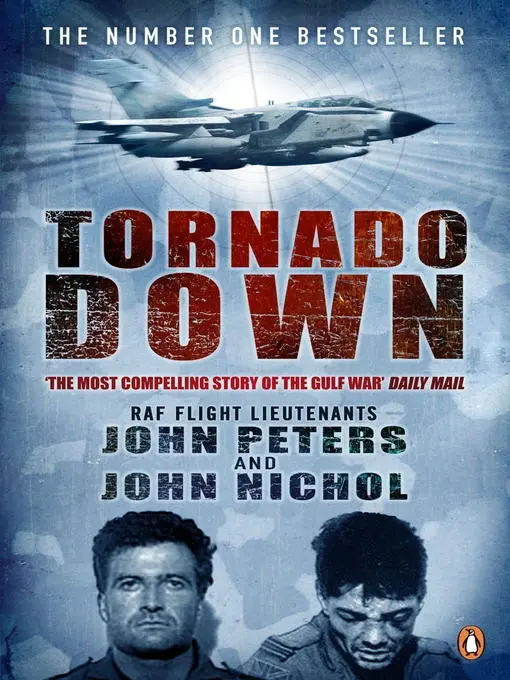
John Nichol - Tornado Down
Здесь есть возможность читать онлайн «John Nichol - Tornado Down» весь текст электронной книги совершенно бесплатно (целиком полную версию без сокращений). В некоторых случаях можно слушать аудио, скачать через торрент в формате fb2 и присутствует краткое содержание. Город: London, Год выпуска: 2008, ISBN: 2008, Издательство: Penguin Adult, Жанр: nonf_military, Биографии и Мемуары, на английском языке. Описание произведения, (предисловие) а так же отзывы посетителей доступны на портале библиотеки ЛибКат.
- Название:Tornado Down
- Автор:
- Издательство:Penguin Adult
- Жанр:
- Год:2008
- Город:London
- ISBN:978-0-14-193771-7
- Рейтинг книги:5 / 5. Голосов: 1
-
Избранное:Добавить в избранное
- Отзывы:
-
Ваша оценка:
Tornado Down: краткое содержание, описание и аннотация
Предлагаем к чтению аннотацию, описание, краткое содержание или предисловие (зависит от того, что написал сам автор книги «Tornado Down»). Если вы не нашли необходимую информацию о книге — напишите в комментариях, мы постараемся отыскать её.
In
, John Peters and John Nichol tell the incredible story of their part in the war against Saddam Hussien’s regime. It is a brave and shocking and totally honest story: a story about war and its effects on the hearts and minds of men.
Tornado Down — читать онлайн бесплатно полную книгу (весь текст) целиком
Ниже представлен текст книги, разбитый по страницам. Система сохранения места последней прочитанной страницы, позволяет с удобством читать онлайн бесплатно книгу «Tornado Down», без необходимости каждый раз заново искать на чём Вы остановились. Поставьте закладку, и сможете в любой момент перейти на страницу, на которой закончили чтение.
Интервал:
Закладка:
Some of the guys who weren’t flying on our mission took the prepared cassettes out to the waiting aircraft, and loaded them for the outgoing crews. It was their way of showing us support.
This was the big one, the first war sortie. I can’t speak for Gary, but I was more than a mite nervous. Because we were on a daylight raid, we would be using bombs instead of JP-233s. We checked and re-checked that we had the safest routes to and from the target, re-plotted the turn points, re-checked the precise timings required to get four aircraft travelling at about 540 knots to drop ordnance onto a target in quick succession and with percussive proximity – this without hitting one another, and giving least advantage to the enemy defences.
For an effective attack, each aircraft must maintain a very accurate time and distance from the others, and stay precisely in position and on track. If it should stray out of its own little space-time slot, the consequences could be disastrous. The Time On Target (TOT) is thus everything, or a great part of everything – the sacred cow of flying a fast ground-attack jet. Miss your Time On Target, and your best mate could be coming up your rear end at a speed of one mile every six seconds. If you are running late you will effectively back into him. Miss your TOT on a real attack, and you might find yourself flying through your best mate’s bomb fragments or doing your best to blow up the chaps behind. When the raid is planned, each Tornado is carefully tasked to drop its bombs on the target in such a way that the bomb fragments from one aircraft do not hit the next one coming through – ‘fragging your mates’, as people say. The dust and debris from a 1,000-pound bomb explosion rise at least 2,000 feet into the air, and can hang there for as much as half a minute. These nice calculations are the bread and butter of the RAF navigator’s job: flying in the Tornado, and operating its weaponry, are the jam.
It was very good to be doing something concrete, something I had been through a hundred times before in training, to hit that groove, to think of it as just another mission. On his way back from breakfast, JP later told me he had had one of those gut-wrenching moments that hit you when something terrible and momentous is about to happen, the sudden stab of adrenalin. I had been experiencing similar moments. We were about to find out if we could do it – or be found out.
By now we knew that the TOT for the first mass air attacks on Iraq was going to be at about 0400 Iraq time, after the Tomahawk cruise missiles and the F-117A Stealth bombers had done their preliminary softening up work. We had BBC World Service radio on; sure enough, ever reliable, as the first strikes went in, a clear female voice came over the airwaves, ‘I can confirm that Baghdad is under attack, the first bombs are falling now…’
This was thrilling, a momentary tingle through the nerves. We were part of this. History was being made. This brief feeling of exhilaration was considerably dampened by the wail of the air-raid sirens. As we attacked them, so they were attacking us. There had been a couple of false alarms earlier that night, but we knew the threat was real this time. There were live Scuds inbound for our heads, and it wasn’t funny: it was scary. The siren wail of the air-raid warning went right through you. As it turned out, the Scuds were aimed at Dhahran twenty miles away, but everybody leapt into their chemical warfare suits anyway, donned their gasmasks, and huddled into the air-raid shelter. Eventually, when the all-clear sounded, we went back to the Ops Room for the brief. It was not a small room, but it seemed very crowded. Everybody had guns, helmets, bags, and technical reference books with them: there was stuff everywhere.
The mission briefing was specifically about our own target for the night. It was to be the Ar Rumaylah airfield, in southern Iraq. We were briefed on its layout, its defences, in this case numerous Triple-A, SAM-3 and SAM-6 sites, how we were going to attack it and get out again in one piece, and the air support we could expect. While we were attacking the access taxiways, the tarmac links between the HAS sites and the runways, the US Navy F-18s were trying to hit the HAS sites themselves, and the US Air Force F-llls were taking on the oilfields and military storage sites to the southeast. With all this, unless we were very lucky, the raid was never going to be more than an exercise in harassment.
After the mission brief, we went back into the Ops Room to get our final Intelligence brief from the GLO. He gave us an update on the latest assessment of the defences we could expect to face at and around the target. Then we, too, sang the Squadron going-to-war song. All of a sudden, and from nowhere, I got a huge lump in my throat. It was really difficult to hide this reaction, to continue singing. Singing the song on exercise was one thing. You could have a good laugh about it. Singing it now, on the point of flying into heavily defended territory, with the very real prospect of not coming back, was something entirely different. It occurred to me that I might never see some of the men singing in that room again – ever.
With this rousing chorus, for our formation, Operation Desert Storm got underway.
John Peters: As Squadron Intelligence Officer, one of Janine’s tasks was to ‘sterilise’ all aircrew flying into enemy territory, that is, to make sure we removed everything that might give away to the enemy details of our personal lives: rings, lockets, mementoes, photographs, lucky charms, credit cards… details that could be used against us under interrogation. Taking off the signet ring my parents had given me for my eighteenth birthday was hard; taking off the wedding ring, and thinking of Helen and the kids while I did it, made me pause for a moment too. Here was my life going into a little plastic bag, to be kept in case I was shot down. We also had to cleanse our flying-suits of anything that might be of military advantage to the Iraqis in the event of our capture. This was no longer make-believe. This was beginning to feel really seriously like grown-up going to war.
Having taken us through our detailed escape and evasion brief – what to do in the event of getting shot down – and handed us the appropriate evasion maps for the area, Janine gave us £1,000 sterling in gold sovereigns, which we were obliged to sign for. She also issued us with our ‘Goolie Chits’. A Goolie Chit is a piece of paper on which Her Majesty’s Government promises to pay the bearer the sum of £ 5,000, provided said bearer returns Her Majesty’s airman unharmed and in one piece to a place of safety – i.e., with his ‘goolies’, or testicles, still attached. Being given one of these just before a live combat mission really makes you think. We were also issued with high-tech infra-red light beacons, to summon the Combat Search and Rescue (CSAR) guys in, at night, if we were shot down. Only someone wearing night-vision goggles, like a CSAR chopper pilot, can see these beacons flashing in the darkness: they are invisible to the naked eye. By this time, we were kitted up in full war clothing, pistols strapped round our waists, two magazines apiece, each holding nine rounds. The hardest things to get on were the g-suits, because they were stuffed full of water-filled bags, a shortage of water being the greatest fear in the desert. The g-suit is a system of straps and inflatable bags, a bit like a bondage garment, which blows up automatically when the pilot pulls a hard turn. The inflated bags clamp around your limbs and stop you passing out. If they weren’t there, all the blood would rush to your feet at very high speed, starving your brain of oxygen.
Next there came the ‘outbrief’, a pedantic enforced check that everybody had their maps, film was in their onboard cameras, and so on. Finally, we were signed out for the mission. Every time you go flying in peacetime, you have a specific set mission requirement –air-to-air refuelling, bombing practice, low-level flying or whatever. You have to sign for the aircraft, accepting responsibility for that specific sortie. They don’t give them to just anybody. It seemed strange, somehow, though, that we were still signing for the jet in time of war.
Читать дальшеИнтервал:
Закладка:
Похожие книги на «Tornado Down»
Представляем Вашему вниманию похожие книги на «Tornado Down» списком для выбора. Мы отобрали схожую по названию и смыслу литературу в надежде предоставить читателям больше вариантов отыскать новые, интересные, ещё непрочитанные произведения.




Обсуждение, отзывы о книге «Tornado Down» и просто собственные мнения читателей. Оставьте ваши комментарии, напишите, что Вы думаете о произведении, его смысле или главных героях. Укажите что конкретно понравилось, а что нет, и почему Вы так считаете.