John Nichol - Tornado Down
Здесь есть возможность читать онлайн «John Nichol - Tornado Down» весь текст электронной книги совершенно бесплатно (целиком полную версию без сокращений). В некоторых случаях можно слушать аудио, скачать через торрент в формате fb2 и присутствует краткое содержание. Город: London, Год выпуска: 2008, ISBN: 2008, Издательство: Penguin Adult, Жанр: nonf_military, Биографии и Мемуары, на английском языке. Описание произведения, (предисловие) а так же отзывы посетителей доступны на портале библиотеки ЛибКат.
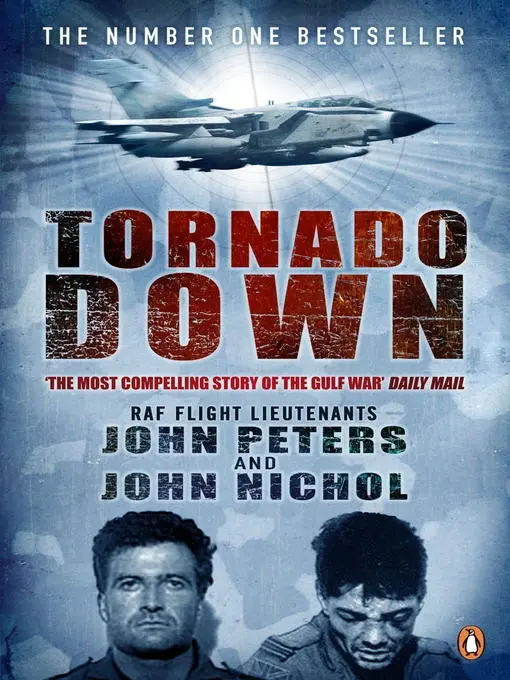
- Название:Tornado Down
- Автор:
- Издательство:Penguin Adult
- Жанр:
- Год:2008
- Город:London
- ISBN:978-0-14-193771-7
- Рейтинг книги:5 / 5. Голосов: 1
-
Избранное:Добавить в избранное
- Отзывы:
-
Ваша оценка:
Tornado Down: краткое содержание, описание и аннотация
Предлагаем к чтению аннотацию, описание, краткое содержание или предисловие (зависит от того, что написал сам автор книги «Tornado Down»). Если вы не нашли необходимую информацию о книге — напишите в комментариях, мы постараемся отыскать её.
In
, John Peters and John Nichol tell the incredible story of their part in the war against Saddam Hussien’s regime. It is a brave and shocking and totally honest story: a story about war and its effects on the hearts and minds of men.
Tornado Down — читать онлайн бесплатно полную книгу (весь текст) целиком
Ниже представлен текст книги, разбитый по страницам. Система сохранения места последней прочитанной страницы, позволяет с удобством читать онлайн бесплатно книгу «Tornado Down», без необходимости каждый раз заново искать на чём Вы остановились. Поставьте закладку, и сможете в любой момент перейти на страницу, на которой закончили чтение.
Интервал:
Закладка:
‘Happy with that,’ he calls, ‘cancel your offset.’ I cancel my own marker. Now we are back into direct target aiming and he can select offset two. Five miles to pull-up, about thirty seconds…
‘Looking at offset two,’ John says. Offset two is a building halfway down the target run. It isn’t exactly what we would like, but we can see there is something there, no problem. ‘Cancel your offset.’
I thumb the button. ‘My offset is cancelled.’
He selects offset three, a corner of the metal fence the Iraqis had thoughtfully built around the airfield perimeter. On the VDU a beautiful corner blossoms up, like the corner of a table: hard-edged, perfect. He can see the double fence, breaking the target out properly from the green and black radar porridge on the screen. He adjusts the gain, adjusts the tilt on the radar, moves the marker over the corner of the fence, inserts, giving the electronic brain a perfect update. In the HUD my target bars jump slightly to the left, straddling the target – exactly where we want the bombs to go. I touch the stick very lightly, easing the aircraft’s nose bang onto the updated target position. ‘My offset’s cancelled.’
‘My offset’s cancelled.’
Now we are both looking directly at the target on the radar. John can see the HAS sites plainly, he can see all the taxiways; he sticks the marker in the centre of the taxiways so the bombs will spread all around that area. Looking outside, no hostile fighters are watching us, RHWR is quiet, so probably no SAMs are coming up at us so far. John checks the Skyshadow ECM is in the correct mode, jamming the missile systems Intelligence had told us to expect. Fifteen seconds to pull-up. Very near the target now, John punches out chaff to confuse any radar-controlled defences that might be tracking us in.
Heavy Triple-A starts coming up, lazy curving arcs of tracer, dozens of bright points, streaming red droplets like a giant showerhead spraying skywards. The buggers are shooting at us! The shells burst into blossoms of black and white smoke, chucking out shrapnel in every direction. As well as being terrifying to look at, it is weird, because inside the cockpit, with our helmets on, we can hear nothing at all of the gunfire. It is like watching a silent film. The explosions are peppering up in continuous streams, right across the span of sky over the target. They look terminally close. For every glowing tracer ball we can see, there are nine accompanying live gobbets of explosive-tipped lead that we can’t. It is the first time we have been under fire. It is horrifying.
Ten seconds to pull-up. Another check round the cockpit to make sure everything is correctly set up, a last glance at the radar screen; the target is still marked exactly where we want it. All the offsets are cleared down, we are in direct target attack mode. Ahead it is flak city now, almost solid with explosions, a box in space holding a wall-to-wall firework display dedicated to us. Adrenalin flooding, heart pumping, seconds to go before pull-up and release. In my headset, John’s clear voice says, ‘I’m happy with the target, you’re clear to commit the attack.’
‘Sticktop live.’ The time-to-pull clock reaches the end of its travel. The target bars are perfectly aligned.
‘Three, two, one, PULL!’
12
Banging Out
John Peters: I eased the stick back on ‘One’. My thumb jammed hard down onto the commit button, the red arming switch on the sticktop I must hold down for the bombs to come off, a final chance to ensure we were attacking the correct target. ‘Committed,’ I said, scanning the HUD for the correct picture.
I was looking for a bright dot of light, generated by the computer – the ‘pull-up cue’. My task was to fly the aircraft so as to ‘capture’ this dot, keeping it bang in the middle of the aircraft symbol in my Head-Up Display. The computer would do the rest. But I could not see it. There was no bright dot to follow. ‘Shit, shit, shit…’ This was a disaster, there was no bloody dot, the bombs would not come off. They must! This was our first attack!
I screamed at John, ‘I haven’t got a package, I haven’t got a package!’ I said it in the heat of the moment, it was a mistake; confusion was now king. I was still pulling up, already through 1,500 feet, the bombs had not come off and every bloody Iraqi tracking system for miles around was busily acquiring and shooting at us since we had popped up into general view. John had no idea what had gone wrong – he was feverishly scanning his switches to make sure he had selected the correct weapons package, which was what he naturally assumed I was shouting about. Urgently, he confirmed, ‘Eight 1,000-pound bombs at eighty metres’ spacing.’
‘I haven’t got a pull-up!’ I shouted. This was much better, this meant something to him. He looked to see if he had forgotten anything connected with the loft. But by this time we were several seconds through the pull, in very dangerous country: we were high, very heavy, very slow, near to the target and the weapons were still attached. What we should have done at that point was jettison the bombs, regardless of why we had not got the pull-up signal. We didn’t.
Because the Tornado is a complex piece of machinery designed to perform a wide variety of tasks, there is a set sequence of switches that should be made for each type of attack. This can mean simply pressing one button, or going through a more complicated routine. If the switches are not made in the correct sequence, the attack will not happen.
John always waited until just before the pull-up to make his attack profile switch, in this case the high-loft switch. He thought maybe he had forgotten to make the high-loft switch.
This would fit. Without that switch, the computer would not know what type of attack profile was required of it, and it would not generate the pull-up signal for the loft. Garbage in, garbage out. He was blaming himself. I was blaming him too – in fact, I was cursing him with every swear word I could think of.
Buttons on the Tornado’s consoles are not little soft-touch switches, they are big and solid; you are being thrown around a lot, you have to press hard, to positive-punch that switch. Maybe he just hadn’t punched the high-loft button hard enough. He blamed himself. Alternatively, and just as likely, there was a fault in the computer-aiming system. We never knew. We never will.
We were still in trouble. Normally we would top out at about 1,700 feet after a loft attack, but we were up at almost twice that. I overbanked, whacking the aircraft virtually upside-down, pulling positive g to get us back down and out of there, fast. A phrase from training came back to me: ‘A target moving in azimuth, changing in height and under g is very hard to hit.’ Let’s hope so. I had not forgotten the bombs, but neither had the aircraft. Almost on its back, slow, turning hard and with 8,000 pounds of dead weight under its exposed belly, the Tornado was very slow to recover, to roll out wings level. I was still swearing continuously, a steady stream of obscenities. ‘Fucking hell, what a cock-up!’
‘Recover, recover, recover!’ John screamed.
‘I’m trying to!’
I was already on the case, and as he finished speaking the wings finally did roll out level. I dived steeply to pick up speed. We came back under better control.
John said, ‘We can’t fail here. Let’s re-attack.’ No one re-attacks. Not ever. It is the biggest sin in the operational rule book. Everybody around the target is ready and waiting, hammers cocked, missiles nicely warmed up. But we sat there thinking about it seriously for a nanosecond: we did not want to go back with ‘Failure’ written all over our first mission. It might get a bit expensive at the bar. John said, ‘Bugger it!’ at the same instant as I exclaimed, ‘Don’t be daft!’ We were at about 100 feet now, running away from the target.
Читать дальшеИнтервал:
Закладка:
Похожие книги на «Tornado Down»
Представляем Вашему вниманию похожие книги на «Tornado Down» списком для выбора. Мы отобрали схожую по названию и смыслу литературу в надежде предоставить читателям больше вариантов отыскать новые, интересные, ещё непрочитанные произведения.





Обсуждение, отзывы о книге «Tornado Down» и просто собственные мнения читателей. Оставьте ваши комментарии, напишите, что Вы думаете о произведении, его смысле или главных героях. Укажите что конкретно понравилось, а что нет, и почему Вы так считаете.