David Rosenberg - Inside Pine Gap
Здесь есть возможность читать онлайн «David Rosenberg - Inside Pine Gap» весь текст электронной книги совершенно бесплатно (целиком полную версию без сокращений). В некоторых случаях можно слушать аудио, скачать через торрент в формате fb2 и присутствует краткое содержание. Город: Melbourne, Год выпуска: 2011, ISBN: 2011, Издательство: Hardie Grant Books, Жанр: Биографии и Мемуары, Политика, на английском языке. Описание произведения, (предисловие) а так же отзывы посетителей доступны на портале библиотеки ЛибКат.
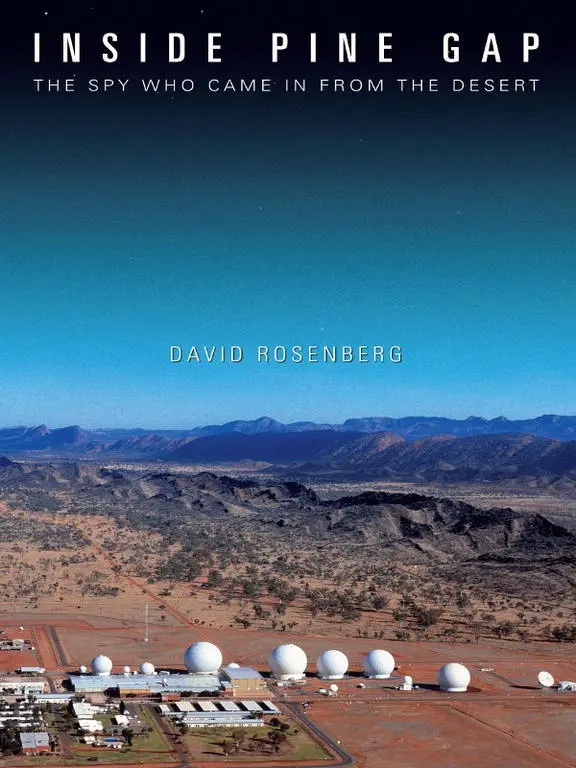
- Название:Inside Pine Gap
- Автор:
- Издательство:Hardie Grant Books
- Жанр:
- Год:2011
- Город:Melbourne
- ISBN:978-1-742-70173-8
- Рейтинг книги:4 / 5. Голосов: 1
-
Избранное:Добавить в избранное
- Отзывы:
-
Ваша оценка:
Inside Pine Gap: краткое содержание, описание и аннотация
Предлагаем к чтению аннотацию, описание, краткое содержание или предисловие (зависит от того, что написал сам автор книги «Inside Pine Gap»). Если вы не нашли необходимую информацию о книге — напишите в комментариях, мы постараемся отыскать её.
Author David Rosenberg details his career with an American intelligence agency during a tumultuous period in history that covered the terms of three American Presidents, four Australian Prime Ministers, the end of the Cold War, a peace treaty between Israel and Jordan, two wars in Iraq, genocide in Rwanda, as well as the ‘War against Terror’ and the emergence of North Korea as a nuclear-armed nation. This is a fascinating glimpse inside the top-secret world of military surveillance.
[This book contain a table.]
Inside Pine Gap — читать онлайн бесплатно полную книгу (весь текст) целиком
Ниже представлен текст книги, разбитый по страницам. Система сохранения места последней прочитанной страницы, позволяет с удобством читать онлайн бесплатно книгу «Inside Pine Gap», без необходимости каждый раз заново искать на чём Вы остановились. Поставьте закладку, и сможете в любой момент перейти на страницу, на которой закончили чтение.
Интервал:
Закладка:
These same senior officials are ultimately responsible for ensuring that accurate intelligence is provided to them, vetted to certify that what they are told is both truthful and the best assessment. But rumours abounded that President Bush had wanted an excuse to invade Iraq since he was installed as president. An inside source within President Bush’s administration, Treasury Secretary Paul O’Neill, discussed the President’s case for war on an episode of 60 Minutes on 14 June 2006 and was quoted by Ron Suskind in his book The Price of Loyalty as declaring the President’s early agenda for war. ‘From the very beginning, there was a conviction that Saddam Hussein was a bad person and that he needed to go,’ O’Neill said, before adding that, ten days after the inauguration—eight months before September 11—going after Saddam was ‘topic A’. [18] http://www.cbsnews.com/stories/2004/01/09/60minutes/main592330.shtml
Many die-hard Republicans have told me that the Bush administration will be remembered for its legacy of being wrong, misleading the American people and the world, and making many wrong decisions that had global impact. The evidence of this is apparent and overwhelming.
Senior government officials want to please their president, and in hindsight these officials were apparently more committed to providing information to the President that he wanted to hear, rather than ensuring that the information was true, vetted and accurate. In order to provide effective intelligence, a ‘please the boss’ mentality must be balanced, and in fact is secondary to a commitment to provide accurate, vetted intelligence. Senior policymakers must have the inner strength to disagree with others, including the president, and must seek conclusive proof when they are unsure of the facts, especially when military action—and potential loss of life—is likely to result.
After the air campaign in Iraq began, I spoke with a friend in the United States, discussing my concerns about the justification of invading Iraq as I was worried that President Bush was dead wrong. Saddam Hussein had politically defeated President Bush’s father and was alleged to have tried to assassinate the elder President Bush when he visited Kuwait as a private citizen in April 1993. [19] Weiner, Legacy of Ashes, p. 513.
I told my friend that I hoped ground forces would find the elusive WMD after the United States entered Iraq or else President Bush’s credibility would be reduced to nothing and America’s reputation around the world would plummet further. I believed President Bush was taking a very high-stakes gamble because if no WMD were found in Iraq, it would look as if President Bush had lied with the intent of using the mighty US military as a means to exact personal revenge for his father against Saddam Hussein; this, at the expense of countless brave, young soldiers who believed they were fighting for a legitimate, worthy cause. ‘You do not go to war on a hunch,’ I told my friend. But as commander-in-chief, President Bush did just that.
The invasion of Iraq effectively ended on 15 April 2003 when Saddam Hussein’s hometown of Tikrit was captured. The occupation of Iraq had now begun. On 1 May 2003, President Bush made a dramatic landing in the co-pilot’s seat of a Navy S-3B Viking onto the USS Abraham Lincoln where a large ‘MISSION ACCOMPLISHED’ banner loomed behind him as he emerged from the cockpit, subsequently declaring victory in Iraq. [20] http://www.cnn.com/2003/ALLPOLITICS/10/28/mission.accomplished/
I watched this in amazement and disbelief, knowing that the mission in Iraq had not yet been accomplished as military forces were still fighting and US troops did not appear to be leaving in the foreseeable future. There was no stable government in Iraq and nothing was certain on the ground, so to me it looked like we had a long way to go. I believed President Bush had suffered another credibility problem and that his ‘mission accomplished’ declaration was grossly premature.
Although I had concerns that President Bush’s reasons for invading Iraq were groundless, my colleagues and I continued to perform our roles to the best of our ability: the lives of American and allied soldiers were our highest concern and everyone in the intelligence community shared this priority.
While President Bush declared victory, the US military was still part of the ongoing mission (not yet accomplished) to search for and find Saddam Hussein. US forces were using UAVs and Saddam’s familial and tribal ties to help identify where he might be hiding. Finally, on 13 December 2003, Saddam was captured near Tikrit in Operation Red Dawn, [21] http://www.cnn.com/2003/WORLD/meast/12/14/sprj.irq.saddam.operation/index.html
and after questioning by US intelligence officers and a subsequent lengthy trial, he was found guilty of crimes against humanity over the killing of 148 Shi’ites from the town of Dujail in 1982. On 5 November 2006, he was sentenced to death by hanging and on 30 December 2006 he was executed at Camp Justice. [22] http://en.wikipedia.org/wiki/Execution_of_Saddam_Hussein
It is tragically ironic that both President George HW Bush and President George W Bush left their successors with the burden of ongoing problems in Iraq—one through incomplete action, the other through what proved to be an unjustified invasion. Iraq had become a dismal, expensive legacy for both presidents, and one that impacted on our work in Operations throughout my time in Alice Springs.
With a large number of US weapons employing GPS receivers to help guide them to their targets, jammers designed specifically to cripple GPS-guided weapons now began to appear around the world, and as Saddam Hussein was driven from power, the intelligence community continued to study their effectiveness. The United States was aware that GPS jammers were being used and employed backup methods if the GPS receivers failed. [23] http://www.loran.org/news/GPS-Backup-Released.pdf
This backup ability was one reason why the Iraq GPS jammers had an insignificant effect on American weapons during the Iraq War.
While many countries continued to develop GPS jammers, Iran realised the importance of UAVs and accelerated the development of various UAVs designed for surveillance and offensive operations. The Mohajer [24] http://en.wikipedia.org/wiki/Mohajer
and Ababil [25] http://en.wikipedia.org/wiki/Ababil
are two UAVs that Iran has extensively tested.
The intelligence community takes a great interest in weapons development in Iran and actively searches for anything associated with new weapon developments in this country. ████████████████████████████████████████████████████████████████████████████████████████████████████████████
Iranian television showed a video reportedly filmed from one of their UAVs that made its way onto YouTube. [26] http://www.youtube.com/watch?v=TS-MHvDylUo
This UAV was reported to have overflown a US aircraft carrier while transiting the Persian Gulf in August 2006. The video claimed that seven aircraft had been scrambled to shoot down the UAV, but the UAV was able to ‘fly back to its base’. [27] ibid.
The apparent claim by Iran that its slow-moving UAV ‘outran’ seven (fighter) aircraft is laughable. As this particular UAV was not ‘weaponised’, the US military ‘let it live’. If the carrier had wanted to shoot down the UAV, it would have.
The rise of China on the world stage, both economically and militarily, had continued throughout the presidencies of Clinton and Bush, with China beginning flight and radar testing of two Airborne Warning and Control System (AWACS) aircraft using Russian IL-76 and Chinese Y-8 aircraft. [28] http://www.centurychina.com/plaboard/archive/3663382.shtml
Интервал:
Закладка:
Похожие книги на «Inside Pine Gap»
Представляем Вашему вниманию похожие книги на «Inside Pine Gap» списком для выбора. Мы отобрали схожую по названию и смыслу литературу в надежде предоставить читателям больше вариантов отыскать новые, интересные, ещё непрочитанные произведения.











Обсуждение, отзывы о книге «Inside Pine Gap» и просто собственные мнения читателей. Оставьте ваши комментарии, напишите, что Вы думаете о произведении, его смысле или главных героях. Укажите что конкретно понравилось, а что нет, и почему Вы так считаете.