David Rosenberg - Inside Pine Gap
Здесь есть возможность читать онлайн «David Rosenberg - Inside Pine Gap» весь текст электронной книги совершенно бесплатно (целиком полную версию без сокращений). В некоторых случаях можно слушать аудио, скачать через торрент в формате fb2 и присутствует краткое содержание. Город: Melbourne, Год выпуска: 2011, ISBN: 2011, Издательство: Hardie Grant Books, Жанр: Биографии и Мемуары, Политика, на английском языке. Описание произведения, (предисловие) а так же отзывы посетителей доступны на портале библиотеки ЛибКат.
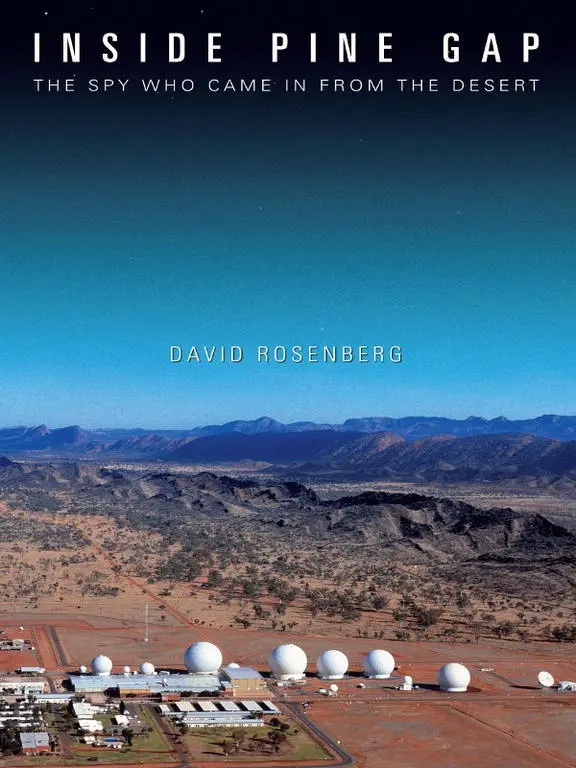
- Название:Inside Pine Gap
- Автор:
- Издательство:Hardie Grant Books
- Жанр:
- Год:2011
- Город:Melbourne
- ISBN:978-1-742-70173-8
- Рейтинг книги:4 / 5. Голосов: 1
-
Избранное:Добавить в избранное
- Отзывы:
-
Ваша оценка:
Inside Pine Gap: краткое содержание, описание и аннотация
Предлагаем к чтению аннотацию, описание, краткое содержание или предисловие (зависит от того, что написал сам автор книги «Inside Pine Gap»). Если вы не нашли необходимую информацию о книге — напишите в комментариях, мы постараемся отыскать её.
Author David Rosenberg details his career with an American intelligence agency during a tumultuous period in history that covered the terms of three American Presidents, four Australian Prime Ministers, the end of the Cold War, a peace treaty between Israel and Jordan, two wars in Iraq, genocide in Rwanda, as well as the ‘War against Terror’ and the emergence of North Korea as a nuclear-armed nation. This is a fascinating glimpse inside the top-secret world of military surveillance.
[This book contain a table.]
Inside Pine Gap — читать онлайн бесплатно полную книгу (весь текст) целиком
Ниже представлен текст книги, разбитый по страницам. Система сохранения места последней прочитанной страницы, позволяет с удобством читать онлайн бесплатно книгу «Inside Pine Gap», без необходимости каждый раз заново искать на чём Вы остановились. Поставьте закладку, и сможете в любой момент перейти на страницу, на которой закончили чтение.
Интервал:
Закладка:
NSA soon returned their verdict: Pine Gap lost the name battle and the other site’s name would be used because they had seen the signal first, regardless of any assistance they received from Pine Gap. My colleagues and I simply continued to use our name anyway, in silent protest, until a permanent name replaced the NSA-approved temporary name. The physical separation between Pine Gap and NSA headquarters often resulted in insufficient advocacy for our analysis results, a problem that still hadn’t been rectified by the time I left in 2008. But from then on our reporting methodology changed and we began issuing ‘quick and dirty’ reports whenever something new was found, with the caveat that a new name would be issued if subsequent analysis results deemed it necessary. The working relationship between the Operations personnel of the two sites suffered from mistrust and a lack of sharing of data (as was generally found in the intelligence community pre-9/11) for more than two years because the other site didn’t acknowledge the assistance made available to them from Pine Gap. By contrast, the operators at Pine Gap were recognised by senior management, and analysts on the team were presented with a team award.
The discovery that caused so much controversy and temporarily damaged the relationship between our two sites turned out to be emitted from a modified weapon system that was expected to be exported from the large weapons-producing country in question.
With help from the United States and its allies, the fledgling government in post-Taliban Afghanistan was struggling to establish legitimacy and some degree of control within its country. Meanwhile, President Bush had begun to make accusations that Saddam Hussein and Iraq were linked to the Al-Qaeda terrorist network. President Bush apparently believed, and wanted the world to believe, that Iraq posed a threat to the United States. He then claimed that Iraq had purchased yellowcake uranium from Niger and the country was somehow rebuilding its chemical and biological weapons stockpiles. About seventy-five senators had been told, in closed session, that Iraq had the means of attacking the eastern seaboard of the United States with these weapons, delivered by unmanned aerodynamic vehicles. All of this would prove untrue. [9] http://en.wikipedia.org/wiki/Iraq_War
The intelligence community had been concerned with Iraq since I arrived in 1990. In January 2003, rumours of an invasion had changed to threatening words when President Bush stated of Saddam Hussein: ‘He is a danger not only to countries in the region but… because of his Al-Qaeda connections, because of his history… [also] to Americans. And we’re going to deal with him. We’re going to deal with him before it’s too late.’ [10] http://www.cnn.com/2003/ALLPOLITICS/01/29/sprj.irq.bush.iraq/
The intelligence community had prepared in advance, with intelligence collection tasking in place, and knew some information about the situation on the ground before the Iraq War air campaign began on 20 March 2003. Meanwhile, it was known that Iraq had acquired the Aviaconversia GPS jamming equipment from Russia, in violation of the twelve-year ban on sales of military equipment to Iraq. [11] http://www.voanews.com/uspolicy/archive/2003-03/a-2003-03-31-3-1.cfm?moddate=2003-03-31
These jammers are designed to disrupt the flight of weapons that use the GPS signal for navigation and were placed in various locations throughout Iraq. [12] http://www.aiaa.org/aerospace/Article.cfm?issuetocid=393&ArchiveIssueID=41
██████████████████████████████████████████████████████████████████████████████
Effective GPS jamming signals have the capability to render almost any GPS device useless if navigation ability depends solely on receiving the valid signals from orbiting GPS satellites. The intelligence community wanted to know the characteristics of this signal from Iraq in order to assess its level of sophistication and develop countermeasures. Satellites just happened to provide an excellent means to intercept this electronic transmission.
The GPS jamming signals were often mounted on towers. Most were destroyed, some with weapons that even used GPS for guidance. [13] http://www.defenselink.mil/news/newsarticle.aspx?id=29230
The jammers, however, were deemed to have played an insignificant and non-deciding role during hostilities as other methods could compensate for a disabled GPS guidance system. [14] http://www.aiaa.org/aerospace/Article.cfm?issuetocid=393&ArchiveIssueID=41
In the final assessment, the cost of the weapons used to destroy the jammers was quite high, especially for a device that didn’t have a game-changing role in the outcome.
With hostilities underway, the intelligence community actively searched for members of Saddam Hussein’s former leadership circle, hoping to find the fifty-two faces on the deck of cards presented by the Bush administration. [15] http://en.wikipedia.org/wiki/Most-wanted_Iraqi_playing_cards
In a stable country, target signals are mostly understood and are quite predictable, but in a country that had been overrun with invading forces, with a military that had been shattered, communication methods were forced to change, as the destruction of a country’s infrastructure, particularly power generation, limits the number of electronic signals that can be conveniently transmitted.
When the United States and its allies invaded Afghanistan after 9/11, I believed this was the correct course of action because it had been shown that Al-Qaeda was behind 9/11 and they were supported and protected by the Taliban. They had essentially committed an act of war against the United States that required a military response which had been sanctioned by the United Nations. I was, however, not confident that President Bush’s claims that Iraq had been allied in some way with Al-Qaeda were true, nor was I convinced that Iraq had any WMD.
I was also concerned that President Bush had failed to gain UN approval for military action against Iraq; this greatly reduced the aid the United States would receive from potential allied countries, both in military personnel and logistical support. I was also fearful of the massive cost of the potentially long-term aftermath. The great question of ‘What will we do, and what will happen after we have successfully occupied Iraq?’ troubled me. I was simply not convinced that the Bush administration knew the answer.
During my time with the NSA, I had read reports on many military-related subjects, including those that I did not have a ‘need to know’ about but which were classified at a relatively low level. Some, on subjects not dissimilar to tomato smuggling in a Third World country (fictitious but based on an actual, similar report), were ones that I can safely say I didn’t really want to know about. But as part of the intelligence community, I had also read reports about WMD within Iraq for over a decade and I had never read a report concluding that Iraq had any WMD after 9/11. This was echoed by Lindsay Moran when she described a fellow CIA officer who had worked on Iraq’s WMD program for more than a decade. ‘She admitted to me, unequivocally,’ said Lindsay about the officer, ‘that the CIA had no definite evidence whatsoever that Saddam Hussein’s regime possessed WMD, or that Iraq presented anything close to an imminent threat to the United States.’ [16] Moran, Blowing My Cover , p. 290.
This relatively low-level analysis directly contradicted what the leadership in Washington was saying. ‘There is no doubt that Saddam Hussein now has weapons of mass destruction,’ said Vice-President Dick Cheney on 26 August 2002. ‘There is no doubt he is amassing them to use against our friends, against our allies, and against us.’ Secretary of Defense Donald Rumsfeld said something similar: ‘We know they have weapons of mass destruction. There isn’t any debate about it.’ CIA Director George Tenet provided his own grim warnings in a secret hearing before the Senate intelligence committee on 17 September: ‘Iraq provided al Qaeda with various kinds of training—combat, bomb making, and chemical, biological, radiological and nuclear.’ [17] Weiner, Legacy of Ashes , p. 562.
Where did their conclusive evidence come from?
Интервал:
Закладка:
Похожие книги на «Inside Pine Gap»
Представляем Вашему вниманию похожие книги на «Inside Pine Gap» списком для выбора. Мы отобрали схожую по названию и смыслу литературу в надежде предоставить читателям больше вариантов отыскать новые, интересные, ещё непрочитанные произведения.











Обсуждение, отзывы о книге «Inside Pine Gap» и просто собственные мнения читателей. Оставьте ваши комментарии, напишите, что Вы думаете о произведении, его смысле или главных героях. Укажите что конкретно понравилось, а что нет, и почему Вы так считаете.