Jack Whyte - The Lance Thrower
Здесь есть возможность читать онлайн «Jack Whyte - The Lance Thrower» весь текст электронной книги совершенно бесплатно (целиком полную версию без сокращений). В некоторых случаях можно слушать аудио, скачать через торрент в формате fb2 и присутствует краткое содержание. Жанр: Старинная литература, на английском языке. Описание произведения, (предисловие) а так же отзывы посетителей доступны на портале библиотеки ЛибКат.
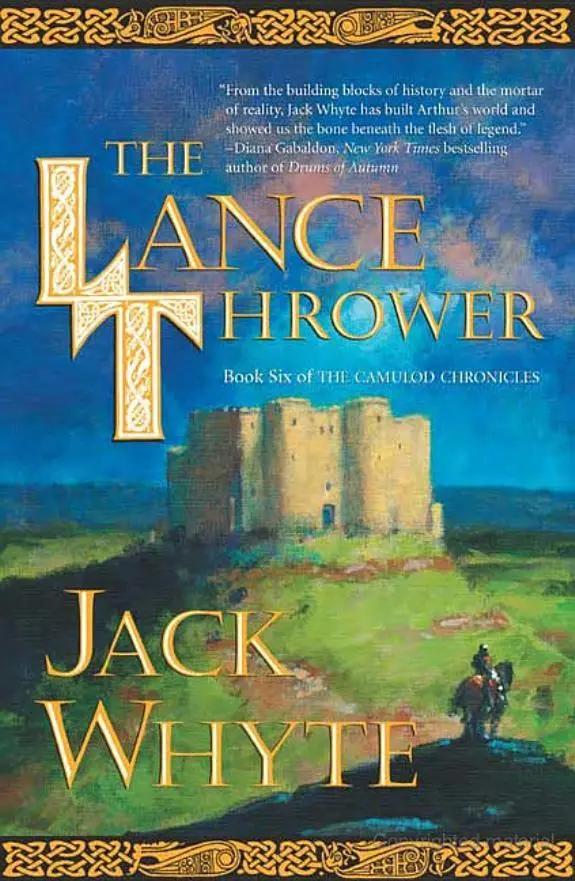
- Название:The Lance Thrower
- Автор:
- Жанр:
- Год:неизвестен
- ISBN:нет данных
- Рейтинг книги:5 / 5. Голосов: 1
-
Избранное:Добавить в избранное
- Отзывы:
-
Ваша оценка:
The Lance Thrower: краткое содержание, описание и аннотация
Предлагаем к чтению аннотацию, описание, краткое содержание или предисловие (зависит от того, что написал сам автор книги «The Lance Thrower»). Если вы не нашли необходимую информацию о книге — напишите в комментариях, мы постараемся отыскать её.
Clothar is a young man of promise. He has been sent from the wreckage of Gaul to one of the few schools remaining, where logic and rhetoric are taught along with battle techniques that will allow him to survive in the cruel new world where the veneer of civilization is held together by barbarism. He is sent by his mentor on a journey to aid another young man: Arthur Pendragon. He is a man who wants to replace barbarism with law, and keep those who work only for destruction at bay. He is seen, as the last great hope for all that is good.
Clothar is drawn to this man, and together they build a dream too perfect to last--and, with a special woman, they share a love that will nearly destroy them all...
The name of Clothar may be unknown to modern readers, for tales change in the telling through centuries. But any reader will surely know this heroic young man as well as they know the man who became his king. Hundreds of years later, chronicles call Clothar, the Lance Thrower, by a much more common name.
That of Lancelot.
The Lance Thrower — читать онлайн бесплатно полную книгу (весь текст) целиком
Ниже представлен текст книги, разбитый по страницам. Система сохранения места последней прочитанной страницы, позволяет с удобством читать онлайн бесплатно книгу «The Lance Thrower», без необходимости каждый раз заново искать на чём Вы остановились. Поставьте закладку, и сможете в любой момент перейти на страницу, на которой закончили чтение.
Интервал:
Закладка:
That part of the announcement caused more excitement among the students than anything else anyone could remember, for although competition in everything was taken for granted at the school, prizes were seldom awarded, and those few that were usually took the form of time off from classes, for one morning or afternoon, in recognition of some stellar achievement. Such rewards were a welcome respite from the normal grind of daily school life, but no one would ever have described them as exciting.
Here, however, was a competition with a valuable prize to be won, and the entire student body was agog with speculation as to what the prize might be.
Everyone competed against everyone else for everything at the Bishop’s School as a matter of course, striving to achieve one’s best possible performance in everything for the greater glory of God. That Latin phrase, ad majorem Dei gloriam, was probably the most commonly heard expression at the Bishop’s School. It was Bishop Germanus’s own personal watchword, conveying his deeply rooted conviction that if everything a person does on Earth is dedicated to glorifying God, then it becomes impossible for that person to sin and incur damnation. By direct association, the sentiment had become the school’s maxim as well, constantly quoted by the teachers and never lost sight of by the student body.
There were twenty-two of us in the senior class that year, a larger number than normal, and according to school tradition we were called the Spartans. The suggestions of discipline, preeminence, and status implied by that name were not accidental. The soldiers of the ancient Greek kingdom of Sparta were renowned and revered in our male, militaristic society, and the story of their heroic fight at the Pass of Thermopylae was one of our legends. In defending and holding that narrow pass against the enormous invading armies of the Persian Empire for longer than anyone could possibly have expected, three hundred of Sparta’s finest soldiers, under the command of their king, Leonidas, had won eternal glory, sacrificing their lives to purchase much-needed time for their countrymen to prepare to defend themselves against the invaders. Therefore we, the Spartans of the Bishop’s School, were charged with the responsibility of being exemplars to the entire school, setting the standard of high achievement, scholastic pride, and sterling behavior for all the younger students following behind us. Tomorrow, we all knew, one of us would win a memorable prize, and each of us was determined to be that winner.
The truth was, of course, that of the twenty-two Spartans in our current year, only eleven possessed the skills and the prowess that would be required to emerge as victor. The remaining eleven possessed skills and abilities directed more toward generating higher standards of clerical and scholastic excellence. It had become the tradition among the Spartans that each Warrior, as the more physically inclined students were called—they were selected by Tiberias Cato and his staff for their athletic and equestrian prowess—would be assigned one or more Scholars as partners for the year. The unit thus formed would become a team, competing together against the other teams in the class, but also performing together when it came to the supervisory duties and responsibilities incumbent upon the Spartans as senior students. There had been eighteen Spartans in the previous year’s class, and of those only six had been real Warriors, and so that class had been split into six teams each of three students. This year, by contrast, we were evenly split into pairs, eleven Warriors and Scholars respectively. My Scholar was Dominic Tara, the smallest and the youngest, but also the most brilliantly gifted student in the class in both mathematics and geography, the areas wherein I was weakest.
Dominic came looking for me soon after Cato’s announcement and found me talking with two of my closest friends, Stephan Lorco and Quintus Milo, who, as his name suggested, was the youngest of five brothers, all of whom had attended the Bishop’s School. Dominic’s face was set in a very peculiar expression and he was moving strangely. I stopped whatever I was saying.
“Dom, what’s wrong?” I asked him. “You look as though you’ve discovered something terrifying.”
He said nothing, but looked at me with that peculiar wide-eyed expression and shook his head.
Dom was the only member of the Spartans who was called by his given name. Everyone else in the school, and certainly among the Spartans, was either known simply by his family name—Lorco and Milo were two of those—or by a descriptive nickname. I cannot remember now why Dom should have been different from everyone else in that respect, but I suspect it had to do with his age and his tiny size—he reminded most of us of smaller brothers we had left at home, and we tended to treat him more tolerantly and gently as a result of that.
“Dom?” I repeated, raising my voice to capture his attention, but he shook his head again, disregarding both me and Milo, and spoke to Lorco.
“I’m to summon you to the Chancellor,” he said.
The smile vanished instantly from Lorco’s face. A summons to the Chancellor was never issued lightly, nor was it treated as anything less than disastrous. Brother Ansel, the Chancellor, was first deputy to Bishop Germanus and was charged with the daily running and discipline of the school whenever the bishop had to go away, which occurred with some regularity. There was little doubt that he was an able administrator, but he was also a man utterly devoid of both humor and mercy. Ansel had become famed for the intolerance and inflexibility of his views and for the ferocity of his punishments. None of us were sure if Germanus was aware of Ansel’s other side, and of course, no one rushed to inform him that his deputy was preternaturally cruel and remorseless, and every student in the school behaved with extreme caution whenever the bishop went away.
Lorco’s face had drained of all color as he tried to think of what crime he must stand charged.
“No, it’s not that,” Dom continued, looking quickly from Lorco to Milo and then to me, seeing the effect his words had had on all of us and trying to reassure us with flapping hands. He turned hurriedly back to Lorco. “It’s nothing bad … at least, I don’t think it is … . He’s not after you … I believe it’s your father.”
Death. The word, unspoken, clanged loudly in all our minds. The only time anyone ever seemed to speak of parents here was when word arrived that one or another of them had died unexpectedly.
“Wha—” Lorco had to cough to clear his throat. “What about my father?”
“He’s here, I think. In the school.”
That was even more startling than the summons to the Chancellor. “My father?” The disbelief in Lorco’s voice would have been laughable at any other time. “You’re mad. My father’s more than five hundred miles from here, probably in Hispania, pacifying the Iberians.”
Dom merely threw up his hands, palms outward. “I don’t know, then. Perhaps I’m wrong. But there’s a strange man in with the Chancellor, someone I’ve never seen before, and he looks like a soldier, and I know your father is a soldier. I went in to do some transcription for Brother Marcus in the vestibule beside the bishop’s day room and I heard old Ansel talking to someone, so I peeked through an open door and saw this man. I couldn’t hear much of what they were saying, but what I could hear sounded boring. I didn’t pay any attention to them at all after that, to tell the truth, until I heard your name being mentioned. And I’m pretty sure I. heard the man say something about his son. A little while after that the door opened and old Ansel stuck his head out and sent me to fetch you.”
Читать дальшеИнтервал:
Закладка:
Похожие книги на «The Lance Thrower»
Представляем Вашему вниманию похожие книги на «The Lance Thrower» списком для выбора. Мы отобрали схожую по названию и смыслу литературу в надежде предоставить читателям больше вариантов отыскать новые, интересные, ещё непрочитанные произведения.







Обсуждение, отзывы о книге «The Lance Thrower» и просто собственные мнения читателей. Оставьте ваши комментарии, напишите, что Вы думаете о произведении, его смысле или главных героях. Укажите что конкретно понравилось, а что нет, и почему Вы так считаете.