Jack Whyte - The Lance Thrower
Здесь есть возможность читать онлайн «Jack Whyte - The Lance Thrower» весь текст электронной книги совершенно бесплатно (целиком полную версию без сокращений). В некоторых случаях можно слушать аудио, скачать через торрент в формате fb2 и присутствует краткое содержание. Жанр: Старинная литература, на английском языке. Описание произведения, (предисловие) а так же отзывы посетителей доступны на портале библиотеки ЛибКат.
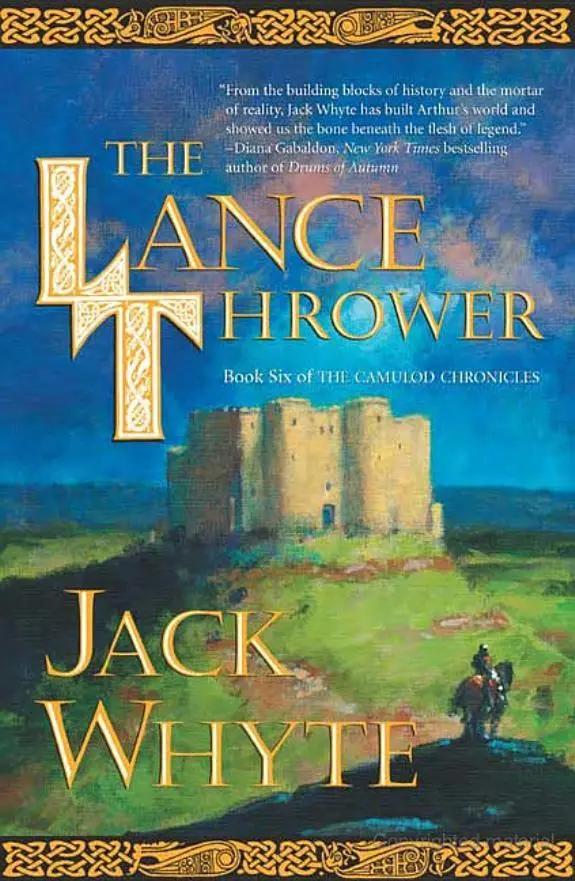
- Название:The Lance Thrower
- Автор:
- Жанр:
- Год:неизвестен
- ISBN:нет данных
- Рейтинг книги:5 / 5. Голосов: 1
-
Избранное:Добавить в избранное
- Отзывы:
-
Ваша оценка:
The Lance Thrower: краткое содержание, описание и аннотация
Предлагаем к чтению аннотацию, описание, краткое содержание или предисловие (зависит от того, что написал сам автор книги «The Lance Thrower»). Если вы не нашли необходимую информацию о книге — напишите в комментариях, мы постараемся отыскать её.
Clothar is a young man of promise. He has been sent from the wreckage of Gaul to one of the few schools remaining, where logic and rhetoric are taught along with battle techniques that will allow him to survive in the cruel new world where the veneer of civilization is held together by barbarism. He is sent by his mentor on a journey to aid another young man: Arthur Pendragon. He is a man who wants to replace barbarism with law, and keep those who work only for destruction at bay. He is seen, as the last great hope for all that is good.
Clothar is drawn to this man, and together they build a dream too perfect to last--and, with a special woman, they share a love that will nearly destroy them all...
The name of Clothar may be unknown to modern readers, for tales change in the telling through centuries. But any reader will surely know this heroic young man as well as they know the man who became his king. Hundreds of years later, chronicles call Clothar, the Lance Thrower, by a much more common name.
That of Lancelot.
The Lance Thrower — читать онлайн бесплатно полную книгу (весь текст) целиком
Ниже представлен текст книги, разбитый по страницам. Система сохранения места последней прочитанной страницы, позволяет с удобством читать онлайн бесплатно книгу «The Lance Thrower», без необходимости каждый раз заново искать на чём Вы остановились. Поставьте закладку, и сможете в любой момент перейти на страницу, на которой закончили чтение.
Интервал:
Закладка:
Lorco looked at me, his eyes wide, and I shrugged. “Better get going,” I told him. “It’s not wise to keep old Ansel waiting, and besides, Dom might be right. If he is, and your father’s here, that’s good, is it not?”
In truth, I was not sure whether it was good or not. We boys, as the stoic Spartans we were supposed to be, seldom spoke among ourselves about our homes or our parents, and the reason for that was more self-defense than reticence. When you were as completely immersed as we were in a life that offered ample hardship and few comforts, it became foolish to endanger what little equanimity you possessed by dwelling on memories of home and family and the softnesses and luxuries you could find there.
Fortunately, Lorco’s face broke into a wide, toothy grin as soon as I asked the question. “Better than good,” he said. “It’s unbelievable. If my Tata’s really here, we’ll all have some fun. You’ll like him, I promise you.”
It turned out to be true. The man with Brother Ansel was Lorco’s father, Phillipus Lorco, another former legate who had soldiered under Germanus’s command and now held the military title and rank of dux, or duke. As Duke Lorco, he was now the imperial governor of a huge territory in the southwest of Gaul that included the entire mountainous region separating Gaul from Hispania, but in his time with the legions, even before the advent of Germanus, he had won great acclaim and successes coordinating and conducting hard-fought, relentless campaigns against the Burgundian tribes who had been invading south-central Gaul and spreading havoc there for nigh on a hundred years.
He was now here in Auxerre, it transpired, because he had been urgently summoned by Germanus’s military successors to attend a gathering of imperial strategists in the fortress at Treves, Germanus’s own former base and still the military headquarters at that time for all of Gaul. The purpose of this extraordinary assembly was to coordinate a campaign against the ever-bellicose Burgundians, who were once again threatening to break out of the territories they had now occupied for decades, this time to engulf the entire southwest, of Gaul. Duke Lorco’s contribution to the planning and prosecution of the campaign had been deemed both invaluable and a sine qua non of success.
Faced with a journey of several hundreds of miles north to Treves from his home base in the ancient fortified town of Carcasso in the south, and aware that the most direct route to his destination would take him within a hundred miles of Auxerre, where his eldest son, Stephan, was in school and prospering, the Duke had allowed himself sufficient time in advance of the gathering to visit his old friend and commander Germanus, his primary purpose to arrange to take his son back home with him to Carcasso when the boy’s schooling was completed and the Duke’s own duties in Treves were concluded.
It turned out that the bishop was not in Auxerre for his arrival but was expected to arrive back in Auxerre the following day. In the meantime, the senior Lorco had three days to spend in Auxerre before striking out for Treves, and Brother Ansel had magnanimously permitted him to renew his acquaintance with his son.
I had the privilege of meeting Duke Lorco that same afternoon, when he came with his son to be introduced to me and Milo as Lorco’s closest friends. He was a friendly, affable man with an easy manner and a charming disposition that stirred a fleeting spasm of resentment in me at the thought of how fortunate Lorco was to have a living father. The sensations caused me to flush with guilt and shame at what I judged to be disloyalty to my adoptive parents in Genava, and with those feelings came an abrupt awareness of how much I missed them and how greatly I wanted to see them again. I would give anything to see my stepfather’s face again I thought then, and with the notion, Ban of Benwick stood before me in my mind, gazing at me with that raised eyebrow of his and smiling his slightly crooked grin.
Those feelings passed and left me feeling content as I stood beside Milo, watching Lorco leave the school with his father. They would dine together privately that evening in the Duke’s quarters in the nearby mansio, the local hostelry maintained by the imperial civil service for the accommodation of couriers and others traveling on official affairs. Whether Lorco would return to the school that night at all was something that remained to be seen, although I hoped that he might not. He was so obviously happy and proud to see his father and to have had the opportunity to introduce him to us, his friends, that I felt he deserved to be allowed to spend every moment that he could in his father’s company. The mere occurrence of such a thing—a student remaining out of the school overnight—was unusual enough to cause all kinds of talk among the other students, and for once the boys talked as they never had before about the places they came from and about their loved ones. More than a few tears were shed without much effort being made to hide them, so that there was a subdued atmosphere in the dormitories at curfew that night that was almost palpable, despite the countering excitement over the coming day’s activities and the promised competition.
It was midafternoon and the celebrations at the school were already well under way when Bishop Germanus arrived, without fanfare, at the exercise grounds attached to the school’s extensive stables. All activities ceased, and a respectful silence hung over the assembled students. I watched my mentor as he dismounted from the pony he rode that day and walked, alone as always, slowly toward the raised reviewing stand at the far end of the open-air arena where most of the afternoon’s contests and events were talking place, then mounted the dais to join the assembled tutors, staff, and visitors.
As I watched the bishop on this occasion, however, something in the way he moved brought the realization home to me, for the first time ever, that Germanus of Auxerre was an old man. I saw something different and bothersome in him that day, something intangible and yet unnervingly suggestive of a lack of healthiness, although it appeared and disappeared so fleetingly that I was able to convince myself that I had imagined it. It may have been the way he walked the few steps from dismounting from the pony to the start of the stairs rising to the stand. The day had been fine, on the whole, but a heavy shower of rain had fallen half an hour earlier and muddied the ground underfoot, making it treacherous, and just before the bishop reached the first of the steps to the dais he paused, a very brief hesitation, and reached, unsteadily it seemed to me, for the support of the handrail. It happened, I saw it, and the unwelcome burden of a new anx-iety descended upon my head and shoulders.
I was completely unprepared for the revelation and I rejected it even as it occurred to me. I can distinctly remember the anger I felt at myself at that moment for even thinking such a thought—entertaining the very notion of his mortality. But unsought and unexpected as it was, it disconcerted me to the point of causing a strong spasm of anxiety in my breast.
No one else noticed, I am quite sure of that, because Germanus reached the top of the stairs to the dais and strode directly along the front row of seats, his bearing utterly regal and resolute, to where Duke Lorco had risen to greet him. The two men embraced as old friends do and exchanged a few pleasantries before Germanus excused himself and turned to bless the gathering before sending Tiberias Cato the signal to continue with the proceedings his arrival had interrupted. That done, he sat down in the vacant seat by Duke Lorco’s side and both men talked animatedly for a while before settling back to watch the competition, which was now approaching the final stages.
Читать дальшеИнтервал:
Закладка:
Похожие книги на «The Lance Thrower»
Представляем Вашему вниманию похожие книги на «The Lance Thrower» списком для выбора. Мы отобрали схожую по названию и смыслу литературу в надежде предоставить читателям больше вариантов отыскать новые, интересные, ещё непрочитанные произведения.







Обсуждение, отзывы о книге «The Lance Thrower» и просто собственные мнения читателей. Оставьте ваши комментарии, напишите, что Вы думаете о произведении, его смысле или главных героях. Укажите что конкретно понравилось, а что нет, и почему Вы так считаете.