Jack Whyte - The Lance Thrower
Здесь есть возможность читать онлайн «Jack Whyte - The Lance Thrower» весь текст электронной книги совершенно бесплатно (целиком полную версию без сокращений). В некоторых случаях можно слушать аудио, скачать через торрент в формате fb2 и присутствует краткое содержание. Жанр: Старинная литература, на английском языке. Описание произведения, (предисловие) а так же отзывы посетителей доступны на портале библиотеки ЛибКат.
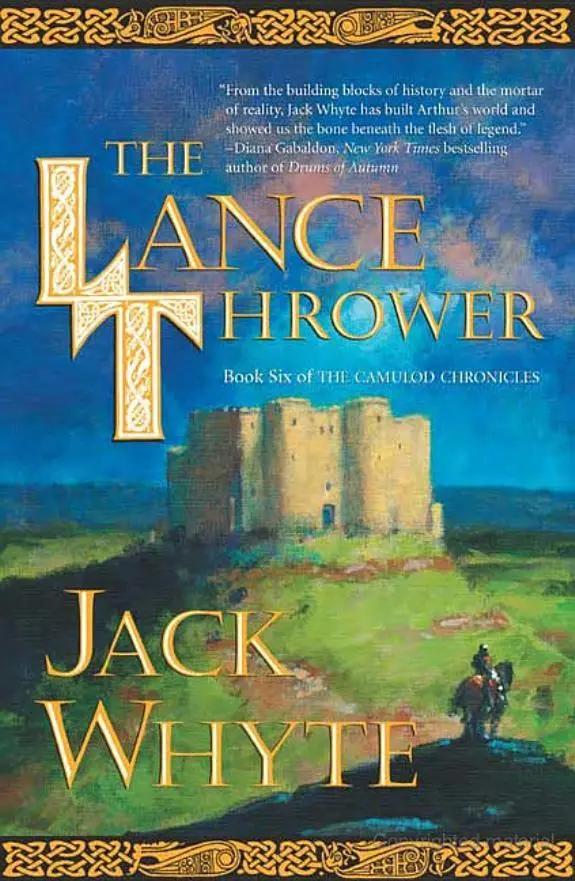
- Название:The Lance Thrower
- Автор:
- Жанр:
- Год:неизвестен
- ISBN:нет данных
- Рейтинг книги:5 / 5. Голосов: 1
-
Избранное:Добавить в избранное
- Отзывы:
-
Ваша оценка:
The Lance Thrower: краткое содержание, описание и аннотация
Предлагаем к чтению аннотацию, описание, краткое содержание или предисловие (зависит от того, что написал сам автор книги «The Lance Thrower»). Если вы не нашли необходимую информацию о книге — напишите в комментариях, мы постараемся отыскать её.
Clothar is a young man of promise. He has been sent from the wreckage of Gaul to one of the few schools remaining, where logic and rhetoric are taught along with battle techniques that will allow him to survive in the cruel new world where the veneer of civilization is held together by barbarism. He is sent by his mentor on a journey to aid another young man: Arthur Pendragon. He is a man who wants to replace barbarism with law, and keep those who work only for destruction at bay. He is seen, as the last great hope for all that is good.
Clothar is drawn to this man, and together they build a dream too perfect to last--and, with a special woman, they share a love that will nearly destroy them all...
The name of Clothar may be unknown to modern readers, for tales change in the telling through centuries. But any reader will surely know this heroic young man as well as they know the man who became his king. Hundreds of years later, chronicles call Clothar, the Lance Thrower, by a much more common name.
That of Lancelot.
The Lance Thrower — читать онлайн бесплатно полную книгу (весь текст) целиком
Ниже представлен текст книги, разбитый по страницам. Система сохранения места последней прочитанной страницы, позволяет с удобством читать онлайн бесплатно книгу «The Lance Thrower», без необходимости каждый раз заново искать на чём Вы остановились. Поставьте закладку, и сможете в любой момент перейти на страницу, на которой закончили чтение.
Интервал:
Закладка:
“They teach you to ride like that in Benwick?” was all he said.
“I’ve never been anywhere else.”
“Hmm. King Ban, does he ride like that?”
I merely nodded, not knowing what else to tell him. I knew, from my riding instructor in Benwick, that even although I was a mere boy, a child, I was one of the best riders in Ban’s kingdom and would one day be the best of all, but I did not want to say that to Tiberias Cato, lest he think me a braggart.
“I didn’t think you’d last through his first jump.”
I was on the point of telling him about the horse with the same trick in Benwick, but then decided to hold my tongue and asked him instead, “Does he do that often?”
The small man nodded. “Every time, even with me. Not many people can stay up there when he does that.”
“Did you know he would try to scrape me off?”
He shook his head, frowning. “No. I’ve never seen him do that before. That’s something new. He’s a clever whoreson, for a gelding.”
I shrugged. “It didn’t work, though, so he might not try it again. I mean, it’s not as if he’s human, is it?”
“No, but there’s times when he seems to come damn close. Anyway, take the bridle off him and turn him loose, then get out of here. You’re not supposed to be here at this time of day. No student is. Come back the day after tomorrow when your lessons start. What’s your name?”
I told him, and he nodded and pursed his lips, and such was my self-conceit that I saw nothing strange in being accepted instantly by Tiberias Cato, Master of the Stables, a unique and formidable being respected and feared by every student in the school. I was, after all, Clothar of Benwick, adopted son of King Ban of Benwick, since birth used to being treated with deference and respect.
It may have taken me as long as a week to realize that Tiberias Cato was no respecter of names or rank and that he cared not a whit what people in the world beyond his paddocks thought of anyone else. In Cato’s eyes, there was but one natural ranking in the order of men, and it lay visible in the ease and skill—or in the lack of ease and skill—that they demonstrated in their relationship with horses. Cato himself was more centaur than human being and he rode as though the animal beneath him was an extension of his body. I cannot remember ever seeing him use his hands to control a horse while mounted. All his control—and it was prodigious—was exerted from his hips downward, leaving his hands free at all times to do whatever he required them to do. It was very impressive, even awe-inspiring to watch, and yet in order to watch and appreciate his mastery of what he did, you had to be aware of it, and the astonishing truth was that most people looked at Cato, then through him or past him, without ever seeing how gifted he was. They dismissed him idly as some form of stable groom with the seniority of age and were too blinded by their own inadequacies to be able to discern anything of the magic he worked with horses.
I had no such blinkers hampering my view of the stable master. He fascinated me from the day I first saw him ride a horse, and he quickly became my hero. I made it my concern to find out everything I could about him, but of course there was only one man, apart from Tiberias Cato himself, who could tell me everything that was known about the Master of the Bishop’s Stables, and that was the bishop, who knew Cato perhaps better than Cato knew himself, and it would be more than a year before I could be sufficiently comfortable in his august company to come right out and ask him openly about his friend and servant Cato. And so until that time I merely watched and admired this favorite of all my teachers, nursing what little knowledge of his history I had been able to acquire from the stories the older boys told about him, and feeling my admiration for him increase with every new example of his knowledge and understanding of the ways and the lore of horses.
The six years that followed my departure from Benwick flew by, as time always does when we enjoy what we are doing, until the day when I found myself, slack mouthed and stunned, contemplating my sixteenth birthday, which was looming in the too-near future. I tend to remember the occasion nowadays as having dropped upon me as a complete surprise, as though I had not even been aware of my increasing age until Father Germanus pointed it out to me in the course of one of our regular weekly meetings. It is a comforting thought, that image of being caught off balance, ill prepared and unready, but that is not really the way it occurred. I may have been mentally and emotionally unprepared to be sixteen years old, indulging in wishful thinking and foolishly believing that if I paid no attention to the passage of time then it would flow on without changing anything, but the truth is that I had been very much aware of time passing, and of the changes I was undergoing, in common with my friends, as a result of its passing. Bodies that had been slim and soft, hairless and childish, had gradually become hardened and muscular, thicker and heavier, and the downy growth that had been barely visible upon our faces no more than a year earlier had coarsened upon some of us, the darker skinned among us, and hardened into stubble on our chins.
The most noteworthy change of all, however, had been in the stuff of our conversations, the things we talked about. Where once we had discussed and debated little else but physical training and our individual performances in drills and contests, most of us now talked of little else but girls; women and the dark and mystical secrets surrounding them and their physical nature. And as a result of our waking preoccupation with such things, our nocturnal lives, once a matter of mere oblivion disturbed very occasionally by nightmares, had changed to encompass exciting and erotically disturbing dreams, barely remembered upon awakening yet no less powerful because of that. Manhood was closing in upon us, we all knew, and although the prospect excited and intimidated us, we continued nonetheless to gull ourselves into believing that we could have and enjoy the satisfactions of physical manhood—the fighting and the womanizing—without ever having to abandon the innocence and comradeship of boyhood.
But now all at once, and beyond equivocation, I was to be sixteen, which meant that I would have to leave the Bishop’s School and make my way alone in the real world, among real men! The realization of that truth was devastating, because it forced me to accept that this stage in my life, boyhood as I had known it in Auxerre, was close to being over. A boy’s sixteenth birthday is his life’s greatest watershed, marking the crossing point into manhood and taking him from childhood to adult status, from carefree idyll to the acceptance of a man’s responsibilities.
On the day when Germanus reminded me of my age, I had been the acknowledged leader of the senior class, the Spartans, for more than a month, but even that exalted estate had failed to make any significant dent in my lack of awareness. I had been so happy and confident in my own popularity and power among the other students that it seemed natural that things must continue as they were. But my entire world changed in the space of one short, supposedly normal interview, when I found myself having to accept that, with the start of the following year, another boy, a younger boy, would be leader of the Spartans and I would be gone, never to be remembered by the boys that followed in my footsteps from year to year. Where I would be by then, I knew not; but I would be a man—if in name only—and probably a serving soldier, my boyhood locked irretrievably behind me.
On a hot spring day in the first half of my sixteenth year, completely without warning, Tiberias Cato announced that the next day. would be a day of festivities and freedom from classes for the entire school, in honor of the return of Bishop Germanus from a particularly long episcopal journey. Furthermore, he announced, the occasion would be highlighted by an all-out competition among the senior students, designed to test their prowess and skills and the progress they had managed to achieve so far in this, their final year. The student who emerged victorious from the final stages of the competition would be rewarded with a special prize, something unique and valuable, although Tiberias Cato refused to say what it was.
Читать дальшеИнтервал:
Закладка:
Похожие книги на «The Lance Thrower»
Представляем Вашему вниманию похожие книги на «The Lance Thrower» списком для выбора. Мы отобрали схожую по названию и смыслу литературу в надежде предоставить читателям больше вариантов отыскать новые, интересные, ещё непрочитанные произведения.








Обсуждение, отзывы о книге «The Lance Thrower» и просто собственные мнения читателей. Оставьте ваши комментарии, напишите, что Вы думаете о произведении, его смысле или главных героях. Укажите что конкретно понравилось, а что нет, и почему Вы так считаете.