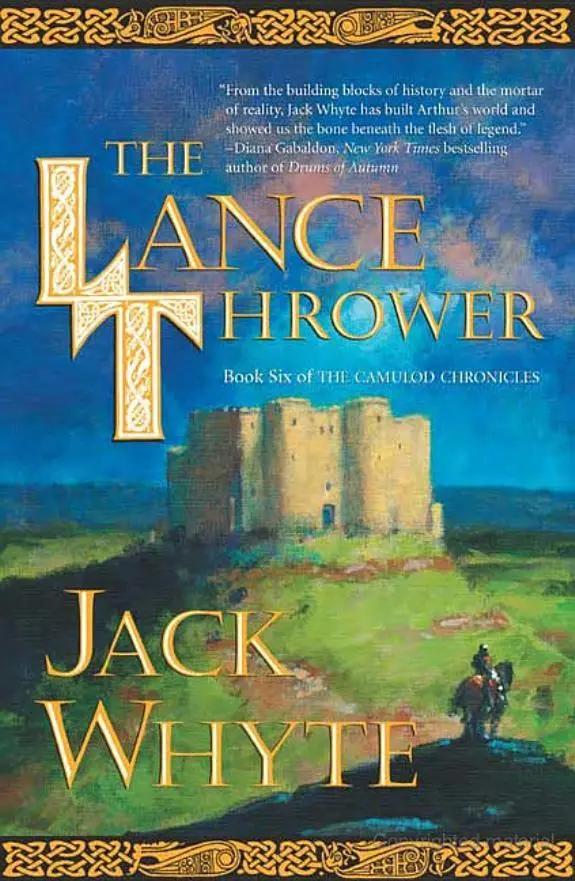
Jack Whyte - The Lance Thrower
Здесь есть возможность читать онлайн «Jack Whyte - The Lance Thrower» весь текст электронной книги совершенно бесплатно (целиком полную версию без сокращений). В некоторых случаях можно слушать аудио, скачать через торрент в формате fb2 и присутствует краткое содержание. Жанр: Старинная литература, на английском языке. Описание произведения, (предисловие) а так же отзывы посетителей доступны на портале библиотеки ЛибКат.
- Название:The Lance Thrower
- Автор:
- Жанр:
- Год:неизвестен
- ISBN:нет данных
- Рейтинг книги:5 / 5. Голосов: 1
-
Избранное:Добавить в избранное
- Отзывы:
-
Ваша оценка:
The Lance Thrower: краткое содержание, описание и аннотация
Предлагаем к чтению аннотацию, описание, краткое содержание или предисловие (зависит от того, что написал сам автор книги «The Lance Thrower»). Если вы не нашли необходимую информацию о книге — напишите в комментариях, мы постараемся отыскать её.
Clothar is a young man of promise. He has been sent from the wreckage of Gaul to one of the few schools remaining, where logic and rhetoric are taught along with battle techniques that will allow him to survive in the cruel new world where the veneer of civilization is held together by barbarism. He is sent by his mentor on a journey to aid another young man: Arthur Pendragon. He is a man who wants to replace barbarism with law, and keep those who work only for destruction at bay. He is seen, as the last great hope for all that is good.
Clothar is drawn to this man, and together they build a dream too perfect to last--and, with a special woman, they share a love that will nearly destroy them all...
The name of Clothar may be unknown to modern readers, for tales change in the telling through centuries. But any reader will surely know this heroic young man as well as they know the man who became his king. Hundreds of years later, chronicles call Clothar, the Lance Thrower, by a much more common name.
That of Lancelot.
The Lance Thrower — читать онлайн бесплатно полную книгу (весь текст) целиком
Ниже представлен текст книги, разбитый по страницам. Система сохранения места последней прочитанной страницы, позволяет с удобством читать онлайн бесплатно книгу «The Lance Thrower», без необходимости каждый раз заново искать на чём Вы остановились. Поставьте закладку, и сможете в любой момент перейти на страницу, на которой закончили чтение.
Интервал:
Закладка:
I had been doing well in the competition until then and was quietly confident that I was ahead of the field on points. I had been in excellent form in the preliminary events, all of which involved athletic activities on foot: running, jumping, and wrestling, and the fighting drills, which included mock combat with clubs, swords, and heavy spears, as well as archery and lance throwing.
I had won the running events easily, to no one’s surprise. I had grown a handsbreadth during the summer of my third year at the school, which had inspired much jesting and also my nickname, Legs. But Lorco had challenged me seriously on the broad jump, and I had been on the point of giving up, convinced that I could not possibly match his final, inspired leap, when I saw Tiberias Cato watching me, a troubled, meditative look on his face. I knew Cato had no time for anyone who ever quit ahead of being beaten in anything, and I did not want him ever to think such a thing of me, so I rallied and gritted my teeth for one last, all-out attempt. Somehow I managed to fly out and land precisely where Lorco had landed, destroying his mark in the process and making it impossible to discern whether one of us had outdistanced the other. The judges shook their heads and consulted the notations they had made earlier and muttered among themselves for a long time before they called the event a draw.
I had then fought my way more than adequately through the range of fighting drills, too, emerging unbeaten from all but the last category, the lance-throwing event, where my closest rivals were Milo and Gaius Balbus, the boy I liked least of all the Spartans. Balbus was taller than I was, and slightly heavier, the largest student in our class, and although I could beat him easily in most events, including swords and heavy spears, he was the only student who could throw a javelin consistently farther than I could. Fortunately for me, however, he could not throw with anything approaching my accuracy, and that displeased him greatly, since accuracy gained more points than distance. I seldom had difficulty in upsetting him sufficiently to make him lose his temper, and with it his judgment, whenever we competed. He was quick to anger and viciously savage with his tongue when he was angry, which was the reason I found it easy to dislike him, for he had stung me and all of my friends too often with his waspish, sarcastic ill-humor.
On this particular morning, however, Balbus had aligned himself alongside Milo, who was throwing very well, consistently, and with impressive accuracy. Balbus had paced himself deliberately and precisely, concentrating fiercely and modeling his performance and his rhythm and tempo on Milo’s and ignoring me and my performance completely. It worked well for him, and by the start of the last round of throws—five casts each at the torso of a man-size target thirty paces distant—he and I had both scored sixteen hits out of a possible twenty-five.
The rules of the competition were simple, but the degree of difficulty escalated hugely with each round of five casts. The initial targets, wooden cut-out figures of men, were set up twenty paces from the throwing line, and the whitewashed scoring area extended from the line of the hips up to the head and included the arms—a relatively easy mark. After each round of five casts, however, new targets were placed two paces farther away from the throwing line and the scoring area was reduced in size, the arms and head being among the first to go, until by the last round the casts were thirty paces long and the scoring area was a wrist-to-elbow-length square on the target’s chest.
Going into that last round, Milo was one point ahead of both of us. He had scored eighteen hits, his best score ever and a school record for twenty-five casts. It may have been the lengthy duration of the event—thirty casts of an infantryman’s lancea, the ancient, thonged javelin used so effectively by the Roman armies for hundreds of years, exacts a terrible toll on the throwing muscles—but Milo missed the scoring area of the target with all five of his final casts, although all five hit the wooden target somewhere, and he ended up with eighteen points out of a possible thirty. I hit three out of five to beat Milo’s score by one, but Balbus, in a display of unsuspected virtuosity that shook and humbled me, hit solidly with all five casts and emerged with yet another record: twenty-one hits out of thirty casts.
It was purely coincidental that the bishop arrived just shortly before we were to progress to the riding events, most of which were designed to test advanced riding skills and the formal, correct, and precise handling of animals in restrictive and difficult situations. Several of the equestrian contests, however—and the most difficult, according to some people—involved grueling tests of both horse and rider in events that measured stamina and endurance, as opposed to precision and obedience. The most brutally demanding of those were point-to-point races over planned routes, and fiendishly difficult obstacle courses that had to be negotiated within stringent, close-to-impossible time constraints.
This was the area in which I felt most confident—far more so even than in the foot-racing events. I did not feel even slightly presumptuous when I told myself that no one among my classmates could come close to me in anything having to do with horses and horsemanship.
At the start of the first race—a point-to-point affair in which each contestant had to ride three miles, collecting three flags along the way and bringing them back to the starting point within the time it took for a sand glass to drain twice—all of us were drenched in a brief but spectacular cloudburst. This was quickly forgotten by everyone but me, because it would cost me the race. I was riding a big bay gelding that I had ridden often before that afternoon, and we were first through the gate leading from the stable yards and along the short, wide lane that led into the open country beyond the town. I gave the bay his head and let him stretch his muscles while I enjoyed the rush of the wind through my hair and the feeling of his enormous body flexing and uncoiling beneath me.
I leaped down from his back at the first pickup point and snatched up one of the red flags that lay there, and I had remounted and was kicking him forward again when the closest of my rivals, Balbus once again, came thundering down toward us.
The run to the second pickup point, with the yellow flags, was uneventful despite a couple of obligatory jumps, one of them a downhill leap over a log at the edge of a deep pool of water. I was confident I was outstripping the field easily until I discovered—unpleasantly and most surprisingly—that Balbus was hard on my heels, far closer than he had been at the red flag pickup. I looked closely at his mount this time as we passed each other—Balbus leaping down to snatch up his flag as I kicked my heels into my mount’s ribs. He was riding a huge gray, and it was sweating visibly, but not inordinately so. I crouched lower on the bay’s back and drummed my heels against his sides, coaxing him to higher speed on our way to pick up the last, green flag, but I was distracted now, wondering how Balbus could have gained so much ground on me so quickly.
It did not occur to me, then or later, that he might have cheated, for that was simply not a possibility. There were no rules to contravene in this race, other than the rule stating that each rider must pick up all three flags before heading for home and the finish line. There were degrees of difficulty in routing, and each rider had the option of deciding whether or not to deviate from the standard course, which wound through valleys between hills, for it was possible, theoretically, to shorten distances dramatically by riding up and over any hill crest, rather than going around it. But we were all familiar with the dangers that lay in wait there; the slopes were steep and treacherous with loose stones and boulders, and in some places they were simply unscalable. Besides, the normal risks of attempting to go up and over were increased and emphasized by the fact of the race and the consequent need, if the attempt were made, to get up one side and down the other quickly with no failed attempts, no hesitation, and no loss of time.
Читать дальшеИнтервал:
Закладка:
Похожие книги на «The Lance Thrower»
Представляем Вашему вниманию похожие книги на «The Lance Thrower» списком для выбора. Мы отобрали схожую по названию и смыслу литературу в надежде предоставить читателям больше вариантов отыскать новые, интересные, ещё непрочитанные произведения.






Обсуждение, отзывы о книге «The Lance Thrower» и просто собственные мнения читателей. Оставьте ваши комментарии, напишите, что Вы думаете о произведении, его смысле или главных героях. Укажите что конкретно понравилось, а что нет, и почему Вы так считаете.